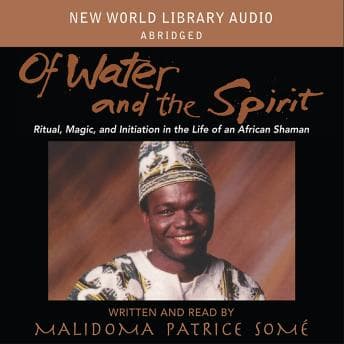

Look, I have a complaint. A petty, personal, very specific complaint: this audiobook is three hours long. Three hours. Malidoma Patrice Somé was kidnapped at four years old, spent fifteen years in a Jesuit seminary where his language and identity were systematically erased, escaped at twenty, was rejected by his own people, and then underwent a month-long shamanic initiation involving - among other things - being buried alive. And we get three hours. I was making lamb rogan josh on a Sunday evening, and the whole thing was done before the meat finished braising. That ratio feels wrong.
But here's the thing I kept circling back to, wooden spoon in hand, staring at my spice jars like they held answers: what is here is extraordinary. Not because of the supernatural claims - though we'll get to those - but because of the psychology.
The Identity Fracture Nobody Talks About Enough
The protagonist exhibits classic identity discontinuity, and Somé knows it. He doesn't use that language, obviously, but the structure of his story maps almost perfectly onto what we see in cases of radical cultural displacement. He's not just a man caught between two worlds - that's the easy framing. He's someone whose selfhood was deliberately dismantled by colonial education and then couldn't be automatically restored by physical return. His Dagara community looks at him and sees contamination. He looks at himself and sees... what? The research actually shows that identity reconstruction after prolonged forced assimilation follows specific patterns, and Somé's account tracks with them in ways that feel almost clinical beneath the spiritual language.
What makes this memoir psychologically fascinating is the initiation sequence. Somé describes becoming a bird, becoming a porcupine, being pulled into an underworld. And I found myself asking: why does this man - who holds degrees from the Sorbonne and Brandeis - present these experiences without hedging? No "it felt as though" or "I seemed to perceive." He states them flatly. He became a bird. Period. Whether you read that as literal shamanic experience or as dissociative processing of extreme ritual stress (my therapist would have thoughts about this character, trust me), the psychological commitment to that narrative is itself the data point. He's chosen which self to believe. The question of how spiritual narrative functions as psychological armor — choosing myth over clinical framing as an act of self-preservation — gets a surprisingly candid treatment in Prayer: Experiencing Awe and Intimacy with God, though from a very different tradition and with considerably less colonial trauma in the mix.
When the Author IS the Narrator - and That's Both the Gift and the Problem
Somé narrates his own story, and this is where it gets complicated. His voice carries something no hired narrator could replicate - a slight formality, an accent shaped by Dagara and French and English layered on top of each other, pauses that feel like a man reaching back across decades for the right word in a language that wasn't his first. Or his second. There's an authenticity there that hit me physically. When he describes the seminary's cruelty, the flatness in his delivery isn't poor narration. It's affect. It's the voice of someone who processed that trauma long ago and now holds it at arm's length.
But - and I need to be honest - the pacing suffers. There are moments where he genuinely seems to be collecting his thoughts mid-sentence, and at three hours, every hesitation is real estate you can't afford to lose. I'd compare it to listening to a brilliant professor who lectures without notes: the content is stunning, the delivery requires your patience. This isn't an audiobook you put on while running through Cambridge. I tried. The rhythm doesn't match a heartbeat. It matches contemplation.
I bumped it to 1.25x speed and that actually helped smooth the hesitations without losing the reflective quality. Worth trying.
Who This Is Really For (and a Gentle Warning)
If you study how stories construct identity - like I do, professionally, obsessively, to the exclusion of normal hobbies - this is a fascinating case study in narrative as self-recovery. Somé isn't just telling you what happened. He's performing the act of belonging through storytelling. Every chapter is a claim: I am Dagara. The repetition isn't redundant. It's ritual.
If you're coming for African spirituality, for shamanic traditions presented from the inside rather than through a Western anthropological lens, this delivers something rare. Somé bridges his academic training and his indigenous knowledge without apologizing for either.
But if you want detailed, scene-by-scene memoir storytelling with dramatic pacing? You'll feel the gaps. Fifteen years of seminary life get compressed. The initiation, which could fill an entire book on its own, moves quickly through experiences that deserve lingering. Three hours isn't enough canvas.
Content note: descriptions of ritual burial, physical and psychological abuse in the seminary, and spiritual experiences presented as literal reality. Know your own thresholds.
My Case Notes, Filed Late on a Sunday
This audiobook is a primary source disguised as a memoir. It's imperfect - too short, narration that requires generosity, pacing that wanders. But the mind at its center is genuinely extraordinary: a man who was split in half by colonialism and chose to reconstruct himself through the older story rather than the imposed one. Psychologically, that choice is the whole book. And it's worth your three hours to sit with it - just maybe not while jogging.