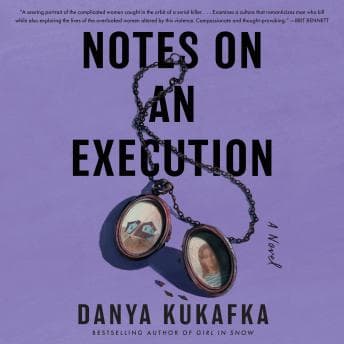

I need to talk about something that's been bothering me since I finished this audiobook at 2 AM, unable to sleep, staring at my ceiling like a woman possessed.
We don't need another serial killer story. We really don't. The true crime industrial complex has given us enough content to last several lifetimes, and my professional opinion—as someone who studies why people do terrible things—is that we've been asking the wrong questions for decades. Why does he kill? What made him this way? What's his origin story?
Danya Kukafka apparently agrees with me. And she's furious about it.
The Women We Never Hear About
Ansel Packer has twelve hours to live. He's our serial killer, and Kukafka does something borderline radical: she makes him boring. Not in a poorly-written way—in a psychologically accurate way. Jim Meskimen delivers Ansel's sections with this gravelly nonchalance that had me thinking about Hannah Arendt's banality of evil. There's no Hannibal Lecter brilliance here, no tortured genius. Just a man who convinced himself his violence meant something. The research actually shows that most violent offenders aren't masterminds—they're mundane, entitled, and utterly convinced of their own importance.
But here's where Kukafka flips the entire genre on its head: we spend most of our time with the women. Lavender, the seventeen-year-old mother pushed past her breaking point. Hazel, watching her twin sister disappear into a relationship she can't save her from. Saffy, the homicide detective who's devoted her career to catching men like Ansel while her own life crumbles around her.
Mozhan Marno—and I need to be specific here—crafts completely distinct tones for each woman. There's a generational weight to how she voices Lavender versus Saffy, a class difference you can hear in the vowels. This isn't just "different voices for different characters." This is a narrator who understood the assignment on a cellular level.
Why This Psychological Portrait Actually Works
I kept asking myself: why does this book succeed where so many others fail?
Because Kukafka isn't interested in understanding Ansel. She's interested in the ripple effects—the fissures that violence leaves in its wake. The women in this book aren't victims in the traditional true crime sense. They're not plot devices to make us feel something about the killer. They're fully realized humans making impossible choices, and the book refuses to judge them for it. That same refusal to judge women in impossible situations is what made Beneath This Mask so compelling to me.
Saffy throws herself into work because looking at her own life is too painful—classic avoidance, textbook stuff. Hazel's twin bond becomes both her greatest strength and her prison. Lavender's desperation isn't excused, but it's understood. My therapist would have thoughts about all of these characters, and none of those thoughts would be simple.
At nearly ten hours, this is not a quick listen. The pacing is deliberate, almost meditative at times, which works for the material but requires your full attention. I tried listening while cooking once and had to rewind three times because I missed crucial psychological beats. We know Ansel dies at the end, so why does every chapter feel like a countdown bomb? Fascinating case study in how structure creates tension.
Who Needs This—And Who Should Walk Away
If you're coming here for a thriller with twists and a satisfying gotcha moment where the detective catches the killer in a dramatic showdown—wrong book. The clock is ticking, yes, but the suspense isn't about whether Ansel will escape. It's about whether we can understand the wreckage without excusing it.
Content warnings are real: violence, abuse, language, sexual content. This book doesn't shy away from the ugly parts of its subject matter. But it also doesn't wallow in them for shock value, which—honestly—is rare enough in this genre that it deserves mention.
Skip this if you want your killers charismatic and your endings cathartic. But if you're tired of true crime narratives that treat killers like fascinating puzzles to solve, if you've ever wondered why we never hear from the women left behind, if you want psychological depth that doesn't feel like a Wikipedia article on personality disorders—this is your book.
Closing the Case File
I finished this at 2 AM, as I said. Couldn't sleep for another hour after. Not because it was scary—because it was true. True in the way that good psychology is true, the way that understanding human nature means sitting with discomfort.
The dual narration works beautifully. Meskimen's Ansel is chilling precisely because he's not trying to be. Marno's women are heartbreaking because they're fighting battles they didn't choose. The production is clean, no audio issues, nothing to distract from the emotional weight.
Kukafka wrote a serial killer novel that's actually about everyone except the serial killer. It shouldn't work—and yet it does, completely. The Edgar Award makes sense. The critical acclaim makes sense.
My only complaint? Now I have to rethink my entire lecture on narrative psychology in crime fiction. Thanks for that, Danya.