
My parents competed with Alibaba before they knew Alibaba existed.
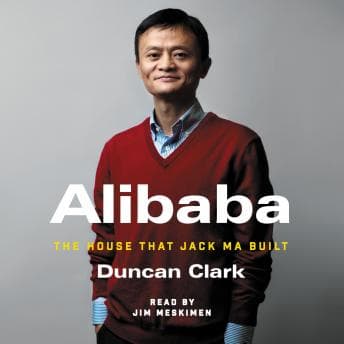
I was up late prepping a deck for a Series B founder who thinks he's going to "disrupt" Southeast Asian logistics. Needed a palate cleanser. Put this on at 1.75x - yes, slower than my usual - because Duncan Clark's insider access to Jack Ma's early days actually warranted paying attention. And here's the thing that hit me sideways: Jack Ma's origin story isn't some Silicon Valley garage myth. It's a guy who failed his college entrance exam twice, got rejected from 30 jobs including KFC, and started a company in his apartment with 17 friends and $60,000 pooled together. That's not a startup. That's a Korean church fundraiser.
This is what my parents did instinctively. Now it has a TED talk.
The Part Where a Teacher Outmaneuvers eBay
Clark's real advantage here is that he was literally in the room. He met Jack Ma in 1999 in that Hangzhou apartment, and it shows. The book isn't some Wikipedia-summary-turned-audiobook. You get the texture of how Alibaba survived the dot-com bust, how Jack positioned Taobao against eBay China by making it free when eBay was charging listing fees - a move that sounds obvious in hindsight but required burning cash they barely had. The strategic maneuvering against Meg Whitman's eBay is genuinely instructive. Jack understood that Chinese consumers needed trust mechanisms (Alipay as escrow) because the market conditions were fundamentally different from the West.
What Clark does well is contextualize Alibaba within China's economic transformation. This isn't just a company biography - it's a crash course in how Chinese internet policy, WTO accession, and urbanization created the conditions for Alibaba to exist. I've recommended this to three founders now, not because they're building in China, but because it demonstrates how market-specific strategy beats copying what works elsewhere. Good to Great makes a similar case about companies that understood their own terrain versus companies that just benchmarked against whoever was winning at the time - though Collins is working with American data that sometimes flattens how much context actually matters. eBay copied eBay. Jack Ma built for China.
The key takeaway is worth the listen. The other 7 hours? Actually, most of them hold up here.
Jim Meskimen and the Mandarin Problem
Let's talk about the elephant. Jim Meskimen has a clear, authoritative voice. He reads this like a sharp journalist filing a long-form piece, which is exactly the right energy. Good pacing, good emphasis on the business strategy sections. But - and this is not a small but - the Chinese word pronunciations are rough. We're talking about a book set almost entirely in China, about Chinese companies, Chinese entrepreneurs, Chinese government officials. When you're consistently mangling Mandarin names and terms, it creates this weird cognitive dissonance where you're absorbing smart analysis through a filter that keeps reminding you the narrator didn't do his homework on pronunciation.
Is it a dealbreaker? For me, no. I grew up hearing butchered Korean from non-Korean speakers, so my tolerance is probably higher than average. But if you speak Mandarin, you'll wince. Repeatedly. It's like listening to someone give an excellent presentation on Italian cuisine while pronouncing bruschetta wrong every single time.
Where the 9 Hours Start to Feel Like 9 Hours
The book is strongest in its first two-thirds - the scrappy early days, the eBay battle, the Yahoo partnership drama, the complicated dance with the Chinese government. Clark earns his insider-access billing during these sections. Where it softens is toward the end, when it shifts into more speculative territory about Alibaba's future in finance (Ant Financial), entertainment, and global expansion. Some of that analysis has aged since the 2016 publication - especially given what's happened with Jack Ma and Chinese regulators since then. The book couldn't have predicted the crackdowns, but it does hint at the tension between Alibaba's ambitions and government patience.
At 9 hours and 10 minutes, it's on the longer side for a single-company biography. I would've cut about 90 minutes of the later-chapter speculation and some of the repetitive context-setting for Western audiences who might not know basic China facts. Skip to chapter 5 if you already know the broad strokes of early Chinese internet history.
Who Gets ROI Here
Founders thinking about market entry strategy in non-Western economies. Consultants advising companies expanding into Asia. Anyone who's tired of business books that only reference American companies as if the rest of the world is a footnote. This is legitimately one of the better business biographies I've listened to this year, partly because Clark resists hagiography - he's clear-eyed about Jack's flaws and Alibaba's government entanglements.
Skip it if you want a rah-rah entrepreneurship book. Jack Ma's story is inspiring, sure, but Clark is more interested in the mechanics than the mythology. Which is exactly why it works.
The Consulting Memo
Bottom line: A serious business biography that earns its length, mostly. Clark's firsthand access and China expertise make this the definitive Alibaba account. Meskimen's narration is competent but the Mandarin mispronunciations are a recurring tax on your patience. I listened to this instead of sleeping and don't regret it. Jenny would say I'm being harsh about the pronunciation stuff. Jenny is right - but she also doesn't have to sit through nine hours of it.