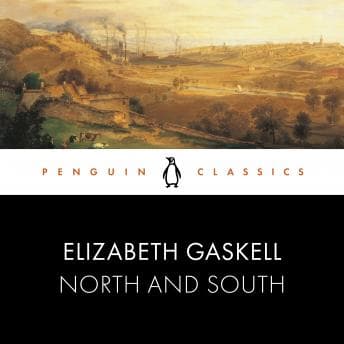

Look, I'll admit something that might get my English teacher credentials revoked: I've always thought North and South was the better Austen novel. (Yes, I know Gaskell wrote it. That's the joke. My students never laugh either.)
But here's the thing—I came into this audiobook expecting a competent reading of a Victorian classic I've taught for years. What I got was Gemma Whelan absolutely disappearing into Milton's smoke-choked streets and making me hear the novel differently than I ever had reading it on the page.
The Voice That Made Me Miss My Stop
Whelan is known for Yara Greyjoy in Game of Thrones, which honestly made me nervous. Would I be listening to Margaret Hale or an Ironborn sailor? Turns out—neither. She just becomes the book. Her Margaret is sharp but not cold, principled but learning. And when she shifts to Mr. Thornton? I believed him. Not in a "doing a man voice" way, but in a way that captures his barely-contained intensity without ever feeling like a performance.
The accents deserve their own paragraph. Bessie Higgins—the working-class friend who represents everything Margaret doesn't understand about industrial England—comes alive in a way that made me genuinely emotional. Whelan gives her this warmth and weariness that the text implies but never quite delivers on its own. This is what I mean when I tell my students that narration is interpretation. The narrator is making choices about who these people are, and Whelan's choices are consistently right.
Nineteen hours is a commitment. I listened over three weeks, mostly during my morning walks along the lakefront and during late-night grading sessions. (Turns out Gaskell pairs well with sophomore essays about The Great Gatsby. Who knew.) The pacing never felt like a slog, which is remarkable for Victorian literature. Some of the philosophical passages—and there are plenty—required me to rewind, but that's Gaskell being Gaskell, not Whelan failing.
Why This Book Still Matters (And Why I'm Assigning It)
Here's what I love about teaching Gaskell: she was doing what we'd now call "both-sidesing" before it was a thing, except she actually earned it. Margaret starts as this Southern gentlewoman who thinks factory owners are monsters. Thornton starts as this Northern industrialist who thinks workers are ungrateful children. And Gaskell—through 600-some pages—forces them both to actually see each other.
The audiobook format makes this evolution feel more natural than reading it ever did for me. You're living with these characters for nineteen hours. You hear Margaret's voice soften toward the North. You hear Thornton's rigid certainty crack. The romance—and yes, there's a romance, it's Victorian literature—earns itself in a way that feels almost radical for its time.
My students would probably hate this. Too slow. Too many descriptions of cotton mills. Not enough murder. I love it.
The Penguin Classics Treatment
The production is exactly what you'd expect from Penguin—clean audio, no weird artifacts, the kind of quality you can trust for a long listen. Patricia Ingham's introduction (included in the recording) provides solid context without being dry. Worth listening to if you're new to Gaskell, skippable if you've been teaching her for two decades.
One small note: if you're listening while doing other things—and let's be real, that's how most of us consume audiobooks—some of the denser passages about political economy and labor relations might require your full attention. I had to rewind a few times when I was grading and suddenly realized I'd missed an entire scene about union organizing. Not a criticism of the narration. Just the reality of Victorian prose.
Who Should Queue This Up (And Who Should Skip)
If you love slow-burn character development and don't mind Victorian prose that occasionally lectures you about cotton manufacturing, this is your audiobook. Skip it if you need immediate stakes and faster pacing—President Is Missing: A Novel delivers that page-turning urgency my students actually respond to. But if you've been meaning to read North and South for years and never quite got there, this is your version.
Adding It to the Syllabus
This is how you do a classic audiobook. Whelan doesn't just read Gaskell—she understands that every pause is punctuation, that the rhythm of Victorian sentences has its own music. If you loved Middlemarch (and you should), this is its industrial cousin.
I'm adding it to my recommended list for AP Lit. Right next to my note that says "listen at 1.0x because the author chose those words." My students will ignore me. They always do.