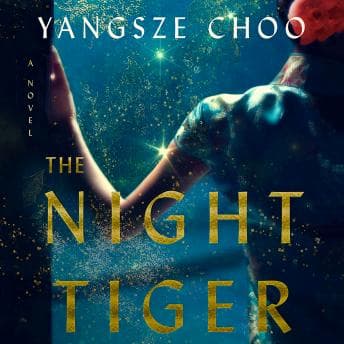

What happens when you take a fantasy-adjacent magic system, strip out the swords and armor, and drop it into 1930s colonial Malaysia with were-tigers and severed fingers? You get something I genuinely did not expect to love as much as I did.
I started The Night Tiger during a late-night board game session where my group bailed one by one - first Kyle had to work early, then Marcus got a migraine, and suddenly it was just me and a half-finished game of Everdell at midnight. So I threw in my earbuds and figured I'd give this a shot while cleaning up cardboard tokens. Fourteen hours later (not that night, but close), I was genuinely upset it was over.
The 49-Day Clock Is Basically a Quest Timer
Let me pitch this to you in terms that matter: an eleven-year-old houseboy named Ren has 49 days to find his dead master's severed finger and reunite it with the body, or the man's soul wanders forever. That's a ticking clock with real stakes. That's a side quest with a hard deadline. And running parallel, Ji Lin - dancehall girl, apprentice dressmaker, deeply frustrated human being - stumbles onto a severed finger that may or may not be the same one. The dual narrative braids these two together in a way that had me genuinely guessing how they'd connect for hours.
The world-building here isn't Sanderson-level in terms of hard magic systems, but it's doing something I don't see enough in fantasy-adjacent fiction: grounding the supernatural in real cultural belief. I reviewed Rise of Nine a while back and came away feeling like its magic existed in a vacuum - cool mechanics, zero cultural weight behind them - which makes what Choo does here hit even harder by contrast. The Chinese superstition about needing all body parts for burial, the five Confucian virtues mapped onto five characters, the idea that men can become tigers - none of this feels like a gimmick. Choo grew up in Malaysia, fourth-generation Chinese descent, and you can feel the difference between someone researching folklore and someone who absorbed it. The mythology sits in the story the way gravity sits in physics - it's just there, shaping everything.
Choo Narrating Choo Is Either Brave or Perfect (It's Both)
Author-narrated audiobooks are a gamble. Sometimes you get the person who wrote the words but can't perform them. Yangsze Choo is not that. Her voice has this quality - deep, precise, with just a trace of British colonial accent that makes absolute sense for the setting without feeling affected. When she voices Ren, there's this childlike openness that genuinely made me protective of the kid. Ji Lin gets a softer, more guarded delivery, which... okay, here's my one gripe. Ji Lin's sections occasionally felt flatter compared to Ren's. Not bad. Just less electric. Like the difference between a narrator who's in the character versus narrating about the character.
But where Choo absolutely nails it is the dream sequences. And look - dream sequences in fiction are usually where I check out. They're the "it was all a dream" cop-out of lazy plotting. Here they're different. The dreams function like a parallel dungeon crawl, this ghostly dreamscape where the rules of the waking world bend. Choo's delivery shifts into something almost hypnotic during these sections, slowing her cadence, letting silences breathe. A few of them felt slightly contrived - like the narrative needed a bridge and grabbed the dream mechanic to get there - but when they work, they work.
Colonial Malaysia as a Character Sheet
This is the part that surprised me most. I came for the were-tigers (obviously), but I stayed for the world. 1930s Malaya under British rule - rubber plantations, hospital storage rooms, dance halls where local women earn money from European men, servants navigating a system designed to keep them invisible. The social hierarchy here is as rigid and layered as anything in a secondary-world fantasy. Ren is a houseboy. Ji Lin moonlights as a dancehall girl to pay her mother's Mahjong debts. Neither of them is supposed to matter, and the tension between their ambitions and their stations drives everything.
If you've read Choo's The Ghost Bride (which Netflix adapted, so you might know it), this is a more confident, more structurally ambitious book. The ghost story elements are woven tighter, the pacing is more deliberate, and the stakes feel more personal. Where The Ghost Bride sometimes leaned into spectacle, The Night Tiger trusts its characters to carry the weight.
Who Rolls Initiative on This One
If you're a hard-magic-system purist who needs Sanderson-style rules for your supernatural elements, this might frustrate you - the tiger mythology operates on folklore logic, not physics. If you hate romance subplots, there's one here that some listeners find contrived (I thought it was fine, but I'm also the guy who thinks Kaladin's love life is the least interesting part of Stormlight, so calibrate accordingly). And if you need nonstop action pacing, the stop/start rhythm of alternating dual narratives might test you.
But if you love world-building that's rooted in real history and real belief systems? If you want a mystery with supernatural stakes and a ticking clock? If you've ever wished your D&D campaign had more cultural texture and less generic medieval Europe? This is your book. My D&D group would love this - I'm already stealing the 49-day burial quest for a one-shot.
I read this instead of writing my thesis. Dr. Patel would not approve. Worth it.
The Finger Points Where It Points
Fourteen hours, author-narrated, colonial Malaysia with were-tigers and severed fingers and a kid on a 49-day quest. It's not the fastest listen and it's not trying to be. But it's the kind of audiobook that makes you forget you're doing dishes or shelving board game boxes or - hypothetically - avoiding your thesis. Spend the credit.