
I was about four miles into my Sunday morning jog through Cambridge — the stretch along the Charles where the wind does that thing where it's actively hostile to your face — when I realized I was listening to a book about running while running. Very meta. Also, I was doing basically everything wrong according to Dr. Vijay Vad.
Let me back up.
A Sports Medicine Doctor Wrote a Running Book and That Actually Matters
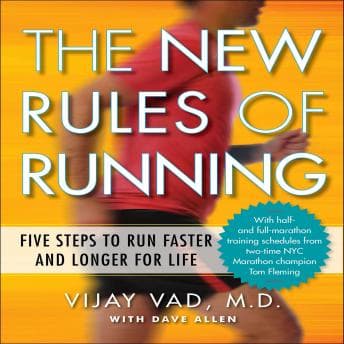
Most running books fall into two camps: the inspirational memoir ("I ran through my pain and found myself!") or the coaching manual ("Here's your 16-week marathon plan, good luck"). The New Rules of Running does something different by leading with injury science. Vad is a sports medicine specialist at the Hospital for Special Surgery in New York and faculty at Weill Cornell, which means he's spent his career looking at the wreckage that running leaves behind — the blown-out knees, the plantar fasciitis, the IT band issues that make you want to cry on a foam roller at 6 AM.
The book's five-step framework covers biomechanics, strength, nutrition, hydration, and training plans (the latter designed by Tom Fleming, two-time NYC Marathon champion). But what sets it apart from, say, Born to Run or Hansons Marathon Method is the medical lens. Vad doesn't just tell you to stretch your hip flexors. He explains why your hip flexors are angry in the first place, what's happening at the joint level, and how the kinetic chain breaks down. The research actually shows that most running injuries aren't random bad luck — they're biomechanical patterns, and Vad treats them as such.
As someone who studies patterns for a living (albeit in fictional characters, not femoral heads), I appreciated this. The human body has its own narrative logic. Ignore it and you get a predictable third act: injury.
Where the Audio Format Gets Awkward
Here's the thing about listening to a book that describes strengthening exercises, stretches, and training schedules: you can't see them. This is a book with diagrams, tables, and training plans that really want to be visual. Steven W. Minage narrates competently — clear, steady, professional pacing — but he's fighting a format problem. When you're hearing descriptions of specific stretches or week-by-week marathon training schedules read aloud, your brain starts doing that thing where words wash over you without sticking. I found myself rewinding sections about core exercises because hearing "now extend your left leg while rotating your torso" while dodging a cyclist on Memorial Drive is, shall we say, suboptimal.
Minage doesn't bring any particular flavor to the narration — no warmth, no humor, no conversational energy that might compensate for the inherently dry material. He reads it like what it is: a medical professional's guide. Functional. Fine. But at 7 hours and 36 minutes, "fine" starts to feel long.
I found myself asking: why does this book need to be an audiobook at all? The training schedules and exercise descriptions — which are arguably the most practical, useful parts — lose almost all their utility in audio. You're not going to pause mid-run to replay the correct form for a single-leg deadlift. The conceptual stuff about injury prevention and biomechanics works well enough in your ears, but it's maybe 60% of the content.
The Psychology of the Injured Runner (My Actual Expertise, Sort Of)
What I did find genuinely interesting was the implicit psychology here. Vad clearly understands something most running coaches don't talk about: runners are terrible at listening to their bodies. The book exhibits classic denial patterns — he describes patients who ran through stress fractures, who ignored hip pain for months, who treated rest like failure. This is a fascinating case study in how identity gets tangled up with behavior. When you are a runner, stopping feels like losing yourself. The psychology of identity-as-behavior is something I kept circling in Own Your Everyday too — that same knotted relationship between who you think you are and what you feel compelled to prove through action.
My therapist would have thoughts about this. (She already has thoughts about why I run five days a week in New England weather, but that's between us.)
Vad's approach is essentially cognitive reframing for the physically reckless: prevention isn't weakness, it's strategy. The strongest runners aren't the ones who push through everything. They're the ones who understand their bodies well enough to know when pushing is productive and when it's self-destruction dressed up as discipline.
That's genuinely useful. That part, I'd recommend to anyone who runs.
Who Gets Value Here (And Who Doesn't)
If you're a new runner or coming back from injury and you want to understand why things break down — get the print version. Seriously. The information is solid, the medical credibility is real, and the training plans designed by Fleming are structured and reasonable. But get. The print. Version. The audiobook strips out too much of the practical utility.
If you're an experienced runner looking for the next level of training philosophy or race strategy, this probably won't blow your mind. It's foundational, not advanced.
My Clinical Assessment
A good book in the wrong format. The injury prevention framework is genuinely valuable — Vad knows his stuff, and the emphasis on biomechanics over willpower is refreshing in a genre obsessed with mental toughness narratives. But the audiobook experience is like attending a cooking class with your eyes closed. You'll get the concepts. You'll miss the details that matter most.