
"You can be anything you want to be" — except, apparently, an art student, if your parents have other plans for you.
That line isn't in the book exactly, but it's the unspoken tension humming underneath every minute of Jerry Craft's New Kid, and it hit me right in the chest. I was grading a stack of persuasive essays — eleventh graders arguing whether social media is "toxic" (groundbreaking stuff, truly) — when I put this on, figuring a two-hour middle grade listen would be palette cleansing. Something light before bed. I was wrong about the "light" part.
Washington Heights to Riverdale Is Only a Few Miles, but Jordan Banks Travels Light-Years
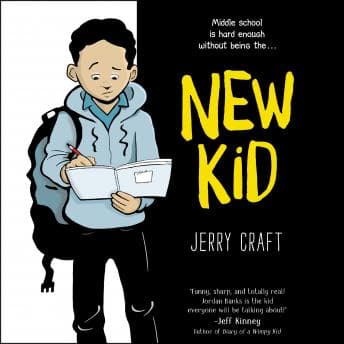
Here's what Craft does that so many authors writing about race and belonging fumble: he makes it specific. Jordan Banks isn't Every Black Kid at a Predominantly White School. He's this kid — a seventh grader who wants to draw comics, whose mom packs him lunch he's embarrassed to eat, who has to navigate a world where a teacher keeps mixing up the two Black kids in class. That last detail? I've watched that happen in my own school. I've corrected that in my own school. Craft doesn't lecture about it. He just lets it sit there, and the discomfort does the teaching.
The book is only two hours, which initially made me skeptical. How do you translate a graphic novel — a medium that lives and dies by visual storytelling — into audio? You lose the art, the panel layouts, the way Craft uses Jordan's drawings-within-the-story to reveal his inner life. That's a real sacrifice. But the production team made a smart bet: they went full-cast, added sound effects, layered in original music, and basically built a radio play.
And it mostly works. Sometimes brilliantly.
Eleven Voices and a Hallway Full of Sound Effects
Eleven narrators for a two-hour audiobook. That's ambitious bordering on reckless, and I respect it. The young voices — particularly the kids playing Jordan and his friends — give the production an energy that a single adult narrator reading in "kid voice" never could. There's a looseness to the delivery, a naturalness that sounds like actual middle schoolers bouncing off each other in a hallway. Ron Butler anchors things with this warm, steady narration that carries the connective tissue between scenes, and his delivery has a kind of quiet elegance that grounds the whole thing when it could easily tip into chaos.
The sound effects are a genuine addition, not a gimmick. School bells, cafeteria noise, the ambient hum of a bus ride from Washington Heights uptown — they fill the visual gap left by losing Craft's illustrations. Are they a perfect replacement? No. You'll miss the art. But they give your brain something to build scenes around, and for younger listeners especially, they transform this from "someone reading to you" into something closer to an experience.
What I couldn't verify — and I want to be honest here — is how individual narrators handle specific characters moment to moment. The research on this production is surprisingly thin on granular detail. I can tell you the ensemble feels cohesive. I can tell you no one sounds like they're phoning it in. But I can't point to a specific scene at minute forty-seven where a particular narrator knocked me sideways. The production is consistently good rather than having one transcendent performance moment.
What My Students Would Actually Say About This
Here's where I put on my teacher hat, which — let's be real — I never take off. This reminds me of what Hemingway said about writing true sentences: Craft writes true moments. The microaggressions Jordan faces aren't melodramatic. They're the quiet, corrosive kind. The well-meaning teacher who assumes Jordan got in on a sports scholarship. The classmate who touches his hair. The constant, exhausting work of code-switching between two worlds.
My students would connect with this immediately. Even the ones who "don't read." (Especially them.) And that's exactly the audience this audiobook is built for — kids who might not pick up the graphic novel but will listen to a two-hour audio drama on a car ride. Parents who want to start a conversation about race and identity but don't want to hand their kid a pamphlet.
The prose deserves to be savored, even in a middle grade format. Craft's writing is deceptively simple. Short sentences that carry heavy freight. Jordan's voice is funny and observant and sometimes heartbreakingly matter-of-fact about things no twelve-year-old should have to be matter-of-fact about.
Is it perfect? The brevity works against deeper character development for some of the supporting cast. Jordan's friend Liam, his friend Drew — they get sketched rather than fully rendered. And some of the adult characters land closer to types than people. But at two hours, Craft chose focus over breadth, and for this story, that's the right call.
Who Needs to Hear This (And I Mean That Literally)
Families. Teachers. Librarians. Any adult who works with kids and wants to understand what navigating predominantly white spaces feels like for a Black child — told without bitterness, without simplification, with humor and grace. My students would hate that I'm assigning emotional homework. I love it. (Ransom Riggs pulls off something similar in Miss Peregrine's Home for Peculiar Children — a story that's ostensibly for younger readers but keeps landing these quiet gut-punches that adults feel just as hard.).
Skip it if you need deep literary complexity or if you're looking for a long listen. This is a quick, sharp, purposeful story that does exactly what it sets out to do.
Worth pausing the faculty meeting for? Absolutely. (Sorry again, Principal Martinez.)
This is why we still read the classics — and why we need new ones, too. Jordan Banks belongs on the shelf next to them.