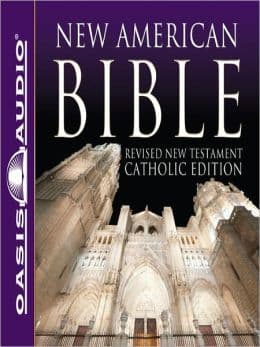

How do you grade the most influential text in Western civilization?
I'm serious. I've spent twenty years teaching teenagers how to analyze prose — finding the thesis in a paragraph, the subtext in a metaphor, the rhythm in a sentence. And then you sit down with the New Testament and realize every tool you've got is both perfectly applicable and laughably insufficient. This is the text that shaped Dante, Milton, Faulkner, Morrison, Flannery O'Connor. You can't teach American literature without tripping over it every other week. Ohiyesa's Soul of the Indian is another text I keep returning to for that same reason — it sits beneath so much of what I teach without ever appearing on the official syllabus. So when I say I spent twenty hours and thirty-nine minutes with Buck Ford's narration of the New American Bible's Revised New Testament, I want you to understand I wasn't approaching this casually.
I started listening on a Saturday morning walk along the lakefront with Denise. She had her own earbuds in — some true crime thing — and I had Matthew's Gospel playing while the November wind came off Lake Michigan like it had a personal grudge. And something about that setting, the gray water, the cold, Ford's unhurried voice moving through the Beatitudes — it hit differently than any Sunday reading I'd sat through in forty-four years of Catholic life.
Buck Ford Treats Silence Like Scripture
Let's talk about what makes this narration work, because it's counterintuitive. Ford reads slowly. Deliberately. With pauses that would make my students fidget out of their chairs. And that's exactly right.
The narrator understands that pause is punctuation. When Ford reaches the end of a parable — say, the Prodigal Son in Luke 15 — he doesn't rush into the next verse. He lets the silence sit. There's a beat, a breath, and you feel the weight of what just happened before the text moves on. It's the audio equivalent of white space on a page. Most Bible narrators I've tried treat the text like a marathon — just keep the pace, get through it, hit your marks. Ford treats it like poetry. Because honestly, a lot of it is poetry.
His inflection is smart too. Not dramatic — smart. He doesn't do "voices" for Jesus versus Paul versus John. Instead, he shifts tone. The Gospels get a warmer, more narrative quality. When he moves into Romans or Corinthians, there's a subtle shift toward something more urgent, more rhetorical — which makes sense, because Paul was essentially writing argumentative essays. (My students would recognize the structure. They'd still hate the assignment, but they'd recognize it.) Ford seems to understand the genre differences within the New Testament itself, and he adjusts without ever breaking the reverence of the thing.
The production is clean. No music, no ambient sound, no dramatic orchestral swells when we hit Revelation. Just Ford's voice in a quiet room. For a text like this, that restraint is the right call.
The NAB Translation — Why This Version Matters
Here's where the English teacher in me gets particular. The New American Bible translation is the one you hear at Mass if you're Catholic in the United States. It's the product of fifty-some scholars working for decades, and it prioritizes clarity and directness over the literary grandeur of, say, the King James. If you love the KJV's "through a glass, darkly" — and I do, because that's magnificent prose — you might find the NAB's rendering flatter. That's by design. The NAB is trying to get you closer to what the original Greek and Hebrew actually said, not what sounds best in Elizabethan English.
This matters for an audiobook because you're hearing the translation choices in real time. Some passages in the NAB land with beautiful simplicity — the opening of John's Gospel still stops me cold every time. Others feel more utilitarian. Ford's pacing helps the plainer passages breathe, gives them room to land even when the language itself isn't soaring. But I won't pretend every moment of twenty hours is equally gripping. The genealogies in Matthew? The detailed greetings at the end of Paul's letters? Ford does his best, but some stretches are what they are.
Who This Is Actually For
If you're Catholic and want to hear the translation you already know from Mass, this is your audiobook. Full stop. It's great for reading along with a physical NAB Bible — Ford's pace actually makes that feasible, which is rare for audio Bibles. If you're a student of literature and you want to understand the source material that runs underneath basically everything written in English for the last five centuries, this is solid.
If you want theatrical performance or a full-cast production with sound effects — look elsewhere. This is a single voice in a quiet room reading sacred text with intelligence and care. My students would probably lose focus. I loved it.
If you're not Catholic, or you're comparing translations, just know what you're getting: this is the NAB, not the NRSV, not the KJV, not The Message. It's a specific translation for a specific tradition, and it does that job well.
The Margin Note I'd Leave
I finished Revelation on a Tuesday night while grading sophomore essays on The Great Gatsby. A kid had written "Gatsby is basically about wanting stuff you can't have" and I thought — yeah, that's reductive, but it's not wrong. And that's sort of how I feel about reviewing the New Testament as an audiobook. Any rating I give is reductive. But Buck Ford's narration is genuinely excellent for what it is: respectful, intelligent, unhurried. The prose deserves to be savored. He lets you savor it.
Worth pausing the faculty meeting for. (Sorry again, Principal Martinez.)