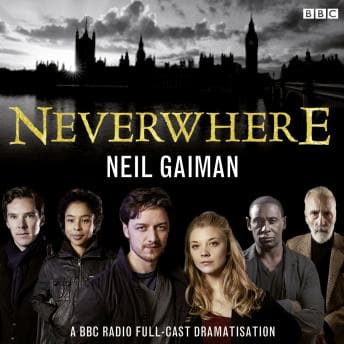

So here's the thing - I went into this expecting a solid BBC radio drama, maybe a nice background listen while I pretended to work on my thesis. What I got was basically a tabletop session run by the world's most stacked D&D group, and I forgot to write a single line of code for three hours and forty-nine minutes.
Let me back up. I was reorganizing my board game shelf (a task I do when I'm avoiding Dr. Patel's emails) and figured a sub-four-hour listen would be perfect. Light commitment. Easy. Except the moment James McAvoy's Richard Mayhew stumbled into London Below, I sat down on the floor between my copy of Gloomhaven and a stack of unread thesis notes and didn't move until the credits rolled.
London Below Plays Like the Best Campaign Setting You've Never Run
Neil Gaiman's world-building here is the kind that makes me want to crack open a notebook and start statting things out. The conceit is deceptively simple - London place names are literal. The Earl of Earl's Court is an actual earl, holding court in an abandoned tube station. The Black Friars are actual friars. The Angel Islington is an actual angel. Called Islington. It's the kind of wordplay-as-world-building that shouldn't work but absolutely does, and Dirk Maggs's adaptation leans all the way into the physicality of these spaces. You hear the echo of the tube tunnels, the drip of the sewers, the ambient noise of the Floating Market. James Hannigan's score doesn't just sit underneath the dialogue - it shifts texture depending on whether you're in London Above or Below, and your brain starts associating certain musical cues with safety or danger without you even noticing.
My D&D group would lose their minds over this setting. The Floating Market alone is a campaign arc waiting to happen.
Anthony Head's Mr. Croup Is the Best Villain Voice I've Heard Since Steven Pacey's Bayaz
I need to talk about Anthony Head. His Mr. Croup is wicked, theatrical, almost giddy with violence - he speaks like someone who learned vocabulary from eating dictionaries and enjoys every syllable the way a cat enjoys a cornered mouse. There's this quality where he stretches certain words, savoring them, and it makes Croup genuinely unsettling beneath the humor. Paired with David Schofield's Vandemar - who's more blunt, more animal - you get this assassin duo that feels like mismatched NPCs a DM threw together just to see what would happen.
But the performance that genuinely surprised me was Benedict Cumberbatch as the angel Islington. I expected good. I did not expect otherworldly. There's this quality he brings - a warmth that feels slightly wrong, like a frequency just off from human - and when Islington reveals its true nature, his voice shifts in a way that made me physically uncomfortable sitting on my apartment floor at 11 PM. It's not a big shift. That's what makes it work. The angel doesn't suddenly become a monster. The monster was always there, wearing angel like a costume, and Cumberbatch calibrates it perfectly. That gap between surface performance and hidden nature is something Christopher Browning excavates from a completely different angle in Ordinary Men - how ordinary warmth and monstrous capacity coexist in the same person without either canceling the other out, and it wrecked me in a way I wasn't expecting from either source.
James McAvoy, meanwhile, does something harder than being scary - he makes Richard Mayhew genuinely likeable and a little pathetic in a way that earns your empathy instead of your pity. You root for this guy because McAvoy makes his confusion feel real, not bumbling.
The Trade-Off of Three Hours and Forty-Nine Minutes
Here's where I have to be honest. This is a dramatization, not a full audiobook, and at under four hours it moves fast. Really fast. Some plot beats that breathe in the novel get compressed into quick scene transitions here, and if you haven't read the book, a couple of the world-building elements might fly past before you've fully absorbed them. The Floating Market, for instance - I wanted to live there for another twenty minutes. The adaptation chooses momentum over immersion in a few spots, and while that's the right call for radio drama, part of me wishes they'd let certain scenes expand.
The bonus material (bloopers, extended scenes, outtakes) is a fun addition and worth your time, especially if you want to hear Christopher Lee being Christopher Lee between takes. But it's bonus content, not essential content.
Who Gets an Invitation to London Below
If you love full-cast productions, BBC radio drama, or you just want to hear what happens when you throw an absurd amount of acting talent at a Gaiman story - this is your thing. If you're someone who needs 40 hours of deep lore and info-dumps (and honestly, I usually am that person), the brevity might leave you hungry. But it's the good kind of hungry. The kind that makes you pick up the novel or track down the TV series.
If you don't like info-dumps, this isn't for you - wait, no, this one actually isn't info-dump heavy. This is pure story. Pure atmosphere. Pure session recap energy where every scene matters.
I read this instead of writing my thesis. Under four hours. Dr. Patel can't even be mad about that one.