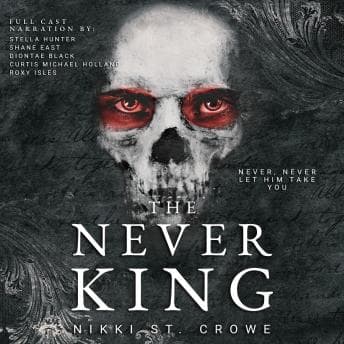
What happens when you take the boy who never grew up and strip away every scrap of Disney-approved whimsy until all that's left is teeth and territorial rage and something uncomfortably close to desire?
That's the question Never King asks, and honestly, it's a question I didn't know I needed answered until I was two hours deep, sitting cross-legged on my apartment floor at midnight, Shirley (my cat) giving me that look she reserves for when she judges my life choices. Which is always.
Peter Pan With Fangs and a Grudge
Look, I grew up in a household where horror was the devil's media and fairy tales were sanitized into oblivion. So dark retellings? They scratch an itch that's been building since I was eight years old sneaking R.L. Stine books under my covers. Nikki St. Crowe takes the Peter Pan mythos and does something genuinely unnerving with it — she keeps the bones recognizable but rots away the flesh until what's underneath is this possessive, feral, rage-soaked power dynamic between a Darling girl and a Neverland that feels more like a cage than a paradise.
The premise is sharp: every Darling woman, taken on her eighteenth birthday, returned broken. That generational curse element? That's horror scaffolding, even if the book itself lands firmly in dark romance territory. And I respect the commitment to that darkness. St. Crowe doesn't soften Peter into a misunderstood bad boy with a heart of gold. He's cruel. The Lost Boys are cruel. The dynamic is enemies-to-lovers by way of captivity and control, and the book doesn't apologize for any of it.
But — and this is where I have to be honest — the world-building is tissue-thin. Neverland exists mostly as a backdrop for the character dynamics rather than as a living, breathing place. For a setting that should feel ancient and alien and wrong, it reads more like a stage set. I wanted the island to unsettle me the way Hill House unsettles. I wanted it to be a character. It's not. It's furniture.
Five Narrators Walk Into Neverland
Five narrators for a four-and-a-half-hour book. That's ambitious. That's almost one narrator per hour. And you know what? The narrator commits. That's rare — and I mean all five of them.
Stella Hunter carries the Darling POV with this breathy defiance that walks the line between fear and fury. She's not doing damsel-in-distress; she's doing cornered-animal-who-might-bite-back. The male narrators — Curtis Michael Holland, Diontae Black, Shane East — each bring a distinct energy to the Lost Boys that keeps you from confusing who's who even when the plot is moving fast. There's a graveliness to one, a silky menace to another, and a volatility to the third that makes the shifting POVs feel intentional rather than chaotic. Roxy Isles rounds out the cast.
The full-cast approach works here specifically because the book is so POV-heavy and so short. Without distinct voices, you'd lose the thread in minutes. With them, each chapter shift feels like a camera cut. It's almost cinematic. Almost.
My one gripe: at under five hours, you barely settle into one narrator's rhythm before you're yanked to the next. The production is clean and the performances are strong, but the brevity works against the ensemble format. You've got five talented people and not quite enough runway to let any of them fully breathe.
The Spice-to-Substance Ratio Problem
Here's where I put on my librarian hat (I literally am one, this isn't a metaphor). I've recommended hundreds of dark retellings from behind my desk — quietly, conspiratorially, the way you should recommend books that would make your grandmother faint. And the good ones balance the heat with the world and the dread and the why of it all.
Never King leans hard into the spice. Hard. And listen, I'm not clutching pearls — I'm the person who hosts a podcast called "The Witching Hour." But when the ratio tips too far toward the physical and away from the psychological, the horror elements that make a dark retelling dark start to feel decorative. The curse of the Darling women? Genuinely creepy premise. But it functions more as setup than as something the book interrogates with any real depth.
If you're here for the enemies-to-lovers heat and the "touch her and I'll unalive you" energy, you'll get exactly what you came for. If you're here for the horror of being taken, of generational trauma, of a Neverland that corrupts — you'll get glimpses. Appetizers. And then it ends on a cliff, because of course it does.
Who Gets Taken and Who Stays Home
If you scare easily, this isn't the book that'll test you — it's dark romance first, horror-adjacent second. But if you like your fairy tale retellings vicious, your love interests morally bankrupt, and your narrators fully committed to the bit, Never King delivers on those specific promises. Neil Gaiman does something similar with inherited myth and moral rot in Anansi Boys — different genre, different register, but that same bone-deep understanding that the old stories have teeth if you let them. Shirley Jackson walked so dark retelling authors could run — St. Crowe isn't quite running yet, but she's found a very compelling stride. Shirley (my cat) was unimpressed. I'm keeping the series on my list.
Just know what you're getting into. Check those content warnings on the author's site. I mean it.