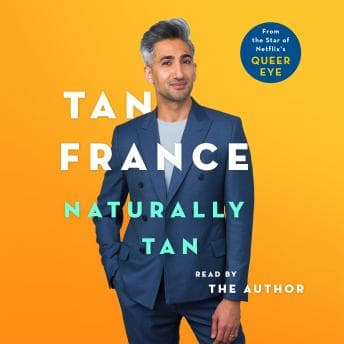

I have a confession. I've been skeptical of celebrity memoirs ever since a certain reality star's ghostwritten book nearly put me to sleep during a particularly brutal faculty meeting. So when I started Naturally Tan while grading sophomore essays on The Great Gatsby at 11 PM, I was bracing myself for seven hours of surface-level celebrity fluff.
I was wrong. Delightfully, unexpectedly wrong.
When the Narrator IS the Story
This is one of those rare cases where author-narration isn't just acceptable—it's essential. Tan France reading his own words transforms what could have been a standard memoir into something that feels like you've been cornered at a party by the most charming person in the room, and you don't actually mind. His Yorkshire accent carries this fascinating blend of British propriety and genuine warmth. When he describes the casual racism of his childhood—being told to "go back where you came from" in the only country he'd ever known—there's a weight in his delivery that no hired narrator could replicate.
And then there's the Antoni Porowski cameo. Their natural banter during the recording is the audio equivalent of watching two friends who genuinely like each other riff in real time. It's unscripted energy that breaks through the usual memoir monotony.
The Bitchy Diary Problem (And Why It's Actually Not a Problem)
Here's where I'll be honest with you. Some listeners have called this a "bitchy personal diary," and I understand where they're coming from. The structure is loose—this isn't a carefully crafted literary memoir with thematic arcs and metaphorical through-lines. Tan isn't Didion. He's not trying to be.
But there's something refreshing about that. The man came out to his Muslim family at 34, after years of hiding who he was while building a fashion empire. He married a Mormon cowboy from Salt Lake City. (I had to pause and process that sentence when I first heard it. A Mormon cowboy. From Salt Lake City. Sometimes life writes better comedy than any novelist could.)
The informal structure actually works because Tan's story doesn't fit into neat narrative boxes. His life has been a series of contradictions—gay and Muslim, British and now American, fashion-obsessed and deeply practical about business. A traditional memoir structure would have flattened those tensions.
What Tan's Really Getting At
Beneath the fashion tips and celebrity anecdotes, there's a genuine exploration of identity formation under pressure. Tan talks about code-switching between his South Asian home life and the white British world outside—something my students from immigrant families understand intimately. He describes learning to perform confidence before he actually felt it, which is basically the thesis of every self-help book ever written, except he's honest about how exhausting it was.
The sections on body image hit harder than I expected. Here's a man whose literal job involves making people look better, and he's candid about his own struggles with how he looks. That vulnerability—delivered in his own voice, with those characteristic pauses and that slightly self-deprecating tone—lands differently than it would on the page.
The Audio Quality Situation
I should mention: some listeners have noted sound quality inconsistencies, and they're not wrong. There are moments where the recording environment seems to shift slightly. It's not egregious, but if you're the type who notices these things, you'll notice. Waste Land had similar production quirks, but the raw emotional honesty made me forget I was even listening to an audiobook. I was too busy being charmed to care much, but your mileage may vary.
Who Will Love This (And Who Should Skip)
If you're a Queer Eye fan, this is obviously for you—it's like an extended episode focused entirely on Tan's backstory. If you appreciate memoirs that prioritize voice over structure, you'll find this engaging. And if you're someone navigating multiple identities—cultural, religious, sexual—there's genuine insight here about how to hold contradictions without breaking.
Skip it if you want literary polish or if informal narration styles make you twitchy. And definitely skip if you're looking for deep fashion expertise—the tips are surface-level, which is fine, because that's not really what this book is about.
Worth Pausing the Faculty Meeting For
By the end, I'd finished grading those Gatsby essays and found myself genuinely moved by Tan's story. Not because it's a literary triumph—it's not. But because it's honest in a way celebrity books rarely are. He talks about suicidal thoughts during his closeted years with the same matter-of-fact tone he uses to discuss French tucks. That tonal consistency, that refusal to perform trauma for the audience, is what makes this work. I heard that same unflinching honesty in Passionate Friends, where the narrator refuses to sensationalize difficult moments.
My students would probably love this. And for once, I wouldn't judge them for it.