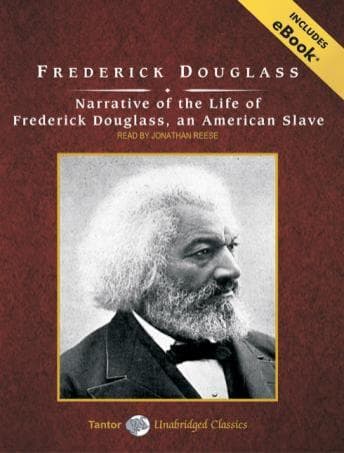

Everyone tells you this is required reading. School assigns it, history podcasts reference it, LinkedIn influencers drop Douglass quotes like they discovered him. And here's the thing - they're all right, but for the wrong reasons. This isn't just an Important Historical Document™. It's a 4.5-hour business case study on how systems of exploitation actually function, told by someone who lived inside the machine.
I put this on during a late Sunday meal prep session - Jenny was out, I had bibimbap ingredients everywhere, and I figured a short classic would be good company. I didn't touch the stove for the last hour. Just stood in the kitchen with a wooden spoon in my hand, listening.
The Original Disruption Playbook
Here's what business school never taught me: Frederick Douglass reverse-engineers slavery like a McKinsey analyst dismantling a broken org chart. He doesn't just describe cruelty - he explains the incentive structures. Why slaveholders deliberately separated mothers from infants. Why they kept slaves ignorant of their own birthdays. Why the "kindest" masters were sometimes the most dangerous to the system's opponents. Every mechanism of control gets examined with surgical precision.
The scene where his slaveholder's wife starts teaching him the alphabet, and her husband shuts it down immediately - Douglass doesn't just recount this as a sad moment. He identifies it as the strategic inflection point of his entire life. The husband's panicked reaction told young Douglass exactly what the path to freedom looked like. That's not memoir. That's competitive intelligence gathered under threat of death.
My parents understood this instinctively. Education as escape velocity. They pressed dry shirts for 14 hours so my sister and I could read whatever we wanted. Douglass taught himself to read by trading bread to white kids in the neighborhood for lessons. Different century, different magnitude of oppression entirely, but that desperate arithmetic of sacrifice for knowledge - I recognized it in my bones.
Where the Audio Gets Complicated
Jonathan Reese brings genuine intelligence to this performance. You can tell he understands the material - his pacing during Douglass's more analytical passages gives you room to absorb the arguments, and he handles the description of Aunt Hester's beating with the gravity it demands without tipping into melodrama.
But - and this is a real but - there are stretches where the audio quality sounds weirdly processed. Almost computerized. I noticed it most during longer passages where Douglass is cataloguing specific abuses. It pulled me out of the text at exactly the wrong moments. At 2.0x, which is my default, it got borderline unintelligible in spots. I dropped to 1.5x and that helped, but it shouldn't require troubleshooting.
Some listeners have called this narration "disrespectful to Frederick Douglass." I think that's too harsh. Reese clearly cares about the material. But the production quality doesn't match his effort, and for a text this important, that's a problem. There are other versions of this audiobook out there, and I'd be lying if I said I wasn't curious whether they solve this issue.
45 Minutes of Insight? Try 4.5 Hours.
Here's where I eat my own words. I'm the guy who says most business books have 45 minutes of insight padded into 8 hours. This book is 4.5 hours with zero padding. Every chapter earns its runtime. Douglass moves from plantation to plantation, owner to owner, and each transition reveals a new dimension of how the system operated. The chapter on the slave-breaker Covey - where Douglass finally fights back - isn't just dramatic. It's the moment where he articulates something I've seen in every turnaround engagement I've ever done: the difference between being broken and choosing not to be.
No frameworks. No "5 Steps to Resilience." Just a man describing the exact moment he decided he'd rather die than remain property. That scene has more leadership insight than the last ten books in my Audible library combined.
The brevity is the point. Douglass wrote this in 1845, when every page could endanger people who helped him escape. Economy of language wasn't a stylistic choice - it was operational security. And it makes for incredibly tight, efficient writing that respects your time in a way modern authors have completely forgotten how to do.
Who Needs This in Their Ears
Anyone who reads business books should listen to this. Not because it's a business book - it's not - but because it will recalibrate your understanding of what "hustle," "disruption," and "self-made" actually mean. If you've ever unironically posted a Gary Vee quote, you need this corrective.
Skip this specific version if audio quality is a dealbreaker for you. The narration is intelligent but the production has real issues. If you can tolerate some rough patches, the content more than compensates.
The Spreadsheet Says Listen
Bottom line: this is a 4.5-hour investment that will rewire how you think about systems, power, and what it actually costs to educate yourself against the wishes of people who profit from your ignorance. Jenny asked me what I was listening to and I just said "the only self-help book that matters." She rolled her eyes. But I meant it. The closest I've come to that same gut-punch reckoning about race, class, and who actually pays the price for whose comfort is Such a Fun Age - lighter in tone, obviously, but Kiley Reid is also quietly dismantling incentive structures and the polite fictions people tell themselves to avoid seeing them.