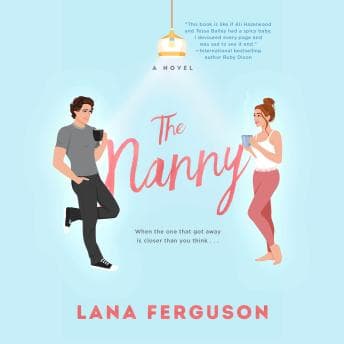

Look, I'll be honest. When people hear "high school English teacher" they don't exactly picture a guy who spent his Saturday afternoon listening to a romance novel about an OnlyFans creator and a hot chef. But Denise and I were driving back from her sister's place in Milwaukee, she was napping in the passenger seat, and I needed something to keep me alert on I-94. So here we are. Me, Marcus Williams, reviewing The Nanny by Lana Ferguson. My students would lose their minds.
Here's the thing everyone seems to agree on: Samantha Summers is having the time of her life narrating Cassie. And that energy is infectious - genuinely. Her read is bubbly and sharp, like she's your best friend telling you this absolutely unhinged story over brunch. She leans into the rom-com energy so hard that the book practically has a laugh track baked in. If you're the kind of listener who wants personality over precision, Summers delivers. She makes Cassie feel like a real person - messy, anxious, funny in that self-aware millennial way.
But then there's Jameson Adams as Aiden, and this is where things get complicated.
The Chef Who Reads Like a Menu
Adams is... fine? He's competent. His voice has the right depth for a single-dad-executive-chef character. But there are stretches - and I noticed this especially during the longer emotional exchanges - where his delivery goes a little flat. Not monotone exactly, but something closer to reading a recipe than feeling a feeling. It's like watching a cooking show where the chef explains the technique perfectly but never actually tastes the food on camera. You believe he knows the words. You're less sure he's living in them.
The contrast between the two narrators is striking. Summers is doing full rom-com theater, and Adams is doing... an audiobook. Both are valid approaches, but together they create this tonal whiplash where Cassie's chapters feel like a Netflix original and Aiden's chapters feel like a different production entirely. It's not a dealbreaker, but it's noticeable. Especially at 1.0x, where every pause and inflection gets its full weight.
The OnlyFans Elephant in the Room
I teach teenagers, so I'm contractually obligated to mention that the premise here is wild. Cassie, broke and desperate, takes a nanny job. Discovers her employer was - how do I put this delicately - a very enthusiastic subscriber to her former adult content. He doesn't recognize her in person. She knows. He doesn't. That's your engine.
And look, as a setup for romantic tension, it works. Ferguson understands that the best slow burns run on dramatic irony - the audience knowing something a character doesn't. Hitchcock talked about this with the bomb under the table. (This reminds me of what Hemingway said about the iceberg theory - what's unsaid carries more weight than what's spoken.) Every interaction between Cassie and Aiden carries this double meaning, this undercurrent of "when is this going to blow up," and for the first half of the book, that tension genuinely kept me engaged through Wisconsin.
The problem is the second half. Once the secret comes out, the book loses its structural advantage. What replaces the dramatic irony is... fairly standard contemporary romance territory. Miscommunication. Fear of vulnerability. A third-act conflict that feels engineered rather than earned. The writing gets cheesy in spots - and I say this as someone who has assigned Romeo and Juliet to sixteen-year-olds for two decades, so my cheese tolerance is high.
Sophie, Aiden's daughter, is a bright spot. She's written with that specific stubborn sweetness that anyone who's spent time around kids recognizes. She's not a prop. She's a character. Ferguson clearly paid attention to how actual children talk and negotiate and wedge themselves into adult situations. That same quality of quiet, lived-in emotional detail is something I noticed in Keeper of Lost Things: A Novel too, where secondary characters are drawn with enough specificity that you feel the author actually spent time watching real people before putting them on the page.
Who Gets a Permission Slip and Who Gets Detention
If you loved The Love Hypothesis or similar contemporary romances where the premise does most of the heavy lifting, this is its spiritual successor. It's fun. It's spicy - genuinely spicy, content warning fully earned there. Summers's narration alone is worth the listen if you vibe with her energy.
But if you're coming in expecting the writing to match the cleverness of the premise, you might hit the same wall I did around hour nine. The dialogue can feel sitcom-adjacent in ways that work sometimes and grate other times. And the swearing - I'm no prude, I teach in Chicago public schools - but it occasionally feels scattered in for flavor rather than character voice. Like hot sauce on a dish that didn't need it.
At 13 hours, it's a commitment. Not an unreasonable one, but I'd have trimmed a couple hours from the middle without losing anything essential.
Worth Pausing the Faculty Meeting For?
Almost. Not quite. It's a fun listen with a killer premise and one genuinely excellent narrator performance. But the uneven dual narration and a second half that can't sustain the tension of the first keep it from being something I'd spend a credit on. Stream it. Enjoy Summers. Appreciate that Ferguson had a truly inspired idea even if the execution doesn't always match. And if Principal Martinez asks, I was definitely not listening to a romance novel about OnlyFans during the budget meeting. (I was.)