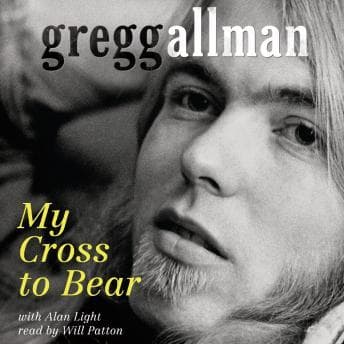

Look, I need to complain about something first: Gregg Allman did not have to go that hard on the parts about his kids. I was three hours into a client's rebrand project, headphones in, vibing to what I thought would be a classic rock-and-roll romp through the seventies — and then he starts talking about trying to reconnect with his children after years of addiction and absence, and I'm sitting here at my desk with tears dropping onto my Wacom tablet while Frida stares at me like I've lost my entire mind.
So. Yeah. This book got me.
The Ghost of Duane Runs Through Everything
Here's what surprised me: I went in expecting Cher stories. I expected groupies and tour bus chaos and maybe some juicy drama about the Southern rock scene. And that stuff is there — Gregg doesn't hold back on any of it. The Cher marriage gets its chapter, the substance abuse is unflinching, the revolving door of relationships is laid bare. But the thing that actually haunts this book, the thing that sits underneath every single chapter like a bass note you can feel in your chest, is Duane. His brother's death at 24 in a motorcycle accident in 1971 — it's the fracture line that runs through Gregg's entire life. He keeps circling back to it. Not in a dramatic, look-how-tragic-I-am way, but in this quiet, almost confused way, like he still can't believe it happened. Like he's still waiting for Duane to walk into the studio.
And the way Will Patton reads those sections — god. That Southern drawl he uses, which apparently sounds genuinely close to Gregg's own voice, gets this slight crack to it when the material turns to Duane or to the kids. It's not actorly crying or dramatic pausing. It's subtler than that. Just a heaviness that creeps in. The kind of weight that tells you this narrator understood the assignment on a bone-deep level.
Will Patton's Voice Is Whiskey and Red Georgia Dirt
I wasn't expecting to love the narration this much. Will Patton isn't someone I'd have picked for this — I associate him more with films than audiobooks — but his voice has this weathered, lived-in quality that fits Gregg Allman's story like a broken-in leather jacket. The Southern cadence never feels put on. It feels like someone telling you their life story on a back porch at dusk, and you're just sitting there listening because what else would you possibly be doing.
There's no music in the production, which — okay, for a book about one of the greatest blues-rock musicians in American history, that feels like a missed opportunity. I would've killed for even a few seconds of "Whipping Post" or "Melissa" woven in somewhere. But Patton's delivery is strong enough to carry it solo. When Gregg talks about hearing a particular song come together in the studio, or the first time the band played and everything clicked, Patton's voice gets this warmth that almost fills the gap. Almost.
At 10 hours, the pacing feels right. Not rushed, not bloated. I listened at my usual 1.0x and it moved like a long conversation — the kind where you look up and realize it's 2 AM and you're still talking.
The Parts Abuela Would've Clutched Her Rosary
The substance abuse sections are raw. Not glamorized, not moralizing. Gregg talks about his addiction like someone who spent decades surviving it and is just now, at the end, looking back with something between exhaustion and amazement that he's still here. (He passed in 2017, five years after this book came out. Knowing that while listening adds another layer of weight.) The marriages — there were six, including Cher — are handled with more honesty than bitterness, though you can hear the regret threading through.
But it's the family reconciliation stuff that wrecked me. When he talks about trying to be a father to children he barely knew, children who grew up watching him choose substances and the road over them — that's where the book stops being a rock memoir and becomes something painfully, universally human. I kept thinking about my own family, about Abuela, about all the ways we try to fix things that might be too broken, and how trying anyway is maybe the bravest thing a person can do.
This book felt like sitting with someone who's done terrible things and knows it and isn't asking for forgiveness — just asking to be heard.
Who Needs This in Their Ears
If you're an Allman Brothers completist, obviously. But honestly? You don't need to know a single song. This is for anyone who's ever watched someone they love destroy themselves slowly, or who's wondered if it's too late to fix what you broke. Wild Swans broke me open in that same specific way — three generations of women asking that same impossible question across an entirely different century and continent. Rock fans will love the behind-the-scenes stuff — the early days in Georgia, Capricorn Records, the insane touring schedule. But the emotional core transcends genre.
Skip it if you want a polished, structured narrative. This is messy and circular the way real memory is. Some people will find that frustrating. I found it honest.
My Heart Needed This Ugly-Cry
Gregg Allman didn't write a redemption arc. He wrote a life — complicated, damaged, sometimes beautiful, often painful. Will Patton delivered it with exactly the kind of quiet emotional intelligence that makes me trust a narrator completely. I finished it at midnight, closed my laptop, and just sat with Diego purring on my lap in the dark for a while.
Abuela would have loved this one. She always had a soft spot for men who were honest about being broken.







![Steve Jobs [unabridged audiobook] audiobook cover](/_next/image?url=https%3A%2F%2Fcovers.audiobooks.com%2Fimages%2Fcovers%2Ffull%2F9788499923406.jpg&w=1920&q=75)