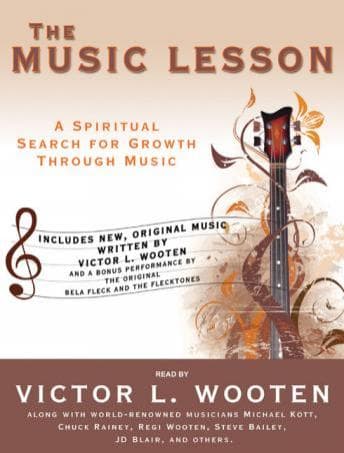

Victor Wooten's The Music Lesson is not a music instruction book. It's a psychology book wearing a bass guitar.
I was chopping onions for chana masala on a Sunday evening — my weekly ritual of cooking something ambitious for one — when the teacher character, Michael, first appeared in Wooten's apartment unannounced. And I found myself asking: why does this narrative device feel so familiar? Because it is familiar. The mysterious guru who materializes to impart wisdom is practically an archetype — think Socrates in The Way of the Peaceful Warrior, think every mentor figure from Carlos Castaneda's work. The protagonist exhibits classic resistance-to-change patterns: he thinks he needs better technique, but what he actually needs is a fundamental shift in how he relates to music, to failure, to himself.
Some listeners call the New Age framing "corny." And yeah, I get it. Characters appearing and disappearing with no logical explanation, mystical encounters that feel more like a spiritual parable than a memoir — it's a lot. But here's the thing. Psychologically, this tracks. Wooten is doing something deliberate. He's using narrative distance to smuggle in genuinely profound ideas about creativity, ego, and growth that would feel preachy in a straight nonfiction format. My therapist would have thoughts about the way Wooten's fictional self clings to technical perfection as a defense mechanism against vulnerability. I had thoughts about it too, standing there with burning eyes (the onions, not crying — okay, maybe a little).
When the Medium Becomes the Message
Here's what makes the audiobook version special and — I don't say this lightly — possibly the only way to experience this book. The narration is handled by eleven different people, many of whom inspired the actual characters. Victor Wooten narrates the main thread, but Chuck Rainey, Steve Bailey, JD Blair, and members of Wooten's own family voice the characters they helped create. This isn't your standard multi-narrator production where different actors are assigned roles. These are the real people behind the fiction. The result is something closer to a radio play than an audiobook, and the conversations between teacher and student carry a warmth and authenticity that would be impossible to manufacture with hired voice actors.
And then there's the music. Original compositions by Wooten woven throughout the listening experience, plus a bonus performance by Béla Fleck and the Flecktones. When the book talks about groove, about space between notes, about how silence is as important as sound — you hear it demonstrated in real time. At 7 hours and 30 minutes, it's not a massive time commitment, but it's dense. This isn't background listening. You need to actually pay attention because the philosophical ideas build on each other, and the musical interludes aren't decoration, they're curriculum.
The Psychology of Why "Just Practice More" Doesn't Work
What makes this book compelling from a research perspective is Wooten's intuitive grasp of what psychologists call self-determination theory. The lessons Michael teaches — about playing music for connection rather than validation, about letting go of the need to be "correct" — map almost perfectly onto the research on intrinsic versus extrinsic motivation. The research actually shows that once you start performing for external approval, your creativity tanks. Wooten dramatizes this without ever citing a single study, and honestly? He makes the case more persuasively than most academic papers I've read. (Including mine. Especially mine.)
The book covers ten elements of music — notes, articulation, technique, emotion, dynamics, rhythm, tone, phrasing, space, and listening — but treats each one as a metaphor for how we approach life. It's a fascinating case study in how people resist the lessons they most need to learn. Wooten's protagonist keeps wanting concrete answers and keeps getting koans instead. The frustration feels genuine, not performed.
Now — is some of it heavy-handed? Sure. There are moments where the mystical elements strain credulity past the breaking point, and if you have zero tolerance for spiritual philosophy mixed with your music theory, you're going to have a rough seven hours. But I'd argue that discomfort is kind of the point. The book is asking you to sit with uncertainty, which is precisely what most of us are terrible at.
Who Gets the Most Out of This
Musicians will find the most immediate practical value here, but honestly, anyone interested in the psychology of learning, creativity, or perfectionism will find something worth chewing on. Skip it if you want a literal how-to guide for bass technique — this isn't that. Skip it if mystical-teacher narratives make you physically recoil. But if you've ever been stuck in the loop of "I need to be better before I can really start" — in music, in writing, in anything — this is a fascinating case study in breaking that pattern.
The audiobook format is the definitive version. Reading this in print without the music would be like studying oceanography in a desert.
My Clinical Assessment (Not That Anyone Asked)
I finished it while the chana masala simmered, sat in my kitchen in Cambridge, and immediately replayed the section on space and silence. Not because I play bass — I don't — but because Wooten articulated something about the fear of pausing, of not filling every moment with effort, that hit uncomfortably close to home. Pretty much every overachiever I know, myself included, could use that lesson. The production is a genuine achievement: an AUDIE Award finalist for good reason. This is what happens when the people who lived the story are the ones who tell it. The raw, unguarded quality of a life told by its actual owner is something Me: Elton John Official Autobiography also delivers in spades — and Elton's narration carries that same sense of a person who has genuinely metabolized their own mythology.









