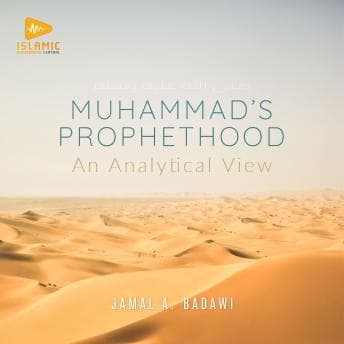

Look, I'll be honest - when I saw this was under an hour long, I almost dismissed it. Fifty-three minutes? That's barely a commute. But here's the thing about academic arguments: sometimes brevity is the point. Dr. Badawi isn't trying to write an exhaustive biography. He's constructing a case. And as someone who's spent two decades teaching kids how to build an argument, I can appreciate the craft here.
I listened to this while grading a stack of sophomore essays on The Great Gatsby - yes, the irony of analyzing one text while absorbing another isn't lost on me - and what struck me was how methodically Badawi approaches his subject. This isn't devotional literature dressed up as scholarship. It's genuinely analytical, which is refreshing in a genre that often leans heavily on faith-based assumptions.
The Rational Framework That Actually Works
What Badawi does well is something I wish more of my students understood: he anticipates counterarguments. The questions he poses - Was Muhammad a true prophet or an imposter? Did he unconsciously fabricate a religion? Is the Qur'an plagiarized from Judeo-Christian sources? - these aren't softballs. They're the actual critiques that orientalists and missionaries have leveled for centuries.
Rather than getting defensive or dismissive, Badawi engages them directly. There's something almost Socratic about his approach. He presents the skeptical position fairly before dismantling it. My students would probably hate this method because it requires patience. I love it for exactly the same reason.
The content itself is dense for its runtime. Don't let the short duration fool you into thinking this is surface-level. Badawi packs a lot of comparative religious analysis into under an hour, drawing on historical sources and logical frameworks. It's the kind of material that rewards a second listen - preferably without the distraction of explaining to a sixteen-year-old why "Gatsby was rich and sad" isn't a thesis statement.
Wes Malik's Measured Delivery
Wes Malik has a voice that works for this material - clear, steady, with a soothing quality that keeps the academic content from feeling like a lecture. (And I say this as someone who gives lectures for a living. I know when something sounds like homework.)
The pacing is deliberate, which matches Badawi's methodical argumentation. This isn't the kind of book that needs dramatic vocal shifts or character voices - it's a sustained intellectual argument, and Malik treats it as such. Some listeners have noted his accent might take a moment to adjust to, but honestly, I found it added authenticity to the subject matter.
Where the narration could improve: there's not much vocal variety when Badawi shifts between presenting opposing viewpoints and offering his own analysis. A bit more tonal distinction there would help listeners track the argumentative structure. But this is a minor quibble for what is essentially a straightforward reading of scholarly material.
Who This Is (and Isn't) For
Here's where I'll be direct, because I think this matters: this audiobook has a specific audience, and it's not everyone.
If you're a believer looking for devotional reinforcement, this might feel too detached and academic. If you're a skeptic looking to have your criticisms validated, you won't find that here either. What you will find is a Muslim scholar engaging seriously with Western critiques of Islamic prophethood.
For comparative religion enthusiasts, students of Islamic history, or anyone interested in how faith traditions defend their foundational claims through reason rather than just revelation - this is worth your hour. It sits nicely alongside works like Martin Lings' biography of Muhammad, though Badawi is more argumentative where Lings is more narrative. That same analytical rigor—building a case through evidence rather than emotion—shows up in Gambler: Secrets from a Life at Risk, though obviously in a wildly different context.
The production quality is clean, if basic. No music, no sound effects, no bonus content. Just the text, delivered competently. For academic material, that's exactly what you want.
Walking It Off by the Lake
I finished this during my walk along the lakefront - Denise was ahead of me, probably grateful I wasn't talking about Faulkner for once - and I found myself thinking about how we teach argumentation. Badawi models something valuable here: engaging your critics on their own terms, using their frameworks to make your case.
Is it going to convert skeptics? Probably not. Is it going to deepen believers' faith? Maybe, though that doesn't seem to be its primary goal. What it does is demonstrate that religious claims can be subjected to rational analysis without the analysis being inherently hostile.
At under an hour, it's a low-commitment listen. But it's the kind of material that sticks with you longer than its runtime suggests. Worth it if you're in the market for thoughtful religious apologetics that doesn't insult your intelligence.