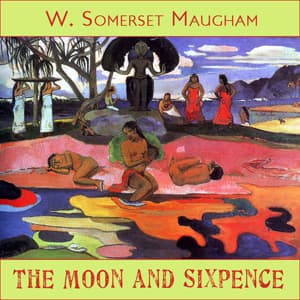

Maugham wrote the cruelest character study of the twentieth century and disguised it as a novel about art.
I'd been meaning to get to The Moon and Sixpence for years. It's one of those books I'd assigned excerpts from, talked about in class when discussing the Gauguin myth, referenced in my podcast episode on artistic obsession - but never actually sat with from beginning to end. Denise and I were driving back from visiting her sister in Milwaukee, two hours of flat highway ahead, and I figured it was time. By the time we hit the Wisconsin-Illinois border, I was genuinely angry at Charles Strickland. By the time we got home, I was angry at Maugham for making me understand him anyway.
The Most Unlikable Man in Fiction (And Why You Can't Look Away)
Let me be clear about something: Strickland is not a tortured genius you're meant to sympathize with. He's a stockbroker who abandons his wife and children with the emotional warmth of someone returning a library book. Maugham doesn't soften this. He doesn't give you a childhood trauma to explain it away. Strickland simply decides he must paint, and every human relationship becomes kindling for that fire. His wife Amy gets some of Maugham's sharpest writing - her shift from abandoned spouse to bitter social performer is so precise it made me wince. This reminds me of what Hemingway said about the iceberg theory, except Maugham isn't hiding the cruelty beneath the surface. He's laying it right on the table and asking you to keep eating.
What makes this more than just a character assassination is the unnamed narrator. He's Maugham's brilliant trick - this mild, reasonable English writer who keeps getting pulled into Strickland's orbit against his better judgment. He's us. He knows Strickland is monstrous. He watches Strickland destroy Dirk Stroeve's marriage with the casual indifference of someone stepping on an insect, and still - still - he can't stop being fascinated. White Tiger does something similar - Balram Halwai is also a man you shouldn't root for, and Adiga makes you root for him anyway, which is its own kind of authorial cruelty. That tension between moral revulsion and aesthetic awe is the entire engine of the book, and at under eight hours, Maugham never lets it idle.
The Narrator Understands That Pause Is Punctuation
So here's the thing about this recording - Termin Dyan is apparently Andy Minter under another name, and whoever he is, the man gets Maugham's rhythm. Maugham writes in this deceptively simple prose that's actually doing enormous work in the silences between observations. Dyan doesn't rush those silences. He reads like someone who trusts the text, which is exactly what this book needs.
I don't have a lot of specifics on character differentiation because this is a LibriVox recording, not a big-studio production, and it shows in the expected ways - the audio is clean but unadorned, no music, no effects, just one voice and Maugham's sentences. But honestly? That stripped-down quality works here. The novel is already structured as one man telling you a story, so the single-narrator intimacy feels right. Dyan's pacing through the Tahiti sections - where the prose loosens and the descriptions of light and color get almost hallucinatory - slowed down just enough that I could feel the shift in atmosphere. The prose deserves to be savored, and he lets you.
I will say this: if you're used to Audible productions with distinct vocal characterizations for every speaking part, adjust your expectations. This is a reader, not a performer, and the difference matters. But it's a good reader.
What Maugham Is Really Saying (And Why My Students Would Hate It)
Let's talk about what the author is really saying, because the Gauguin connection is both the hook and the trap. Yes, Strickland is loosely based on Gauguin. Yes, there's the flight to the South Pacific, the painting, the leprosy. But Maugham isn't writing biography. He's asking an uncomfortable question: does genius excuse destruction? And his answer - delivered through that final devastating image of Strickland's masterpiece painted on the walls of his hut, ordered burned after his death - is essentially: it doesn't matter. Beauty exists whether we deserve it or not.
My students would hate this. They'd want Strickland punished, or redeemed, or explained. Maugham refuses all three. The leprosy isn't karma; it's just disease. The art isn't redemption; it's compulsion. And Strickland dies blind and rotting in a hut, having painted something transcendent on walls no one will ever see. If you loved A Portrait of the Artist as a Young Man, this is its spiritual successor - except Joyce at least let Stephen Dedalus keep his eyesight.
Who This Is For (And Who Should Walk Away)
If you want likable characters, skip this entirely. If you want a book that flatters the idea of artistic passion, keep walking. But if you want to sit with a genuinely difficult question about what we owe each other versus what we owe ourselves - and you want Maugham's cool, surgical prose delivering it at a perfect 7 hours and 52 minutes - this is worth your time. The LibriVox recording won't win any production awards, but it's free and it's honest, and so is the book.
Worth pausing the faculty meeting for. (Sorry again, Principal Martinez.)
The Annotation in the Margin
This is why we still read the classics. Not because they're comfortable or aspirational, but because a book written in 1919 can still make you argue with your wife about whether selfishness and vision are the same thing on a highway outside Kenosha. We didn't resolve it. I don't think Maugham wanted us to.