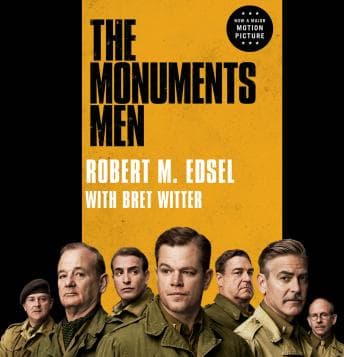

"The first to go in, and the last to come out." That's how the Monuments Men described their mission - entering towns still under fire, sometimes before the combat engineers had even cleared the roads, all to save a painting or a cathedral. I was listening to this one at about 2 AM, couldn't sleep - Ranger was sprawled across the foot of the bed and Linda was dead to the world - and something about that line just stopped me cold. Because I've been the guy going in first. But never for a Vermeer.
When the Mission Briefing Is the Best Part
Let me cut to the chase: the story Robert Edsel tells here is genuinely extraordinary. Six men - museum directors, curators, art historians - essentially talked their way into a war zone with minimal training, no real authority, and almost no resources. The Army treated them like an afterthought, which honestly tracks with how the military handles anything that doesn't fit neatly into the org chart. I've seen this scenario play out in real life - guys with specialized knowledge getting shuffled around because nobody in the chain of command knows what to do with them.
Edsel focuses on the eleven months between D-Day and V-E Day, and there's genuinely riveting material here. The discovery of art cached in German salt mines. The race against Soviet forces who were claiming everything as war reparations. The sheer bureaucratic nightmare of trying to catalog and protect thousands of works while the war was still actively destroying the buildings they were stored in. The author clearly did their homework - you can feel the years of research behind every chapter.
But here's where it gets complicated. Edsel tries to follow six different Monuments Men simultaneously across the European theater, jumping between them chapter by chapter. It's an ambitious structural choice, and at 14 hours, it starts to feel like tracking six different patrols on a radio net where everyone's call signs sound the same. By hour seven or eight, I was genuinely struggling to remember which guy was in Belgium and which was chasing leads in southern Germany. The book needed a tighter focus - maybe three men, maybe two - or it needed a stronger through-line connecting the threads.
Jeremy Davidson and the Accent Problem
Worth your time? Here's the debrief on the narration: Jeremy Davidson has a solid baseline voice for nonfiction. He reads with appropriate weight, varies his pacing well between action sequences and the more administrative passages (and there are plenty of those - requisition forms don't narrate themselves). When he's just telling the story straight, he's perfectly serviceable.
But then the accents start. His attempts at German pronunciations are rough - and in a book where every other name is German, that's a real problem. We're talking about well-known places and historical figures getting mangled. If you call a magazine a "clip," I'm already annoyed - same principle applies when you butcher the pronunciation of cities that any history buff would know. And his British accent work... look, one reviewer said he thinks he's Olivier, and that's not entirely unfair. It's distracting in the way that a bad toupee is distracting - you can't stop noticing it even when you're trying to focus on what matters.
At 1.25x speed, some of the accent issues actually smooth out a bit - the exaggerated quality gets compressed into something slightly more tolerable. Small mercy.
Art History as Tactical Intelligence
What kept me engaged despite the structural sprawl and the narrator hiccups was the fundamental tension at the heart of this story: is art worth dying for? Two Monuments Men actually did die. And the question isn't academic when you're standing in front of a burning church that contains an altarpiece that's survived 500 years. I spent 25 years protecting things - people, territory, national interests. The idea of protecting culture as a strategic objective is fascinating, and Edsel makes a solid case that the Monuments Men's work was among the most important of the entire war effort. Not because a Michelangelo is worth more than a soldier's life, but because destroying a civilization's art is its own form of warfare.
The sections on Hitler's planned Führermuseum in Linz and his systematic cataloging of art to steal versus art to burn are chilling. That's where Edsel is at his best - connecting the art theft to the broader machinery of totalitarianism. That same impulse to illuminate the stranger-than-fiction corners of American and world history is what drives Miracles and Massacres, though that one casts an even wider net across overlooked episodes - with mixed results.
Who Should Saddle Up (And Who Should Stand Down)
WWII history buffs who've already covered the major campaigns and want a different angle - this is your book. Same for anyone interested in art history who can stomach the military context. If you're coming in expecting a thriller with constant action, recalibrate your expectations. This is more staff meeting than firefight, with bursts of genuine danger.
If mispronunciations are a deal-breaker for you (and I get it - they are for me with military terminology), the narration might push you toward the print version instead.
Mission Debrief
Good story, imperfect delivery. The kind of book where you walk away knowing something important about the war that most people never learn, even if you had to fight through some rough audio patches to get there. Ranger slept through most of it, but he perked up during the salt mine sequences. Even he knows when the stakes are real.