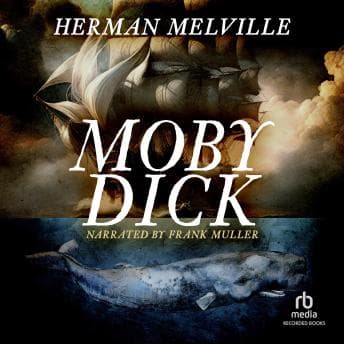

Twenty-one hours. That's how long it took me to understand why I've been teaching this novel wrong for fifteen years.
I started this audiobook during a particularly brutal stretch of grading junior essays on symbolism - the irony of reading their surface-level takes on the white whale while Frank Muller whispered Melville's actual intentions into my ears was not lost on me. By hour three, walking the lakefront with Denise on a Sunday morning, I found myself stopping mid-stride during Ahab's first real speech. She asked if I was okay. I wasn't. I was reconsidering my entire curriculum.
What the Classroom Gets Wrong
Here's the thing about teaching Moby Dick - we reduce it to symbols. White whale equals obsession. Pequod equals America. Ahab equals hubris. Check, check, check, move on to the quiz. But Muller's performance exposed something I'd forgotten: this is a comedy. Ishmael is funny. His observations about Queequeg, his dry asides about the whaling industry, his philosophical tangents that feel like a 19th-century podcast - Muller delivers these with timing that made me laugh out loud during a faculty meeting. (Sorry, Principal Martinez. I was definitely not listening to your budget presentation.)
The comedic timing in Ishmael's voice versus the gradual descent into Ahab's obsessive register creates this tonal whiplash that mirrors the novel's structure. You're chuckling at a digression about whale taxonomy, and then suddenly Muller's voice drops into something haunted, something inevitable, and you remember - oh right, everyone dies.
The Anatomy of Patience
Let's talk about the whale chapters. The cetology. The spermaceti. The rendering of blubber. My students would hate this. I love it.
Muller does go somewhat monotone during these technical passages - and honestly? That's correct. These chapters are Melville's meditation on work, on process, on the way obsession requires you to know everything about your subject. Speeding through them at 1.25x, as some suggest, misses the point entirely. The prose deserves to be savored. Though I'll admit, around hour twelve, during an extended discussion of whale bone structure, I did pause to refill my coffee. Twice.
There are reported audio skips in some editions, particularly during intense passages. I caught one during the storm sequence that pulled me out of the narrative like a needle scratch on vinyl. Frustrating, but not ruinous.
Muller's Ahab Is a Tragedy You Can Hear
This is why we still read the classics - because every generation needs to hear what obsession sounds like. Muller's Ahab isn't a cartoon villain. He's a man who has reasoned himself into madness, and you can hear the logic in his voice even as it curdles into something monstrous. The "Whiteness of the Whale" speech - and if you've only read it, you haven't experienced it - becomes this philosophical horror show in Muller's delivery. He understands that pause is punctuation.
His accent work for the multicultural crew of the Pequod creates an immediate sense of this floating world - Queequeg's island cadence, Stubb's New England practicality, Flask's working-class directness. Yes, he mispronounces some nautical terms (I caught "gunwale" rendered oddly), but these are minor stumbles in a marathon performance.
Some listeners find his dramatic delivery over-the-top. I'd argue they're listening to the wrong book. Moby Dick is operatic. It demands theatrical commitment. Muller gives it.
Who Should Chase This Whale (And Who Should Stay Ashore)
If you loved The Count of Monte Cristo's patient revenge arc, this is its spiritual successor on the sea. That same operatic scope shows up in Dune, where Herbert builds an entire universe with the same obsessive detail Melville brings to whaling. Skip this if you want plot-driven action - you'll be checking your phone by hour five. This is a book that requires focus. I wouldn't recommend it for background listening or workouts. It demands your attention the way Ahab demands his crew's loyalty: completely, unreasonably, and with the promise of something profound at the end.
The AudioFile Earphones Award is well-deserved. This is the definitive audio version of America's definitive novel.
Worth Pausing the Faculty Meeting For
I finished the final confrontation at 11 PM, papers ungraded beside me, and sat in silence for a long time. Denise asked what was wrong. I told her I'd just watched a man destroy himself and everyone around him for something he could never possess, and that I'd been teaching it as a symbol when it was always a warning.
My students will get a different lecture this fall. They'll probably still hate the whale chapters. But maybe - just maybe - they'll understand why we still chase white whales, and why that chase always ends the same way.