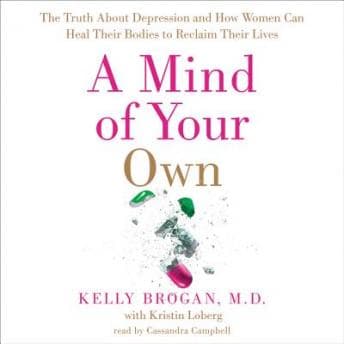

Look. I'm a software engineer who spent four years studying cognitive neuroscience adjacently through a CS degree. I debug distributed systems for a living. So when someone tells me that depression is "not a disease" but a "lifestyle crisis," my BS detector doesn't just go off — it throws a stack trace.
And that's basically where I landed with this book for about 10 hours of my commute.
The Part Where I Almost Rage-Quit at Millbrae Station
Dr. Kelly Brogan has legitimate credentials — MIT, Weill Cornell, board certified in psychiatry. Which is what makes this book so frustrating. She takes real, interesting research threads — the gut-brain axis, the role of inflammation in mood disorders, thyroid dysfunction being misdiagnosed as depression — and then yanks them so far past what the evidence supports that I found myself stress-gripping my phone on a packed Caltrain car.
The core argument: antidepressants are overprescribed (true, and well-documented), the chemical imbalance theory of depression is oversimplified (also true, most psychiatrists agree now), and therefore you should go off your meds and do her 30-day diet-and-detox protocol instead. That logical leap? That's where the distributed system fails. You can't just go from "SSRIs are imperfect" to "SSRIs are permanently disabling your body's self-healing potential" without, you know, robust evidence. She cherry-picks studies the way a junior dev cherry-picks commits — technically valid individual pieces, but the resulting build doesn't compile. I ran into a similar frustration with In the Weeds — another book where the author's real-world credibility kept making me want to trust conclusions that the underlying evidence simply didn't support.
Specifically, she cites a lot of observational studies and case reports as though they're randomized controlled trials. There's a section where she discusses gluten sensitivity and depression that conflates correlation with causation so hard I actually paused the audiobook and Googled the original papers. Some of them don't say what she says they say. As someone who reads whitepapers for fun (yes, Kevin judges me), this drove me up the wall.
What's Actually Useful Under the Hood
Here's the thing — buried inside the ideology, there IS a reasonable kernel. The 30-day plan itself isn't crazy: cut processed food, reduce sugar, prioritize sleep, manage blood sugar, eat more whole foods, supplement vitamin D and B12, meditate. None of that is bad advice. It's basically "take care of your body and your brain might feel better," which... yeah. The chapters on gut health and the microbiome are genuinely interesting if you treat them as "here's emerging research" rather than "here's settled science."
And her point about women specifically being overprescribed antidepressants for things like PMS, perimenopause symptoms, and grief? That's a real, important conversation. She's right that the medical system often hands women an SSRI when what they actually need is a thyroid panel, a hormone workup, or just someone to take their symptoms seriously. That part landed. Hard.
But she undermines her own credibility by going full anti-pharma, anti-fluoride, and veering into territory that felt less "evidence-based psychiatry" and more "wellness influencer." The book would've been 10x stronger if she'd said "AND sometimes you also need medication" instead of treating pharmaceutical intervention as the enemy.
Cassandra Campbell Does Her Job (Admirably)
Cassandra Campbell narrates with the kind of clean, steady professionalism that works well for nonfiction — she was actually nominated for an Audie for this one. Her pacing is even, her pronunciation of medical terminology is solid, and she makes dense sections about cytokines and methylation listenable at 6 AM. She doesn't inject drama where there isn't any, which I appreciate. This isn't a book that needs theatrical performance — it needs clarity, and she delivers that.
That said, there's nothing about her performance here that made me sit up and take notice. It's competent. Professional. The audiobook equivalent of well-documented code: does exactly what it's supposed to, nothing more.
I listened at 1.5x, my default, and it tracked fine. The 30-day plan section in the back half is pretty prescriptive and list-heavy, which is always a little awkward in audio format — you'll want the companion PDF or the physical book for that part.
Perfect For: People Who Want a Second Opinion. Skip For: People Who Might Stop Their Meds.
This is the part where I get genuinely worried. If you're someone with mild, situational depression who wants to explore lifestyle interventions alongside (ALONGSIDE) professional treatment — okay, there are useful ideas here. But if you're someone in a dark place who reads the subtitle "How Women Can Heal Their Bodies to Reclaim Their Lives" and thinks this book is telling you to flush your Zoloft? Please don't. The book is irresponsible in how little it emphasizes the danger of unsupervised medication discontinuation, and that's not a minor quibble.
The ROI Calculation
TL;DR: Interesting premise, some good nutritional science, undermined by ideological overreach and cherry-picked evidence. Solid narration that makes dense material accessible. The ROI on this audiobook is... mixed. You'll get some genuinely useful health information, but you'll spend significant mental energy filtering signal from noise. And for a book about mental health, asking your listener to do that much cognitive labor feels like a design flaw.
I finished this in 5 commutes. Could've been a (long) blog post — or better yet, three separate, more honest books: one on gut-brain research, one on women's health gaps, and one on anti-inflammatory eating. Bundled together with an anti-pharma thesis holding them together, it's less than the sum of its parts.