
So here's the thing people don't tell you about Brian Weiss: if you come at his work from a clinical psychology background, your eyebrows are going to spend a lot of time near your hairline. I knew this going in. I'd heard colleagues reference Many Lives, Many Masters with the same tone my mother uses when talking about her astrologer — reverent, certain, slightly defensive. And yet I found myself downloading Messages from the Masters at 1 AM during one of those sleepless nights where your brain won't stop cataloging everything you haven't finished writing. My therapist would have thoughts about that timing.
Let me be upfront: I didn't come to this book as a believer. I came as someone who studies why people believe.
A Yale-Trained Psychiatrist Walks Into a Past Life
What makes Weiss interesting as a case study — and I mean him, not just his patients — is the trajectory. Columbia undergrad, Yale Medical School, chairman of psychiatry at Mount Sinai in Miami. The man had every institutional credential designed to inoculate someone against exactly the kind of claims he ended up making. The protagonist of this story exhibits classic cognitive dissonance resolution: when your patient channels information about your dead son that she couldn't possibly know, you either dismiss the experience entirely or you restructure your worldview. Weiss chose door number two.
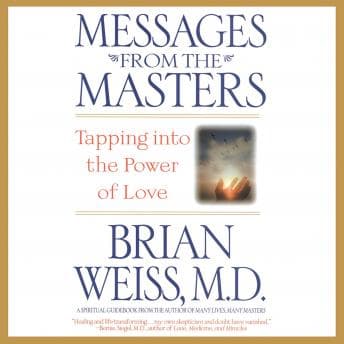
The book expands on themes from his earlier work, presenting "messages" from spiritual entities encountered during past-life regression therapy. At three hours, it's barely a commitment — more like a long conversation than a deep dive. And that's both its strength and its limitation. Weiss covers love, fear, healing, the nature of the soul, but he moves through these enormous concepts with the pacing of someone summarizing a weekend workshop. I found myself asking: why does he rush past the clinical details that would make this more credible and linger on the spiritual aphorisms?
Psychologically, some of it doesn't track for me. The regression accounts are presented without the messy ambiguity that real therapeutic breakthroughs contain. Everything is too clean, too neatly packaged. Where's the patient who regresses and gets nothing? Where's the session that fails? The research actually shows that memory is reconstructive, not reproductive — we build narratives that serve our current emotional needs. Weiss acknowledges his initial skepticism but never really grapples with the alternative explanations a scientist should consider.
But — and this is the part that surprised me — I'm not sure that matters for what this book is actually doing.
When the Author IS the Narrator (and the Therapist)
Weiss narrates this himself, and honestly? It works in ways a professional narrator couldn't replicate. His voice has this steady, low, almost hypnotic quality — the cadence of someone who has spent decades talking people into relaxed states. There are moments where the "messages from the Masters" are delivered in this quiet, deliberate rhythm that genuinely shifts your breathing. I caught myself standing completely still in my kitchen, wooden spoon in hand, dal absolutely burning, because his delivery of a passage about releasing fear had this strange physiological pull.
Is that therapeutic skill or good audiobook performance? Maybe there's no difference here. The man sounds like your most reassuring professor at 2 AM telling you everything will be okay. No vocal fireworks, no character voices — this isn't that kind of book. It's one man, one microphone, and a very specific kind of calm authority.
The weakness is the flip side of that same quality: at three hours of unbroken, soothing monotone, there's a real risk of it becoming background noise. I had to actively resist letting it wash over me without engaging critically. Which, I suspect, is exactly how some listeners prefer to experience it. Arnold Bennett made a similar argument about passive consumption in How to Live on Twenty-Four Hours a Day — that the real danger isn't wasting time, it's letting your mind go slack while technically doing something.
Who This Is Actually For (And Who Should Keep Walking)
If you're looking for rigorous science, peer-reviewed methodology, or anything that would survive a psychology department journal review — this isn't it. If you're a skeptic hoping to be convinced by evidence, you'll leave frustrated. Weiss makes claims and presents anecdotes, but the epistemological framework is faith-based, not empirical.
But if you're someone already open to spiritual frameworks, grieving, anxious, or just looking for something that functions like a guided meditation with narrative structure — this is a fascinating case study in how a clinician's authority can make metaphysical ideas feel safe to explore. The listeners who love this book love it, and I think that's because Weiss gives them permission to believe something comforting from a voice they associate with medical legitimacy.
My mother would adore this book. She'd listen once and then make me listen to her favorite parts over the phone. "See, beta, even the doctor says love is everything." And honestly? She wouldn't be wrong about what Weiss is saying. She'd just be skipping the part where I argue about methodology.
The Case File Stays Open
I can't rate this purely on scientific merit — it would fail. I can't rate it purely on emotional impact — it would soar. So I'm splitting the difference. Messages from the Masters is a short, soothing, author-narrated experience that does exactly what it promises if you meet it where it is. At three hours, it's barely asking for your time. Whether it earns your belief is a different question entirely.