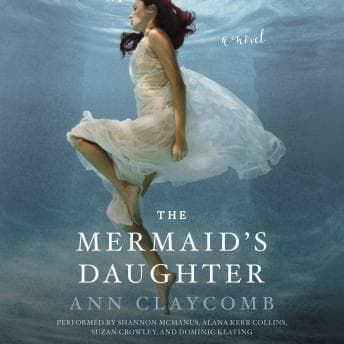
I was sitting in the break room at 2 AM, eating cold lumpia my mom packed me (yes, I'm 38 and my mother still sends me to work with food), and I had about twenty minutes before I needed to chart on a post-op patient. I'd been listening to The Mermaid's Daughter on my drive in and I couldn't stop thinking about it. Specifically about Kathleen's feet. The stabbing pain with no medical explanation, the way no drug touches it, the doctors shrugging and moving on. As someone who's actually worked with patients in unexplained chronic pain - the ones who cycle through the ER and everyone starts whispering "drug-seeking" - that detail hit different. Claycomb gets something right that most fiction writers don't even attempt: the specific loneliness of pain nobody believes in.
So I sat there with my lumpia getting cold and pulled my earbuds back in. Bad idea. Good book.
The Curse That Runs Through Women Like a Bloodline
This is Hans Christian Andersen's The Little Mermaid - the real one, not the Disney version - stretched across generations of women in an Irish family. Kathleen's mother killed herself. Her grandmother killed herself. And Kathleen, a 25-year-old opera student in Boston with a voice that could shatter you, is starting to show the same symptoms. The phantom foot pain. The feeling of her tongue being cut out. The pull toward the sea that's less romantic and more like watching someone walk toward a cliff edge in slow motion.
What makes this work is that Claycomb doesn't just give you the fairy tale and call it a day. She builds a real world around it - the opera program in Boston, Kathleen's relationship with Harry (her girlfriend, a mezzo-soprano, and honestly the emotional anchor of this whole book), the trip to Ireland to dig into family history. The fantasy elements creep in at the edges. Sea witches narrate their own chapters in this eerie collective voice. There are whispers from the ocean that the narrators deliver in a way that genuinely made the hair on my arms stand up during a 4 AM drive home.
And the opera thread - look, I don't know opera. I know Bad Bunny and whatever Carlos puts on the grill playlist. But the way music functions in this story, as both Kathleen's gift and her curse, as the thing the sea witch took and the thing that might save her? That I understood. Music as medicine. Music as the thing that keeps you human when something ancient is trying to pull you apart.
Four Narrators Walk Into a Fairy Tale (And Most of Them Nail It)
Four narrators: Shannon McManus, Alana Kerr Collins, Suzan Crowley, Dominic Keating. Each takes a different character's perspective - Kathleen, Harry, Robin (Kathleen's father), and the sea witch chapters. The format works beautifully for a story that's fundamentally about how different people experience the same curse from different angles. Harry's sections have this desperate, practical energy - she's the one trying to solve the problem, research the history, keep Kathleen alive. Robin's sections carry decades of grief.
The sea witch chapters? Chilling. Crowley (or whoever voices those sections) delivers them in this detached, almost hungry tone that made me check my rearview mirror more than once. There's something about hearing the ocean's perspective narrated aloud that you just don't get on the page. The closest thing I've found to that same creeping dread from something ancient and oceanic is Seven H.P. Lovecraft Stories — different era, completely different register, but that same feeling of something vast and indifferent narrating its hunger at you.
Now. The mispronunciations. If you know opera - and this is a book ABOUT opera students - you're going to notice that some of the narrators stumble on operatic heroine names. I'm not an opera person and even I could tell something was off in a couple of spots. For a book that so clearly loves and respects opera as an art form, that's a miss. It's like - imagine a medical thriller where they call it a "defibulator." You'd hear me yelling at my dashboard. Same energy.
But it's a handful of moments in nearly 13 hours of otherwise strong performance. I'm docking points, not throwing the whole thing out.
When the Fairy Tale Is Actually About Generational Trauma
Here's what got me. Under the fantasy, under the mermaids and sea witches and magic, this is a book about what mothers pass to daughters. Not just genetics. The patterns. The pain. The things nobody talks about until it's too late.
Kathleen's grandmother killed herself. Kathleen's mother killed herself. And everyone around Kathleen is watching her and wondering if love is enough to break the cycle. That's not fantasy. That's Tuesday in my unit.
Carlos asked why I was crying in the car. I blamed allergies. It was 6:47 AM and I was sitting in my driveway unable to turn the engine off because I had about forty minutes left and the ending was coming and I needed to know if Kathleen got a different choice than the women before her.
I won't spoil it. But I will say the ending earned its tears.
Who This Is For (And Who Should Probably Skip)
If you want a fast-paced thriller, this isn't it. It's a slow burn - literary fiction with fantasy woven through it, and it takes its time building the emotional weight. If you need action every chapter, you'll get restless. But if you're someone who processes heavy things through story - grief, family cycles, the question of whether love can actually save someone or if that's just something we tell ourselves - this one's going to sit with you.
Perfect for that post-shift decompression when you need something absorbing enough to pull your brain out of work mode but beautiful enough that you don't feel like you're just numbing out.
My mom would love this. She still thinks I should've been a doctor, but she's also the woman who cried through every episode of that mermaid telenovela when I was a kid. This is her kind of story, dressed up in literary fiction clothes.
Night shift approved. Just maybe not for the drive home if you're already emotionally compromised from a rough shift. Trust me on that one.