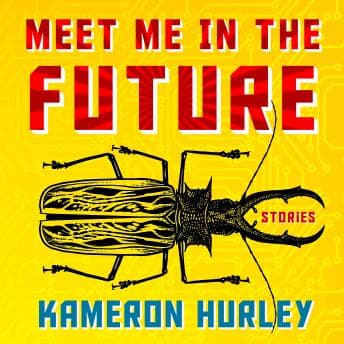

"A body-hopping mercenary avenges his pet elephant."
That's the actual description of one of these stories. I read it on the Audible page at 6:15 AM, blinked at my phone, looked up at the fluorescent Caltrain lights, and thought: okay, Hurley, you have my attention.
The Short Story Collection Problem (And Why This One Mostly Survives It)
Let me be upfront: short story collections in audio format are a gamble. They're the microservices architecture of literature - each piece needs to spin up its own world, do its job, and shut down cleanly before the next one deploys. Most collections have a ~40% hit rate for me. Hurley's batting closer to 65-70%, which for a collection this weird and varied is genuinely impressive.
The range here is wild. You've got the elephant-avenging mercenary story sitting next to a piece about an orphan falling in love with a sentient starship, sitting next to what's basically a post-apocalyptic swamp witch divorce story. Hurley writes like someone who keeps a folder labeled "ideas too unhinged for a novel" and then decided to publish all of them at once. The body horror is real - there's a story where the physicality of war gets so visceral I actually flinched on the train and the guy next to me gave me a look. And then two stories later she'll hit you with something so absurdly funny about the mundane logistics of surviving in an impossible world that you're trying not to laugh out loud in the quiet car.
The connective tissue is Hurley's obsession with bodies - who controls them, who inhabits them, who destroys them, who rebuilds them. War, gender, autonomy, all of it filtered through speculative premises that refuse to be comfortable. The content warnings on this thing read like a disaster checklist (violence, body horror, genocide, torture, PTSD - pick your poison), and none of it feels gratuitous. It feels like Hurley looked at the worst parts of being human and said "now imagine this, but with biotech."
Where it stumbles: a few of the shorter pieces feel like proof-of-concept sketches rather than complete stories. You get this incredible worldbuilding premise, a fascinating character setup, and then... it ends. Like a function that returns before processing the result. Three or four stories left me wanting another 50 pages, and not in the satisfying "I want more" way - in the "wait, that's it?" way.
Two Narrators, One Brutal Collection
Eric Michael Summerer and Traci Odom split duties here, and the dual-narrator approach works well for a collection this tonally diverse. Summerer handles the gruffer, more action-oriented stories with solid energy - he's got this dry delivery on the darkly funny beats that lands well at 1.5x. Odom brings a different texture to her stories, quieter in places, which provides some breathing room between the more intense pieces.
Here's the thing though - I don't have strong feelings about either performance, and for a collection dealing with this much emotional extremity, that's a slight miss. The material is so raw and strange that I wanted the narration to match that energy more consistently. It's competent, professional work. But Hurley's prose has this feral quality on the page (I skimmed a few stories in text afterward) that doesn't always translate through the audio. Nobody's phoning it in, but nobody's setting anything on fire either.
The two-narrator split does help with the collection's biggest structural challenge: tonal whiplash. When you shift from Summerer's story about fighters powering a reality-bending engine to Odom's piece about the plague-casting ex-wife, the voice change itself acts as a palate cleanser. Smart production choice.
Who Should Queue This Up (And Who Should Hard Pass)
Perfect for: train, gym. Skip for: bedtime (the body horror will give you weird dreams - speaking from experience after making that mistake on a Tuesday night).
If you loved The Light Brigade or The Stars Are Legion, this is basically Hurley's sketchbook - rougher, more experimental, but you can see the same brain at work. If you're the kind of SF reader who wants their science fiction to hurt a little, to leave a bruise, Hurley delivers. If you prefer your speculative fiction clean and optimistic - with clear resolutions and characters you'd want to grab coffee with - this is not your book. These characters would bite you. The only other audiobook that left me feeling similarly roughed up in a good way was Song of Achilles - different genre entirely, but the same sense that the author is not going to protect you from the emotional wreckage.
The 10h 52m runtime is actually perfect for a collection. I finished it across maybe five commutes, and the story-per-trip pacing worked well. Some mornings I'd get one complete story, sometimes two shorter ones. It's modular in a way that novels can't be.
The Commit Message
TL;DR: Worth your commute. Hurley's short fiction is uneven but fearless - the hits hit hard enough to justify the misses. The ROI on this audiobook is solid if you're already a Hurley fan, decent if you're curious about her voice. Not her best entry point (start with The Light Brigade for that), but a strong showcase of a writer who refuses to play it safe. Narration is good, not great. The stories themselves do the heavy lifting.