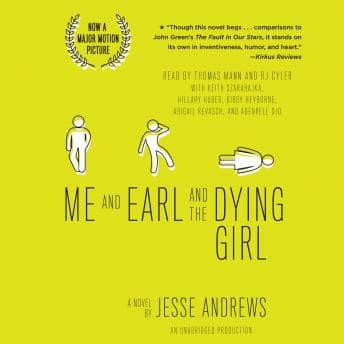
I was supposed to be debugging my procedural dungeon generator at 2 AM. Instead I was sitting in my desk chair with my headphones on, staring at a terminal I hadn't touched in three hours, because Jesse Andrews had me in a chokehold with a book about a kid who makes terrible movies and a girl who's dying of leukemia. My thesis advisor would be so proud.
Here's the thing - I almost bounced off this one. The title screams "manipulative tear-jerker," and the YA shelves are absolutely lousy with books designed to make you cry about a dead or dying teenager. I'm not saying that's inherently bad, but I've been burned before. I went in expecting The Fault in Our Stars with worse dating prospects.
What I got was something way weirder and way more honest. The books that actually surprise you are getting rarer - I had a similar experience of bracing for manipulation and getting something genuinely strange when I picked up Hot Zone, which has no business being as propulsive as it is given that you already know how it ends.
Greg Gaines Is the Worst Narrator and That's the Point
Greg is - and I mean this with genuine affection - an insufferable coward. He's built his entire high school existence around being invisible, maintaining surface-level friendships with every clique without belonging to any of them. He calls Earl his "coworker" instead of his friend. He makes parody films of classic cinema that he insists are terrible (they are). And when his mom forces him to hang out with Rachel, a girl with leukemia, he spends an enormous amount of energy trying to convince you, the listener, that he's not the hero of this story.
Thomas Mann gets this. He played Greg in the film adaptation, and you can tell he's lived inside this kid's brain. The narration isn't performative - it's got this halting, self-deprecating quality where Greg will start building toward something earnest and then immediately undercut it with a joke or a disclaimer. Mann nails the rhythm of a teenager who is genuinely terrified of sincerity. There's a bit where Greg describes his own screenplay format for the book you're currently reading, complete with stage directions like "GREG stumbles through another social interaction like a concussed bear" - and Mann reads it with this flat deadpan that made me laugh out loud in my apartment at a completely unreasonable hour.
Earl's Voice Hits Different
RJ Cyler as Earl is the secret weapon here. Where Greg is all deflection and anxiety, Earl is blunt-force honesty delivered with zero filter. Cyler's delivery has this casual directness that contrasts perfectly with Mann's nervous energy - when Earl tells Greg he's being an idiot, there's no softening, no apology, just the raw truth delivered like he's commenting on the weather. The contrast between these two voices carries the entire emotional backbone of the story. You get the sense that Earl understands things about friendship and mortality that Greg is desperately running from, and Cyler communicates that through tone alone without ever making Earl into some kind of magical wisdom dispenser.
The full cast works well for the supporting characters - Hillary Huber as Greg's mom has exactly the right amount of well-meaning-but-oblivious parent energy, and Keith Szarabajka brings weight to the few adult moments that need it. But this is really the Thomas Mann and RJ Cyler show, and their chemistry from the film translates surprisingly well to audio.
The Anti-Sick-Lit Sick Book
What surprised me most - and this is where I started neglecting my thesis even harder - is how aggressively this book refuses to be sentimental. Jesse Andrews structures the whole thing as Greg's failed attempt to write a book about what happened, complete with false starts, meta-commentary about how books are supposed to work, and straight-up admissions that he's probably remembering things wrong. There are chapters that are literally just lists. There's a section formatted as a screenplay. Greg keeps stopping to tell you this isn't going to have a satisfying emotional climax, and he's kind of right, and it kind of works anyway.
Rachel herself is deliberately kept at arm's length - not because the book doesn't care about her, but because Greg can't bring himself to fully engage with what's happening. That's the point. It's a book about a kid who's so afraid of feeling something real that he almost misses the chance to be there for someone who needs him. And when the emotional moments do land, they land harder precisely because the book hasn't been trying to manipulate you into crying for the previous five hours.
At six hours, it's a quick listen. Almost suspiciously quick. My D&D group would roast me for calling this fantasy-adjacent, but there's something about Greg's movie-making obsession - these terrible, passionate homages to films nobody asked for - that scratches the same itch as a character putting all their skill points into a deeply impractical build. You know it's not going to save the day. You root for it anyway.
Save Your Spell Slot for This One
Look, if you want epic fantasy or LitRPG stat progression, this ain't it. But if you've ever been a weird kid who channeled everything into a creative project nobody understood, this book will hit you somewhere uncomfortable. The full-cast production with the actual film actors is a genuine advantage over reading it on the page - you get performances from people who've already figured out who these characters are at a molecular level.
Who should grab this: awkward creative types, fans of books that mess with their own format, anyone who's tired of YA death stories that feel like emotional manipulation. Who should skip: if you want a traditional narrative structure, or if meta-humor annoys you, steer clear. Greg's constant fourth-wall breaking is either charming or exhausting depending on your tolerance.
I read this instead of writing my thesis. Worth it.