
Halfway through grading a stack of essays on The Great Gatsby—you know, the ones where every student discovers that the green light is a symbol for the first time—I decided I needed something to keep me awake. Something with teeth. MatchUp seemed like the literary equivalent of a faculty potluck: a bunch of professionals bringing their signature dishes to the same table. Whether that results in a feast or food poisoning depends entirely on how well the flavors mix.
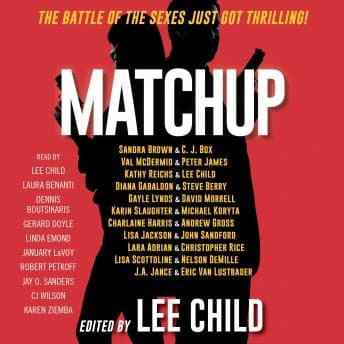
The concept here is genuinely clever. Take twenty-two bestselling thriller writers, pair them male-female like some kind of genre Dancing with the Stars, and have their beloved series characters collide. Jamie Fraser meets Cotton Malone. Temperance Brennan teams up with Jack Reacher. It's fan service elevated to an art form—or at least an interesting experiment.
When Literary Worlds Collide (And Sometimes Just Bump Into Each Other)
The thing about anthology collections is they're inherently uneven. This isn't a criticism so much as a mathematical certainty. With eleven different stories from twenty-two different creative visions, you're going to get some that sing and some that merely hum along pleasantly.
The Gabaldon-Berry pairing fascinated me most. Diana Gabaldon's Jamie Fraser—a character built for sweeping historical romance and time-bending drama—suddenly thrust into Steve Berry's world of international intrigue. It shouldn't work. It's like asking your AP Literature class to collaborate with the kids in Model UN. But there's something genuinely entertaining about watching these authors negotiate their characters' personalities on neutral ground.
Kathy Reichs and Lee Child's collaboration gives us Temperance Brennan and Jack Reacher in the same story, which is a bit like watching a forensic scientist try to work alongside a bulldozer. Brennan's meticulous, evidence-based approach versus Reacher's punch-first-ask-questions-never methodology creates genuine friction. The kind of friction that actually generates heat rather than just noise.
Ten Voices, Fifteen Hours, One Very Long Faculty Meeting
Here's where I need to be honest about what I don't know. The research on individual narrator performances is frustratingly thin. Gerard Doyle is award-winning, which means something. Lee Child narrates some portion himself—and there's always something interesting about an author voicing their own creation, even if it's not always better than a professional interpretation.
With ten narrators across eleven stories, you're essentially getting ten different audiobook experiences stitched together. The transitions between stories mean transitions between voices, styles, pacing. For some listeners, this variety is a feature. For others—particularly those of us who believe narration should be invisible, should serve the text rather than compete with it—the constant switching can feel disorienting.
I found myself adjusting to each new narrator like adjusting to a new substitute teacher. Some you warm to immediately. Others take a chapter or two. A few you simply endure until the bell rings.
The Anthology Problem (Or: Why Short Stories Are Hard)
My students hate short stories. They want novels. They want time to settle in, to learn the furniture of a fictional world. And I get it—there's a reason we call it "getting lost" in a book. You can't get lost in something you finish in twenty minutes.
MatchUp runs fifteen hours, which sounds substantial until you divide it by eleven. Each story gets maybe an hour and change to establish its premise, merge two distinct fictional universes, tell a complete narrative, and send you on your way. Some authors handle this compression brilliantly. Others feel rushed, like they're trying to cram a novel's worth of plot into a novella's worth of space. Golden Lion manages that same balancing act—epic scope compressed into something you can actually finish without requesting a sabbatical.
The content warnings are worth noting: violence, language, sexual content. This is thriller territory, after all. If you're looking for cozy mysteries, this isn't your stop.
Who Gets an A, Who Gets Extra Credit Elsewhere
If you're already a fan of multiple authors in this collection, this is a no-brainer. Hearing your favorite characters interact with someone else's favorite characters scratches an itch you didn't know you had. It's like authorized fan fiction with professional production values. New to most of these writers? MatchUp functions as an excellent sampler platter. Find a pairing that works for you, then go explore that author's full catalog. That's exactly how I approached Secret Garden—used it as a gateway to figure out if that style worked for me before committing to anything longer.
Skip this if you need deep character development or complex plotting. These are sprints, not marathons. They're designed for entertainment, not enlightenment.
Class Dismissed
I finished MatchUp across three nights of grading, and it did exactly what I needed it to do: kept me awake, kept me entertained, occasionally surprised me. It's not going to change anyone's life. It's not the kind of thing I'd assign to my students as an example of literary craft.
But sometimes you don't want Faulkner. Sometimes you want eleven different authors showing off their best characters like proud parents at a talent show. Sometimes you want the literary equivalent of comfort food—familiar flavors, competent preparation, no pretense of being anything more than what it is.
Hemingway said about writing: "All you have to do is write one true sentence." These authors write true sentences about characters they've spent years developing. The collaborations force them to see their own creations through someone else's eyes. That's worth something, even if the result is more entertaining than profound.