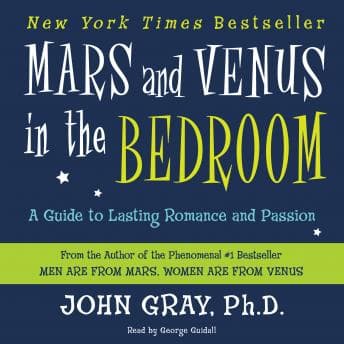

How many relationship books does it take before you realize your parents figured this stuff out without a single self-help title on their shelf?
I was making bibimbap at 10 PM - Jenny was already asleep - and I had this queued up because honestly, I'd been avoiding it. John Gray's Men Are from Mars, Women Are from Venus sold forty million copies. Forty. Million. That's not a book, that's a cultural event. So when the bedroom-specific spinoff showed up in my recommendations, I figured I owed it a fair shot. At 2.0x speed, that's under three hours of my life. Reasonable risk.
The Framework That Built an Empire (And Whether It Still Holds)
Here's the thing about Gray's Mars/Venus framework: it was revolutionary in 1992. Men process differently than women. Groundbreaking stuff - if you'd never talked to a married couple. But I'll give him this: he packages it in a way that makes people actually do something about it. The bedroom edition takes his core gender-difference model and applies it to physical intimacy, arguing that understanding your partner's distinct emotional cycle around sex is the key to not ending up as roommates who share a mortgage.
The central idea - that men need sex to feel emotionally connected while women need emotional connection to want sex - is presented as this big revelation. My parents wouldn't have articulated it that way, but my mom knew exactly when to make my dad's favorite jjigae after a long week. This is what my parents did instinctively. Now it has a TED talk.
Where Gray actually earns your time is in the specifics of what he calls "advanced bedroom skills," which is less about technique and more about sequencing. He breaks the sexual experience into stages and argues that most couples rush past the stages their partner needs most. His concept of women needing to "empty" emotionally before they can receive physically - that's genuinely useful framing. Not new if you've read Esther Perel or Sue Johnson, but Gray makes it accessible for the guy who's never cracked a relationship book.
Compared to Mating in Captivity by Perel, which treats desire as this complex, contradictory force, Gray's model feels... tidy. Almost too tidy. He loves his clean categories. Men do X, women do Y, follow these steps. The consultant in me respects the framework. The realist in me knows humans are messier than any 2x2 matrix.
George Guidall Reads Your Intimacy Playbook with a Straight Face
George Guidall is a narrator I've heard on everything from literary fiction to business titles, and the man is a professional. He reads passages about oral sex techniques and emotional vulnerability with the same measured, authoritative tone he'd use for a biography of Winston Churchill. There's something both admirable and slightly absurd about it. No dramatic inflections, no awkward pauses around the explicit content - just steady, balanced delivery that treats the material like what it is: advice.
For a book like this, that's exactly right. You don't want a narrator winking at you during the spicy parts. Guidall keeps it clinical enough to feel educational and warm enough to not feel like a medical lecture. At 2.0x, his pacing held up perfectly - clear diction, no muddy consonants.
The 5-Hour Problem
At 5 hours 45 minutes, this is mercifully short by self-help standards. But even so - and I say this with love for anyone trying to improve their relationship - there's about 2.5 hours of actual insight here, padded with repetitive examples and the kind of "imagine this scenario" storytelling that makes me reach for the skip-forward button. The key takeaway is worth the listen. The other 7 hours? Not so much. (Okay, technically 3 hours of padding, but it felt like 7.)
Skip to chapter 5. Thank me later. That's where Gray stops with the setup and gets into the actual mechanics of what he calls "polarity" - maintaining masculine and feminine energy dynamics. You can argue with the gender essentialism (and plenty of people should), but the underlying principle of maintaining erotic tension in long-term relationships? That's real. I've seen it play out with founder couples who merge their identities so completely into their startup that they forget they're also supposed to be attracted to each other.
The book's biggest weakness is its age. Published in the late '90s, it treats gender as strictly binary and roles as more fixed than most modern readers will accept. Gray's framework doesn't leave room for couples who don't fit his Mars/Venus boxes. If you can filter for the underlying principles and ignore the dated packaging, there's value. If rigid gender categorization makes you want to throw your earbuds, steer clear.
Who Gets ROI on This
Couples in long-term relationships who've hit a dry spell and need a shared vocabulary to talk about it - this works. It's a conversation starter disguised as a book. Solo listeners looking for sophisticated relationship psychology? Go read Perel. You'll get more per hour.
Jenny would say I'm being harsh. Jenny is right. But she'd also say that any book that gets couples actually talking about their needs has earned its shelf space. And on that metric, Gray delivers.
Bottom Line: Decent Returns on a Modest Investment
This is a legacy product from the Mars/Venus franchise - not Gray's best work, but not a waste of a credit if you're in the target audience. Guidall's narration is solid and unobtrusive. The framework is dated but functional. At under 6 hours, the time commitment is low enough that even if you only extract two or three actionable ideas, you're ahead. My parents never needed a book to figure out their marriage. But they also never took a vacation in 30 years, so maybe a little outside perspective isn't the worst thing. Though I'll say this - the couples who actually execute on the domestic fundamentals, the ones who've figured out how to share a household without slowly resenting each other, seem to have better luck applying Gray's advice too. How to Manage Your Home Without Losing Your Mind isn't a relationship book per se, but I kept thinking about it here - my parents' partnership was built on that exact operational foundation before anything else.