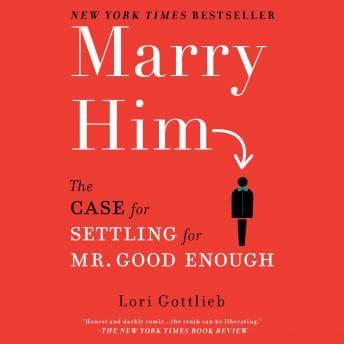

I need to start with a confession: I almost rage-quit this audiobook somewhere around hour three. Not because it's bad—actually, that would've been easier to deal with. It's because Lori Gottlieb kept describing dating patterns that hit way too close to home, and I was sitting on a packed 6:47 AM Caltrain thinking "oh no, she's talking about me."
The title is deliberately provocative, and yeah, "settling" is a terrible word choice that Gottlieb herself admits was basically clickbait for her original Atlantic article. But here's the thing—the actual argument is way more nuanced than the title suggests. This is basically "Thinking, Fast and Slow" but for dating. If you're into that whole "understanding how your brain sabotages you" thing, Atomic Habits does something similar for productivity—turns out we're equally terrible at predicting what habits will stick. She brings in behavioral economists, neuropsychologists, matchmakers, and divorce lawyers to basically prove that our brains are terrible at predicting what will make us happy long-term. The ROI on this audiobook is pretty solid if you're willing to sit with some uncomfortable truths.
The Part Where I Got Defensive (And Then Less Defensive)
Gottlieb's core thesis is that women—especially high-achieving, perfectionist types—have been sold a fantasy about finding someone who checks every single box. And that this fantasy is actively sabotaging our chances at happiness. She interviews couples who've been married for decades, and surprise surprise, most of them wouldn't have swiped right on each other in today's dating app hellscape.
I kept wanting to argue with her. "But I SHOULD have standards!" "But compatibility IS important!" And she addresses all of this. She's not saying marry someone you're not attracted to or who doesn't share your values. She's saying maybe the guy who's 5'9" instead of 6'2" and works in accounting instead of being a startup founder could actually make you happier than the "perfect" guy who gives you butterflies but also anxiety.
The data she presents is genuinely interesting. Matchmakers have higher success rates than dating apps because they ignore what people SAY they want and focus on what actually works. There's a whole section on how our "type" is often just our attachment trauma wearing a trench coat. (She doesn't phrase it that way, but that's the vibe.)
Brittany Pressley Keeps It Real
Brittany Pressley's narration is pretty much perfect for this material. She has this warm, conversational tone that makes the whole thing feel like you're getting advice from a really smart friend who's also done her research. The pacing is well-balanced—she doesn't rush through the data-heavy parts, but she also doesn't drag during Gottlieb's personal anecdotes.
I've seen some reviews mention her accent can be distracting, but honestly? I didn't notice it being an issue. Maybe I was too busy having an existential crisis about my own dating patterns to care. She does a solid job conveying Gottlieb's mix of self-deprecating humor and genuine concern, which is tricky to pull off.
The Middle Section Needs a Refactor
Okay, real talk—this book could've been shorter. There are sections in the middle where Gottlieb interviews what feels like the same type of person multiple times, and I found myself zoning out during my commute. The first three hours are great, the middle gets repetitive, and then it picks back up toward the end when she starts synthesizing all the research.
Perfect for: commute, gym, cleaning your apartment. Skip for: deep work or anything requiring concentration. This is the kind of book where you can miss thirty seconds and still follow along.
I finished this in about four commutes, and I'll be honest—I texted Kevin about it after day two. He was very smug about the whole thing. (He's been saying I'm too picky about restaurants for years, so apparently this validated his entire worldview.)
Anti-Fantasy, Not Anti-Romance
Here's what I kept coming back to: Gottlieb isn't anti-romance. She's anti-fantasy. And there's a difference. The book is really about understanding that the person who makes your heart race at 25 might not be the person who makes your life work at 45. That's not settling—that's just growing up.
Is it a little heteronormative and focused on marriage specifically? Yeah. Is some of it dated since the original article was from 2008? A bit. But the core psychological insights about how we make decisions and what actually predicts relationship satisfaction—that stuff holds up.
Who should listen: Anyone who's been dating for a while and feeling frustrated. Anyone who's ever rejected someone for a reason they couldn't quite articulate. Anyone curious about the psychology of attraction versus compatibility.
Who should skip: If you're happily partnered, this might just make you anxious. If you're not interested in heterosexual marriage specifically, a lot of the framing won't apply. And if you're going to get defensive about the word "settling" and never get past it, save yourself the nine hours.
Still Running the Analysis
I'm still processing some of this, honestly. But it made me think, which is more than I can say for most self-help books that could've been blog posts. This one actually needed the full nine hours.