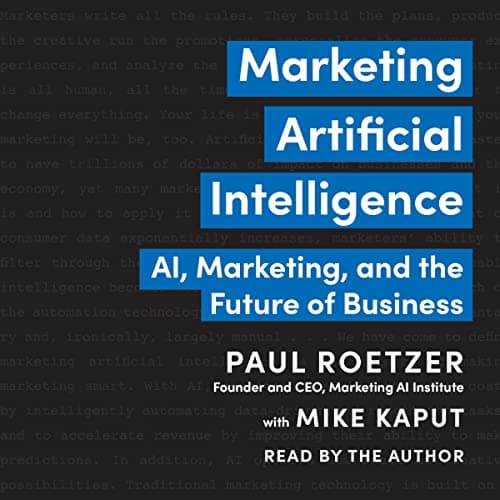

Everybody's got an AI marketing book now. I get it. The gold rush is on and publishers are handing out shovels. So when I cracked open Marketing Artificial Intelligence at 11 PM on a Tuesday — Jenny asleep, me hunched over my laptop trying to build a go-to-market strategy for a SaaS client who thinks ChatGPT is a marketing plan — I was fully prepared to be annoyed.
I was only half annoyed. That's progress.
The 45-Minute Insight Problem, Partially Solved
Bottom line: this book has about 3.5 hours of real substance in a 7-hour package. That ratio is actually above average for the genre, which tells you everything about the genre. Roetzer and Kaput do something I appreciate — they build a framework for thinking about AI in marketing rather than just listing tools that'll be obsolete by the time your Audible credit renews. Their "5Ps of Marketing AI" framework (planning, production, personalization, promotion, performance) is genuinely useful as a mental model. I've already stolen it for client workshops. Not sorry.
But here's where it gets tricky. The book was published in 2022, and AI moves in dog years. Some of the specific tool recommendations and capability descriptions feel like reading a travel guide from three software generations ago. The concepts hold up. The examples? About 60% still land. The other 40% are basically historical artifacts — interesting for context, less useful for execution.
Where My Parents' Dry Cleaning Beats the Framework
Roetzer talks about using AI to identify patterns in customer behavior and predict churn. This is what my parents did instinctively. Now it has a TED talk. My mom knew which customers were slipping away based on pickup frequency changes — no algorithm needed, just 14-hour days and a brain that never stopped tracking. The difference is scale, and that's where the book actually earns its keep. The authors make a solid case that AI doesn't replace marketing intuition — it extends it across thousands or millions of customer interactions that no human brain can hold simultaneously.
That's the real insight, buried under layers of case studies and executive quotes. Skip to the sections on the "Intelligent Automation" scale (chapters around the middle stretch) where they break down the spectrum from task automation to full machine learning. That's the meat. The early chapters defining AI basics? If you're listening to this book in the first place, you probably don't need the "What is AI?" primer that takes up the first hour-plus.
Roetzer Reading Roetzer
Paul Roetzer narrates his own book, and — look, he's a smart guy who knows his material. The delivery is authoritative, clear, and about as exciting as a well-organized spreadsheet. Which is fine. This isn't a book that needs dramatic flair. It needs credibility and clarity, and he delivers both. But at 1.0x speed, his pacing is genuinely too slow for the content density. I bumped to 1.75x (not even my usual 2.0x) and it felt right — like a good conference keynote instead of a lecture. His voice is steady and professional, no weird inflections or mispronunciations, which already puts him ahead of half the author-narrated business books in my library.
No sound effects, no music, no production tricks. Clean audio. Just a guy talking about marketing AI with the confidence of someone who's been doing it for years. Jenny would say I'm being harsh. Jenny is right. But also — author-narrated business books set a low bar, and Roetzer clears it comfortably.
The Shelf Life Question
Here's my real concern, and it's the one that keeps this from being a strong recommendation: this book is fighting against the clock. The framework thinking — how to evaluate AI tools, how to assess your organization's readiness, how to pilot AI projects — that stuff ages well. The specific references to tools, capabilities, and market positioning? Already stale in places. If you're coming to this in 2024 or beyond, you're getting maybe 70% of the value the original listeners got.
Compare this to Prediction Machines by Agrawal, Gans, and Goldfarb, which took a more conceptual approach to AI economics and still reads fresh years later. The shelf-life gap between conceptual and tactical writing is something I keep running into — Less is More is another book that swings hard at big frameworks and holds up precisely because it refuses to get too tool-specific. Marketing Artificial Intelligence is more practical and marketing-specific, which makes it more immediately useful but also more perishable. Trade-offs.
I've seen this fail at three different companies — teams that read one AI marketing book, bought a bunch of tools, and expected transformation. Roetzer and Kaput, to their credit, explicitly warn against this. They push for pilot programs, incremental adoption, internal education. That's honest advice. Most AI books are selling revolution. This one's selling evolution. I respect that, even if the delivery could use more urgency.
Who Should Listen (And Who Should Skip)
If you're a marketing leader who's been nodding along in meetings about AI without actually understanding what's feasible — this is your crash course. The 5Ps framework alone is worth the listen. If you're already running AI pilots or knee-deep in prompt engineering, skip it — you've outgrown this material. And if you're looking for an evergreen AI strategy book rather than a marketing-specific one, go with Prediction Machines instead.
The Consulting Invoice
Just know what you're buying: a solid 2022 snapshot of marketing AI with a framework that outlasts its examples. The other 5 hours beyond that core framework? Diminishing returns. But for the price of one Audible credit and a few focused commutes, you'll at least stop being the person in the room who confuses machine learning with automation. In 2024, that's table stakes.
At 1.75x, you'll finish it in an afternoon. At 1.0x, you'll finish your patience first.