
"If you do things for people, they feel obligated to help you back."
That's it. That's the big reveal. I was debugging a particularly nasty race condition at 11 PM, half-listening to this while my code compiled, and I actually laughed out loud. Not because it's wrong—reciprocity is real psychology—but because this audiobook treats it like some forbidden secret rather than something my grandmother taught me when I was six.
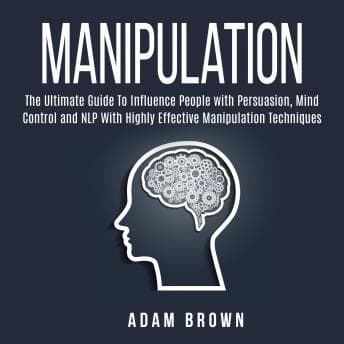
Here's what the product page doesn't tell you: this is 25 minutes of actual content. Not 3 hours. Twenty-five minutes. I know because I finished it during a single compile-test-debug cycle. The description promises "proven steps and strategies on how to covertly manipulate and brainwash anyone" and what you get is... a listicle. With narration.
The Blog Post Problem
Look, I grabbed this because I've been dealing with a stakeholder who somehow gets everyone to agree to impossible deadlines through sheer force of personality. Understanding the playbook seemed useful for defense. The title mentions NLP, mind control, persuasion techniques—sounds like a comprehensive toolkit, right?
What Adam Brown actually delivers: mirroring (copy people's body language), rapport building (be nice), reciprocity (do favors), and "setting the mood" (create comfortable environments). These are real concepts! Robert Cialdini wrote an entire 10-hour book called Influence unpacking just the reciprocity principle with actual research, case studies, and nuanced application. Brown gives you maybe 90 seconds on each topic.
One listener review said this book made them "sad and sometimes angry but also informative," and I felt that in my bones. Sad because you paid for this. Angry because the marketing promises so much more. Informative in the sense that a fortune cookie is informative—technically accurate, practically useless.
I got more genuine psychological insight from Anxiety Solution: A Quieter Mind, A Calmer You, which at least delivers on its modest promises instead of dressing up common sense in a trench coat and calling it mind control.Nick Dolle Does What He Can
The narration is clean and professional. Dolle has a clear, steady delivery that works fine for informational content. But there's nothing to differentiate here—no examples requiring dramatic reading, no dialogue, no stories. He's essentially reading bullet points with complete sentences, and he does it competently. That's about all you can ask for when the source material is this thin.
The production is straightforward—no music, no sound effects, just a guy reading. Which is appropriate for what this is. You can't narrate your way out of content that could've been a Medium article.
The ROI Math Doesn't Math
Let me engineer-brain this for you: at 25 minutes, this is shorter than most podcast episodes. At typical audiobook credit prices (~$15), you're paying roughly $36 per hour of content. For comparison, Cialdini's Influence is 10+ hours covering the same concepts with actual depth. That's $1.50 per hour. The ROI here is... not great.
If you're genuinely interested in persuasion psychology, grab Influence or Pre-Suasion. If you want the dark psychology angle, there are better options that don't feel like they were written during a lunch break. This is the audiobook equivalent of those "10 TRICKS THEY DON'T WANT YOU TO KNOW" articles that promise secrets and deliver common sense.
Perfect For: Absolutely Nothing, Actually
I can't think of a scenario where I'd recommend spending money on this. Even if you've never encountered these concepts before, there are free YouTube videos that cover the same ground with more depth. The only possible use case is if you have exactly 25 minutes, zero internet access, and a burning need to learn that "people like people who are similar to them." Groundbreaking.
I learned more about manipulation from watching my cat convince Kevin to give her treats than I did from this audiobook. And she does it in under 30 seconds, without promising "mind control" in the title.
Skip if: You've read literally any psychology book. You value your time. You expect "The Ultimate Guide" to contain more than surface-level Wikipedia summaries. So... everyone.