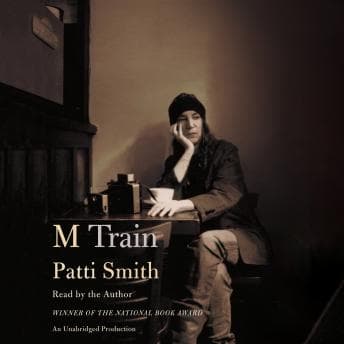

"I order my black coffee and look out the window." That's not a direct quote - it's basically the entire book. And somehow, against every instinct I have as a consultant who bills by the quarter-hour, I didn't hate it.
I was up at 5 AM prepping a pitch deck for a Series B founder who thinks unit economics are optional (they're not), and I put this on while the coffee brewed. Patti Smith's voice came through my kitchen speaker like a late-night FM radio signal - grainy, unhurried, completely indifferent to my need for actionable frameworks. And I just... stood there. Holding my mug. Staring at the wall. Jenny found me like that twenty minutes later and asked if I was having a stroke.
A Business Book This Is Not (And That's the Point)
Let me be upfront: M Train has zero ROI in the traditional sense. There are no bullet points. No "5 Steps to Creative Mastery." No frameworks. Patti Smith drifts from her Greenwich Village café to Frida Kahlo's Casa Azul to the graves of Sylvia Plath and Rimbaud like someone flipping through a box of Polaroids - which, literally, she does. She talks about detective shows (the woman is obsessed with crime procedurals in a way I genuinely respect), about buying a falling-apart bungalow in Far Rockaway right before Hurricane Sandy destroys it, about losing her husband Fred "Sonic" Smith and the crater that left.
The structure is anti-structure. Dreams bleed into memories. A café visit in one country cuts to a pilgrimage to a dead writer's grave in another. At 2.0x, this felt like someone reading a poem while sprinting. I dropped to 1.25x by hour two. Then 1.0x by hour three. This is the first audiobook in maybe two years where I voluntarily slowed down.
Her Voice Is the Whole Production
No sound effects. No music. No co-narrators. Just Patti Smith reading her own words in that voice - low, slightly rough, like she's talking to you across a small table in a café that hasn't been renovated since 1987. There's a plainspoken quality to her delivery that hits different from professional narrators. She doesn't perform. She just... tells you. When she describes finding Fred's old jacket and holding it, there's no dramatic pause, no vocal tremor engineered for effect. It's flat and quiet and that's exactly why it lands.
The Grammy nomination for Best Spoken Word Album makes sense. This is author-narrated done right - not an author awkwardly reading their own prose (we've all suffered through those), but someone whose voice IS the instrument the words were written for.
What My Parents Would Say About This
Here's where I got stuck. My parents didn't have the luxury of sitting in cafés writing in notebooks. They pressed shirts. They counted quarters. The idea of wandering to Berlin for an Arctic explorer's society meeting or making pilgrimages to poets' graves - that's a life built on the back of artistic success that most people never achieve. And Smith knows this. She's not selling you a lifestyle. She's documenting a specific kind of creative existence that's equal parts privilege and genuine devotion.
But here's what surprised me: underneath the wandering, there's a work ethic that would've earned a nod from my mother. Smith writes every day. She shows up to her café table like it's a time clock. When Sandy destroys the Rockaway bungalow - this place she'd poured money and love into - she just keeps going. The grief over Fred doesn't become a brand. It becomes fuel. That I understand.
This is what my parents did instinctively. Now it has a TED talk. Except Smith would never do a TED talk, and that's part of why this works.
Who Gets Value Here (And Who Walks Away Empty)
If you need a book that "delivers results" - skip it. If you measure audiobooks by insights-per-hour, your spreadsheet will weep. But if you've ever sat in a quiet room at 5 AM wondering what all the optimization is actually FOR - the hustle, the decks, the 2.0x listening speed - this book is an inconvenient interruption in the best way.
Creatives will love it. People grieving will feel seen. Consultants who've forgotten what it's like to just sit with a thought instead of monetizing it will feel uncomfortable. The grieving-will-feel-seen part is something I kept coming back to - Head Full of Ghosts operates in that same territory of loss wearing a strange costume, though it gets there through an entirely different door. That discomfort is the point.
Jenny would say I'm being harsh. Jenny is right. But she'd also say this book made me a little more human for six and a half hours, and she'd be right about that too.
The Invoice Nobody Asked For
Bottom line: M Train is 6 hours and 32 minutes of a woman drinking black coffee, visiting graves, and mourning her husband - and it's one of the most genuinely moving listens I've had this year. It has no business being on my Audible shelf between "Zero to One" and "The Hard Thing About Hard Things." But it's staying. At 1.0x. I'm not even mad about it.









