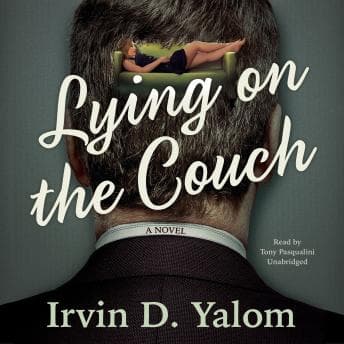

Look, I have a complaint. I teach high school English. I spend my days convincing sixteen-year-olds that unreliable narrators are a literary device, not a lifestyle. And then Irvin Yalom writes a novel where every single character — therapists included — is lying to themselves, to each other, to their patients, and I'm supposed to just sit here and not yell about it?
I was grading sophomore essays on The Great Gatsby at 11 PM, half a glass of wine in, Pasqualini in my earbuds, and I caught myself writing in the margin of a student's paper: "Gatsby lies to himself about Daisy the same way Ernest lies to himself about his motives." The kid's going to be so confused. But I stand by it.
Three Therapists Walk Into Their Own Neuroses
Yalom gives us three psychiatrists, each one a different flavor of professional disaster. Seymour — the old-guard analyst who crosses the sexual boundary line with a patient, and the way Yalom writes his internal justification is genuinely chilling because it sounds so reasonable in the moment. Marshal, who can't stop calculating the dollar value of every therapeutic relationship he has, obsessive-compulsive behaviors leaking into his practice like water through cracked foundation. And then Ernest Lash, the true believer, the idealist, who decides the cure for the dishonesty inherent in therapy is radical, total transparency with a patient.
This is why we still read the classics — because Yalom published this in 1996 and it reads like he wrote it last Tuesday. The questions he's asking about power dynamics between therapist and patient, about whether complete honesty is even possible in a relationship built on professional distance — these haven't been answered. They can't be.
Let's talk about what Yalom is really saying here. Ernest's experiment with total openness isn't just naive. It's a different kind of self-deception. He thinks he's being brave and revolutionary, but Yalom slowly, carefully shows us that Ernest's transparency is its own performance. He's playing the role of "honest therapist" with the same theatrical commitment that Seymour plays "wise elder." By the time you realize what's happening — that Ernest's patient may be running a con of her own — you're already 10 hours deep and the whole architecture of who's manipulating whom has gotten genuinely dizzying.
My students would hate this. I love it.
Pasqualini Gets the Silences Right
Tony Pasqualini does something here that I respect enormously: he doesn't oversell the therapy sessions. When Ernest is sitting with a patient and there's a loaded pause — the kind where the therapist is choosing between three different interventions and you can feel the weight of that choice — Pasqualini lets the silence breathe. The narrator understands that pause is punctuation. He's not rushing to fill dead air the way a lesser performer would.
His voice for Seymour carries this oily warmth that made my skin crawl in exactly the right way. There's a scene where Seymour is rationalizing his behavior — I won't spoil the specifics — and Pasqualini reads it with such measured calm that you almost buy it. Almost. And that "almost" is the whole point of the novel.
I will say the women's voices are adequate but not exceptional. This is a book predominantly about men examining (and failing to examine) their own psychology, and Pasqualini is clearly more comfortable in those registers. It's not a dealbreaker. But I noticed.
Who's This Couch Built For
If you loved When Nietzsche Wept — Yalom's earlier novel that smuggles genuine philosophical inquiry inside a historical fiction wrapper — this is its spiritual successor, except it's set in contemporary San Francisco and the philosophy is replaced with psychoanalytic theory. Valley of Amazement scratches a similar itch if you want that same slow excavation of interiority dressed up in literary fiction — I gave it four stars and still think about certain chapters. If you've ever been in therapy and wondered what your therapist was actually thinking during those long silences, this book will either comfort you or terrify you. Possibly both.
Fair warning: this is not a thriller. It's not even really a drama in the conventional sense. It's a 15-hour slow burn about people talking in rooms, and the tension comes entirely from what they're not saying. You need to be in the right headspace. This is a focused-listening book — don't put this on while doing dishes, you'll miss the crucial subtext that makes the whole thing work.
Skip this if you want plot-driven momentum. Skip it if therapy talk bores you. But if you want a novel that's genuinely intelligent about human self-deception — not "smart" in the way book jackets always claim, but actually, structurally smart about how we lie — this is worth pausing the faculty meeting for.
The Assignment I'd Give If Anyone Were Listening
Yalom was a practicing psychiatrist for decades before he started writing fiction, and you can feel it in every page. This isn't a novelist researching therapy for a book. This is a therapist who happens to write with the precision and humanity of a real novelist. The ending — which I won't spoil — lands with a quiet emotional force that surprised me. I was walking the lakefront with Denise, early Saturday morning, and I actually stopped on the path. She asked if I was okay. I was. I was just thinking about how hard it is to be honest with the people we're supposed to help. And how that might be the most human failure there is.
The prose deserves to be savored. 1.0x speed. Don't cheat yourself.









