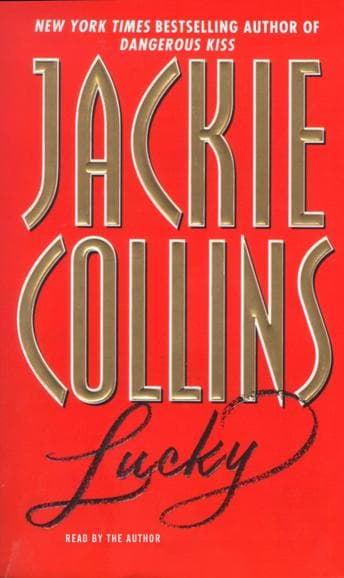

"She's a gambler and a lover. She's wild, savvy, and proud."
That's from the jacket copy, but honestly, it could be the thesis statement for Jackie Collins's entire literary career. And hearing Collins herself read those words - with that knowing, conspiratorial British-meets-Hollywood tone - hits different than seeing them on a page.
Let me set the scene. Friday night, Denise is out with her sister, I'm alone with a stack of sophomore essays on The Great Gatsby that I absolutely should be grading. Instead I'm pouring a second glass of wine and listening to Jackie Collins narrate her own glamour fiction. If my grad school professors could see me now. (They'd be horrified. I'm delighted.)
The Author Who Reads Her Own Mail
Here's what makes this audiobook genuinely interesting from a craft perspective: Jackie Collins narrating her own work is not the same thing as, say, Toni Morrison reading Beloved or Faulkner mumbling through his Nobel speech recordings. Collins isn't performing literature with a capital L. She's performing Jackie Collins - the persona, the brand, the woman who sold 500 million books by understanding exactly what her readers wanted and delivering it with zero apology.
And that's actually kind of fascinating. There's a confidence in her delivery that you can't fake. When she describes Lucky Santangelo sweeping through Vegas or outmaneuvering some would-be rival on a Greek island, Collins reads it the way someone tells a story they've lived adjacent to. Not acted. Told. Like she's leaning across a restaurant table and saying, "You won't believe what happened next." The breathless quality isn't a narrator's choice - it's the author's DNA.
At three hours and four minutes, this is clearly an abridged version of what was originally a massive novel. And that matters. The full Lucky is a sprawling, multi-thread epic covering Las Vegas, Hollywood, New York, Paris, private islands. What you're getting here is the highlight reel - the key confrontations, the big romantic collisions, the power plays. If you've read the original, this is Collins giving you her director's cut of the greatest hits. If you haven't, you're getting the energy without the full architecture.
What Hemingway Wouldn't Say (But Collins Would)
This reminds me of what Hemingway said about writing - that prose is architecture, not interior decoration. Collins would've laughed at that and added more chandeliers. And you know what? There's a place for chandeliers.
I teach the canon. I love the canon. But I've spent twenty years watching kids' eyes glaze over when I explain why Fitzgerald's sentence structure matters, and meanwhile half of them are sneaking genre fiction under their desks. Collins understood something academics often miss: pace is its own kind of craft. Lucky Santangelo isn't a character study in the Henry James sense. She's a force - someone who walks into rooms and rearranges the power dynamics. The prose doesn't ask you to linger. It asks you to keep up.
My students would actually love this. And for once, I wouldn't judge them for it.
The content warnings are real, though - violence, language, sexual content. Collins was writing about sex and power and money before it was fashionable to do so openly, and she didn't bother with euphemism. Kevin Kwan covers some of the same territory in Sex and Vanity, though with a more ironic distance from the glamour than Collins ever allowed herself. Lucky's world is glamorous and brutal in roughly equal measure. If you're looking for subtlety, wrong shelf. If you're looking for a woman character who takes what she wants in a genre landscape that was, in the 1980s, almost entirely male-dominated? That's worth paying attention to.
Who Gets the Assignment
If you loved the first Chances, this is its spiritual successor with the volume turned up. If you're a Collins completist, hearing her narrate is the draw - the book itself you probably already know. If you're coming in cold to the Lucky Santangelo series, I'd actually recommend starting with Chances first; this sequel assumes you already care about these characters and their history.
Skip this if you need literary complexity or if abridged editions make you twitch. (They usually make me twitch. I'm making an exception because Collins narrating Collins is its own artifact worth experiencing.)
The three-hour runtime means this is a single-sitting listen. I finished it before I touched those Gatsby essays. Denise came home, asked what I'd been doing, and I said "grading." She didn't believe me. She never does.
The Red Pen Says
Look, I'm not going to stand here and tell you Jackie Collins is Edith Wharton. But Collins knew her audience, knew her character, and knew how to make you turn pages - or in this case, keep your earbuds in. Hearing her read her own work is like getting the author's commentary track on a blockbuster. The prose deserves to be savored on its own terms, not the terms we impose from the English department. At three hours, it's a quick guilty pleasure that isn't all that guilty. Worth pausing the faculty meeting for? Absolutely. Worth a credit at this length? Grab it on sale.