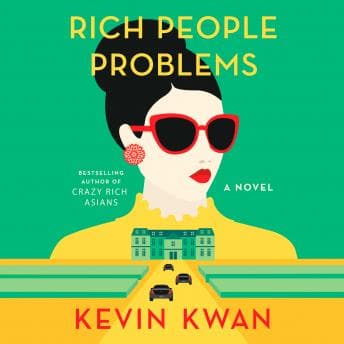

"Your mother is Chinese so it's no surprise you'd be attracted to someone like him."
I was three hours into this book, sprawled on my couch with Diego purring on my chest, when that line hit and I had to pause. Just... sit with it. Because Lucie's cousin Charlotte says this with such casual cruelty, and suddenly I'm fourteen again, overhearing my tía whisper about how I was "too dark" to wear certain colors. Kevin Kwan wrapped internalized racism in Gucci and Capri sunsets, and honestly? My heart wasn't ready.
The Girl Who Couldn't Love Herself Into Loving Him
Lucie Churchill is a mess. A beautiful, privileged, deeply confused mess who has spent her whole life performing whiteness to belong in her blue-blooded father's world. And George Zao? He's everything she's been taught to reject about herself - unapologetically Chinese, comfortable in his skin, annoyingly perfect in that way that makes you want to kiss him and also push him off a cliff. Their chemistry is chef's kiss but watching Lucie sabotage it over and over because she can't reconcile her identity? That hurt in a way I wasn't expecting from a book with this much designer fashion.
Kwan does this thing where he buries the knife in silk. All the glittering descriptions of East Hampton estates and Italian villas and Fifth Avenue co-ops - it's gorgeous, it's aspirational, and it's also a cage. Lucie's performing for an audience that will never fully accept her. I kept thinking about my abuela, how she'd straighten my hair before family parties on my dad's side. She understood the performance even if she hated it.
Abuela would have loved this one. She would have gasped at the co-op board drama and clutched her rosary at the Capri kiss. God, I miss her.
Lydia Look: Champagne Energy With Occasional Hangovers
Okay, here's where it gets complicated. Lydia Look narrates like she's hosting the most fabulous party you've ever attended and she's had exactly one glass of prosecco too many. Her character switching is genuinely impressive - the way she shifts from Lucie's mother's refined Chinese-American lilt to Charlotte's nasally WASP condescension is almost whiplash-inducing but in a fun way?
But. BUT. The Italian accents. Dios mío. I spent a summer in Florence after art school (before I dropped out, long story) and these accents are... a choice. Like someone learned Italian from a Mario Kart tournament. And she goes FAST - there were moments around hour six where I genuinely couldn't track who was speaking because she'd barrel through dialogue like she was late for a fitting at Valentino.
I listened at my usual 1.0x because I'm not a monster, but even I considered slowing it down during the ensemble scenes. If you're a 1.5x listener, you might actually die. Fair warning.
The thing is - when Look hits, she HITS. There's a moment late in the book where Lucie finally breaks down about her identity and Look's voice just... cracks. Not dramatically, just enough. I ugly-cried at that chapter while Frida judged me from her perch on my drafting table. Worth the occasionally chaotic pacing for moments like that.
A Room With a View (of Your Own Internalized Baggage)
Kwan explicitly calls this an homage to E.M. Forster, and yeah, you can see the bones - repressed protagonist, two suitors representing different paths, European setting awakening desire. But where Forster's Lucy Honeychurch was fighting Victorian propriety, Lucie Churchill is fighting something messier: the part of herself she's been taught to hate.
This book felt like sitting with a friend who's finally ready to talk about the thing she's been avoiding for years. It's funny - Kwan's satirical eye for wealthy absurdity is razor-sharp - but underneath all the Hermès and social climbing, there's genuine pain. The vibes are immaculate but also kind of devastating?
At nine and a half hours, it's a commitment. There are stretches in the middle where the society drama overwhelms the emotional core, and I found myself zoning out during yet another description of someone's vintage Chanel. Ninth had that same problem—gorgeous surface details that sometimes buried the emotional stakes. But when it focuses on Lucie's internal war, on her mother's quiet grief, on George's patient love for someone who keeps pushing him away - this is a rainy Sunday book. Curl up, let yourself feel things.
Who Gets an Invitation (And Who Gets Turned Away at the Door)
If you loved Crazy Rich Asians but wanted more emotional depth and less pure comedy, this is your book. If you're biracial or bicultural and have ever felt like you're performing identity for different audiences, this might wreck you (in the good way). If you need your narrators to maintain consistent accents and reasonable pacing, maybe try the print version.
Skip if: You want pure escapism without any identity politics, or if fast-paced narration genuinely stresses you out.
The Design I'd Put on My Wall
Not every element works - the pacing wobbles, the Italian accents are crimes against linguistics, and sometimes the satire overshadows the heart. But when Lucie finally stops running from George and from herself? When she chooses love over performance?
My heart. MY HEART.
Four tissues out of five. Would ugly-cry again.