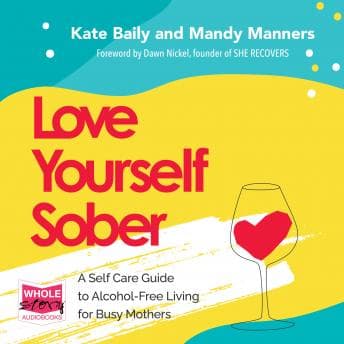

Why do so many self-help audiobooks sound like they're being read by someone who's never actually had a conversation with another human being? I started Love Yourself Sober with such high hopes, and within the first hour, I found myself mentally coaching the narrator on where to breathe naturally. The irony of needing a drink to get through a book about not drinking was not lost on me.
But here's the thing—I stuck with it. And I'm genuinely glad I did.
As someone who spends a lot of time thinking about habit formation and behavioral change (occupational hazard), I was curious how Kate Baily and Mandy Manners would approach the sticky territory of 'grey-area drinking.' You know the type: not quite alcoholic by clinical standards, but definitely using wine as a coping mechanism for the chaos of modern life. The authors nail this demographic with uncomfortable precision. That same precision in understanding parental stress patterns shows up in Siblings Without Rivalry, which dissects family dynamics with equally uncomfortable accuracy. They're not talking to people in crisis intervention—they're talking to the person who finishes a bottle while scrolling through work emails and wonders if maybe that's not entirely healthy.
The Coaching Structure That Actually Works
Four distinct parts take you from understanding your relationship with alcohol, through building what they call a 'sober toolkit,' into maintaining sobriety during life's trickier moments, and finally personalizing your approach for long-term success. It's coaching methodology dressed up as a friendly chat, and honestly, it works. Baily and Manners have clearly spent years refining their approach through their Love Sober platform, and that experience shows in how they anticipate objections and resistance.
What struck me most was the complete absence of shame. So much sobriety content operates on a deficit model—you're broken, here's how to fix yourself. This audiobook flips that script entirely. The authors frame sobriety as self-care, as choosing yourself, as an act of love rather than deprivation. For anyone who's ever white-knuckled through Dry January feeling like they were being punished, this reframe is genuinely revolutionary.
The practical exercises scattered throughout are where the coaching background really shines. These aren't vague suggestions to 'journal your feelings'—they're specific, actionable prompts that force you to examine your drinking patterns with uncomfortable honesty. I found myself pausing the audiobook multiple times to actually think through my responses, which is rare for me. Usually I treat self-help audiobooks as background noise during commutes, but this one demanded more engagement.
Rose Romain's Delivery: Clean But Stiff
The content deserves better delivery. Romain's pacing feels mechanical in places, with pauses that land just slightly off from where natural speech would put them. It's not terrible—the audio is clean and her voice suits the material's gentle, encouraging tone—but there's a stiffness that creates distance when the book is trying to create intimacy. For a book that reads like a supportive friend sitting across from you with tea, the narration sometimes feels more like a corporate training video. I bumped the speed up to 1.25x, which actually helped smooth out some of the awkward timing.
Who This Is Really For (And Who Should Skip It)
The target audience here is unmistakably clear: busy women, particularly mothers, who've found themselves relying on alcohol to decompress. The authors speak directly to the 'wine mom' culture that's become so normalized, and they do it without judgment. If you're a frazzled parent who's noticed that your 'one glass with dinner' has become a bottle, and you're not sure if that's a problem or just life, this book was written specifically for you. Skip it if you're looking for clinical addiction resources or dramatic rock-bottom narratives—that's not what this is.
What I appreciated most was the authors' acknowledgment that sobriety isn't a destination—it's a practice. They don't promise that everything becomes easy once you stop drinking. Instead, they offer tools for navigating the genuinely difficult moments: social pressure, holidays, stress, boredom, all the triggers that make alcohol feel like the obvious solution. The section on high days and holidays felt particularly practical, addressing scenarios that most sobriety resources gloss over.
At just over nine hours, this is a substantial listen, but it never felt padded. Each section builds on the previous one, and the coaching exercises give you natural breaking points. I'd recommend treating this as a workbook rather than something to power through—take a section, sit with it, do the exercises, then return for more.
The Behavioral Scientist's Take
The endorsement from Clare Pooley, author of The Sober Diaries, calling it 'a best sober buddy in your pocket' is apt. This isn't a clinical intervention or a dramatic rock-bottom narrative. It's exactly what it promises: a self-care guide that treats you like an intelligent adult capable of making better choices when given the right support.
Despite my complaints about the narration, the content here is genuinely valuable. If you're sober-curious, already sober and looking for reinforcement, or just starting to question your relationship with alcohol, this audiobook delivers practical, empathetic guidance without the preachy undertones that plague so much of this genre. Just maybe keep your finger on that speed control.