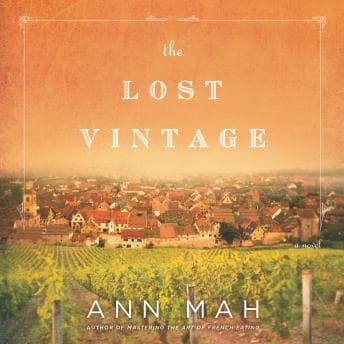

What does it mean to protect someone by burying them? That question sat with me for eleven hours while I worked on a branding project for a local winery — and I'm not even being cute about the timing. I pulled up Lost Vintage on a rainy Tuesday, Frida curled on my monitor arm judging my font choices, and I did not move from my desk chair except to refill my coffee twice and cry once into a dish towel.
Burgundy Dirt Under Your Fingernails
Okay so here's what this book actually is, because the comp titles kind of set you up wrong. Yes, there's a WWII thread. Yes, it's emotional. But Lost Vintage is quieter than The Nightingale — more like sitting in a cold stone cellar with a flashlight than sprinting through occupied France. Kate is studying for the Master of Wine exam (one of the most brutal certifications on earth — like, a 0.05% pass rate brutal), she's failed it twice, and she's running out of chances. She goes to her family's Burgundy vineyard to study and ends up finding a hidden room behind an armoire in the basement.
Behind it: a cot, Resistance pamphlets, and thousands of bottles of wine that shouldn't exist.
And then there's Hélène. A great-half-aunt Kate never knew about. A teenager during the Nazi occupation. The diary sections — alternating between Kate's present-day investigation and Hélène's wartime entries — are where Ann Mah earns everything. Hélène isn't a hero in the clean, movie-poster way. She's a seventeen-year-old girl who is hungry and scared and making choices that look like collaboration from the outside but feel like survival from the inside. The moral blur is real and it hurt to sit with.
I ugly-cried during the scene where Kate finally understands why Hélène was erased from the family. Not a dramatic sob — more like that slow, awful kind where you realize someone was punished for something that wasn't their fault. My abuela would have understood that immediately. She knew about families and their silences. She would have clutched her rosary and said pobrecita and meant it all the way down.
Saskia Maarleveld Is Doing The Lord's Work
The narrator situation here is genuinely impressive, and I want to be specific because "great with accents" gets thrown around and it usually means "not embarrassing." Saskia Maarleveld is not just not embarrassing. She's doing something harder: she's making the French characters sound French without making them sound like a joke, and she's making the German characters — the Gestapo agents — sound cold and bureaucratic in a way that made my skin crawl in exactly the right way. There's one scene where a German officer is being polite and that politeness is somehow more terrifying than if he'd been screaming. That's the delivery. That's her.
Hélène's diary voice is younger, more tentative — you can hear the teenager in it. Kate's present-day narration has this exhausted, holding-it-together quality that fits someone who's failed a career-defining exam twice and is trying not to fall apart in her cousin's guest room. The voices don't blur into each other even when the timeline switches mid-chapter, which at 11.5 hours is genuinely hard to pull off.
I've heard her pull off similar magic in These Deathless Bones, a short horror story where she made every character distinct and managed to chill me to the bone with just a whisper.The pacing is slow by thriller standards. This is a Sunday book. A rainy one. You're not rushing anywhere. But Maarleveld keeps it from ever dragging — there's always something in her delivery that makes the next sentence feel necessary.
Who Should Actually Listen To This
If you need your WWII fiction to be action-forward and plot-driven, this might frustrate you. The mystery of the six missing wine bottles is technically the spine of the plot but emotionally it's almost beside the point — the real question is what happened to Hélène and why her family decided she didn't exist.
But if you're the kind of person who finds wine culture genuinely interesting (I learned things about Burgundy vintages and terroir that I actually retained), or if you have complicated feelings about family secrets and the stories relatives take to their graves — this one will get into you. It got into me in a way I wasn't expecting from what I thought was going to be a breezy historical mystery.
This book felt like finding an old photograph in a box you weren't supposed to open. You can't un-know what you found.