
What happens when you raise a kid who genuinely doesn't know he's the one everyone laughs at?
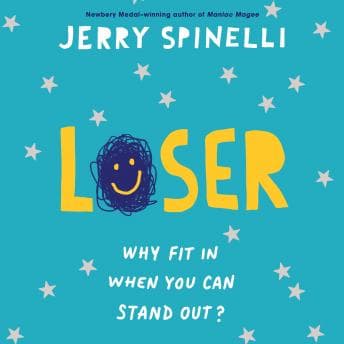
I was chopping onions for a chana masala at like 10 PM on a Tuesday - the kind of cooking that requires zero brain and maximum autopilot - when Steve Buscemi's low, unhurried voice started telling me about Donald Zinkoff. And I'll be honest, I wasn't prepared for how much this deceptively simple little book would get under my skin.
The Kid Who Never Got the Memo
Here's what Jerry Spinelli does that I find genuinely rare in children's literature: he writes a protagonist who is not performing resilience. Zinkoff isn't brave. He isn't defiant. He doesn't "overcome" bullying through some triumphant speech in the cafeteria. He just... doesn't hear it. The word "loser" bounces off him not because he's strong, but because he's too busy being delighted by the world to register that the world isn't delighted by him.
Psychologically, this doesn't track with most fictional portrayals of the "weird kid." Usually we get the sensitive outcast who feels everything too deeply. Zinkoff is the opposite case study - a child whose self-concept is so internally generated that external feedback barely penetrates. The research actually shows this is closer to how some children operate before the social comparison engine really kicks into gear around age 8 or 9. And Spinelli captures that developmental window beautifully. You watch Zinkoff move from first grade to sixth, and the book isn't really about him changing. It's about the social world hardening around him while he stays open.
I found myself asking: why does Zinkoff's obliviousness feel hopeful instead of tragic? And I think it's because Spinelli never frames it as denial. Zinkoff has a family that loves him. He has a dad who's a mailman and treats the job like it matters. He raises his hand with wrong answers because he's genuinely excited to participate, not because he's performing for approval. The kid falls down laughing at the word "Jabip." That's not a character flaw. That's a character gift.
Buscemi's Voice as a Psychological Choice
Okay, let's talk about the Steve Buscemi of it all. Because casting Steve Buscemi to narrate a children's book about a social misfit is - and I mean this as a compliment - kind of perfect and kind of weird. His voice carries this inherent quality of someone who's never quite fit in himself. That gravelly, low register. The lack of showmanship. He reads Zinkoff's story like he's sitting next to you on a park bench, just telling you about this kid he knows.
The weakness is real though: he doesn't differentiate between characters vocally. Zinkoff's mom, his teacher, the neighborhood kids - they all come through in Buscemi's same mellow frequency. For a book that spans six years and introduces a rotating cast of classmates, this can make certain dialogue exchanges a bit flat. You have to lean on context clues to figure out who's talking.
But here's where I'll push back on that criticism. The undifferentiated narration actually works thematically in a way I'm not sure was intentional but I'll credit anyway. This is a book about how a community perceives one person. Everyone else is - in a sense - the chorus. The wallpaper. Zinkoff is the only one who needs to be vivid because the whole point is that he's vivid in a world that keeps trying to make him small. Buscemi's delivery gives you exactly that: Zinkoff's world, filtered through someone who gets what it's like to be the odd one.
What the "Loser" Label Actually Costs
This is a fascinating case study in how labels create social reality. Spinelli tracks the moment when "Zinkoff" becomes synonymous with "loser" among his peers - and the precision of that social mechanism is sharper than most adult fiction manages. Nobody sits down and decides to exclude him. It's gradual. It's the way teams are picked. The way birthday party invitations just... don't arrive. The protagonist exhibits classic social rejection patterns, but because he doesn't internalize them the way we expect, the discomfort shifts to us, the audience. We're the ones who feel it. He doesn't.
And that winter night near the end - when Zinkoff goes out alone searching for a lost child in the snow while everyone else has given up - it's not written as a redemption arc. That's the thing. He doesn't do it to prove anything. He does it because that's just who he is. My therapist would have thoughts about this character, specifically about how we pathologize consistency in people who don't perform social norms.
At under four hours, this is a quick listen that hits harder than its length suggests. I finished it, turned off the stove, and sat with my masala cooling on the counter for longer than I'd like to admit.
Who This Is Really For (And It's Not Just Kids)
Parents, teachers, anyone who's ever watched a kid get sorted into the "wrong" category and wondered what it costs. Also genuinely useful for anyone interested in developmental psychology or social identity formation - Spinelli gets it right without ever being clinical. Skip it if you need vocal fireworks from your narrator or if you want a plot-heavy structure. This is character-driven and episodic and quiet. But the quiet is where the weight lives. Though if you want something on the complete opposite end of that spectrum - all plot, all momentum, zero quiet - my notes on Spy Camp are sitting right there.