
What does it cost a person to forgive someone who's built their entire identity around destroying everything you love?
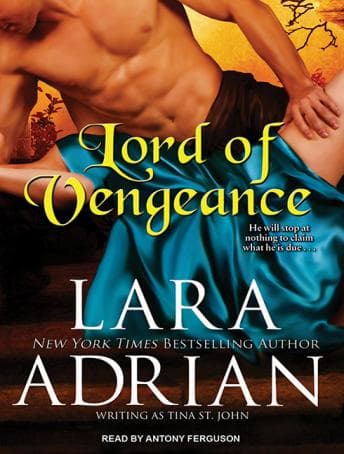
That's the question that kept circling my brain at 2 AM, three hours deep into Lord of Vengeance, Diego purring against my laptop while I stared at a half-finished logo design I'd completely abandoned. Because listen - I picked this up expecting a solid medieval romance, maybe some brooding knights, maybe a kidnapping trope done well. What I didn't expect was to sit there thinking about my abuela and how she used to say "el rencor es veneno que uno se toma esperando que el otro se muera." Resentment is poison you drink hoping the other person dies. Gunnar Rutledge is basically drowning in that poison for ten straight hours.
A Man Made Entirely of Grudge and Jawline
Gunnar is the kind of hero who should be irredeemable. He kidnaps Raina d'Bussy specifically to weaponize her against her father - the man who destroyed Gunnar's family. The captive-who-refuses-to-stay-broken dynamic is something Cage also does with a kind of rawness that stayed with me long after I finished it. And Raina? She's not some wilting damsel waiting to be rescued. She fights back, she challenges him, she basically looks at this enormous angry knight and says no. The push-pull between them is where this book lives and breathes. There's a secret between them that genuinely caught me off guard - I won't spoil it, but when it dropped, I paused my audio and said "wait, WHAT" out loud to my cats, who were supremely unbothered.
Lara Adrian (writing as Tina St. John back in the day, before she became the Midnight Breed queen) does something I really respect here: she doesn't rush Gunnar's softening. He doesn't hear one pretty speech from Raina and suddenly become a different person. His walls crack slowly, almost grudgingly, and you can feel him fighting his own attraction like it's another enemy to vanquish. The chemistry is chef's kiss - especially in the moments where they're furious at each other but can't stop gravitating closer. The action builds to this fevered pitch toward the end that had my heart actually racing while I was doing nothing more physical than adjusting my headphones.
Antony Ferguson's Voice Is Doing Heavy Lifting (Mostly)
Okay, here's where I get honest. Antony Ferguson has this deep, commanding baritone that is genuinely perfect for medieval knights. When he's voicing Gunnar in those low, dangerous moments - threatening, wanting, barely holding himself together - it works beautifully. The pacing shifts between action sequences and the quieter romantic scenes feel intentional and earned. He captures the electricity between Gunnar and Raina in a way that made me hold my breath during their closer moments.
But. There are stretches where the narration goes stiff - like he's reading the words precisely rather than living inside them. Some of the more elaborate medieval phrasing already sits heavy on the page, and when the delivery doesn't loosen up to compensate, the flow stumbles. His character voices aren't always consistent either; a few times I had to rewind because I lost track of who was speaking. It's not a dealbreaker, but it kept me from fully dissolving into the story the way I wanted to. For a book with this much emotional weight, I needed the narrator to lean harder into the vulnerability. He nails the strength. The tenderness? Hit or miss.
Who This Book Is Really For
If you love the kidnapper-falls-for-captive trope and you want it done with real emotional stakes - not just as a setup for spicy scenes but as an actual exploration of what forgiveness costs - this one delivers. Historical romance readers who want their heroes dark but redeemable, who want heroines with actual spines, who don't mind language that skews a little more formal (it's medieval, it comes with the territory). If you need fast, breezy prose, the more elaborate wording might slow you down. And if flat narration is an instant dealbreaker for you, know that Ferguson's performance has genuine highs but also some valleys.
This book felt like sitting in my abuela's living room watching a telenovela where the villain slowly becomes the person you're rooting for most. She would have clutched her rosary at Gunnar's worst moments and then cried when he finally - FINALLY - chose something other than vengeance. Abuela would have loved this one.
My heart. MY HEART. Not a four-cry book, but I got misty twice, and for a medieval romance from the '90s getting a second life in audio, that's saying something. This is a rainy Sunday book - dim the lights, make some tea, let Antony Ferguson's baritone carry you back a few centuries. Just be patient with the bumpy stretches. The destination is worth it.