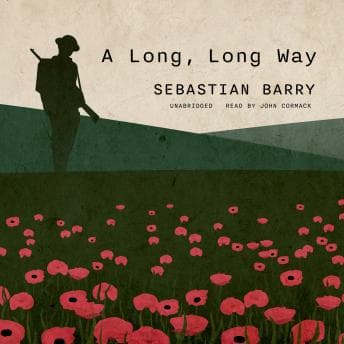

People told me this was a war novel. And I suppose it is, technically. Willie Dunne does go to the Western Front, and the trenches are there, and the dying happens. But calling A Long Long Way a war novel is like calling Middlemarch a book about a bad marriage. You're not wrong, but you're missing the whole cathedral.
I started this one on a Saturday morning, walking the lakefront with Denise. We do six miles most weekends, and I usually queue up something that matches the rhythm of the water. Barry's prose - and the way Cormack delivers it - turned out to be exactly that kind of thing. Liquid. Patient. The sentences roll in and pull back like Lake Michigan on a calm day, and then suddenly there's an undertow that drags you somewhere terrible.
The Quiet Between the Shells
Sebastian Barry writes like a poet who accidentally ended up writing novels. That's not a criticism. The man was shortlisted for the Booker for this, and you can hear why in every paragraph. But here's where I need to be honest with you: this is not a book that puts you in the mud. It's a book that puts you slightly above it, watching. Barry keeps a lyrical distance from the action that some listeners - and I understand them - find frustrating. You want the visceral punch of a trench raid? You'll get the aftermath described in language so beautiful it almost feels wrong to call it beautiful.
Willie visits his former captain's country home at one point, and the scene is drenched in this particular brand of Irish melancholy - the politeness hiding the grief, the tea served in rooms that feel emptied of something you can't name. It's a scene that wouldn't work in a more conventional war novel. Here it devastates.
And then there's the Easter Rising happening back in Dublin while these Irish boys are fighting for the Crown. Barry doesn't hit you over the head with the irony. He lets Willie discover it slowly, like a man realizing the house he left is being dismantled brick by brick while he's away. This reminds me of what Hemingway said about the dignity of movement beneath the surface. Barry trusts his reader to feel the political tragedy without a lecture.
Cormack's Irish Is the Real Thing
John Cormack. Let me just say it plainly: his Irish lilt isn't performance. It's inheritance. There's a difference between a narrator doing an accent and a narrator speaking in his own voice that happens to carry centuries of a particular place. Cormack is the latter. When he reads Barry's dialogue - the clipped, half-swallowed phrases of Dublin working-class speech - it sounds like eavesdropping on someone's grandfather. The narrator understands that pause is punctuation, and he uses silence the way Barry uses white space on the page.
But. (And this is a real but.) The same quality that makes him perfect for the lyrical passages works against him in the battle sequences. There's a detachment - almost a gentleness - to his delivery that keeps the violence at arm's length. I'm not sure if that's a conscious choice or a limitation, but it means the war sections feel observed rather than experienced. If you want your audiobook to put you in the trench with mud in your teeth, this narration won't do that.
I listened at 1.0x, naturally, because the prose deserves to be savored. Speeding this up would be like fast-forwarding through a Chopin nocturne. You'd still hear the notes. You'd miss the point entirely.
My Students Would Hate This. I Love It.
I teach eighteen-year-olds. Willie Dunne is eighteen. And I kept thinking about that while listening - how my kids complain about a fire drill disrupting their lunch period while this boy is watching his friends get erased from the earth. Barry doesn't make Willie heroic. He makes him confused, and loyal, and too young. That's harder to write. That's harder to listen to.
The book runs nine hours and eighteen minutes, which feels right. Not a page too long, not rushed. It's a slow burn, yes. If you need plot momentum - incident, incident, incident - you'll stall out around hour three. But if you loved Barker's Regeneration trilogy or Ford Madox Ford's Parade's End, this is their spiritual successor. Same era, same wounds, different accent. The Irishness matters here. These are men fighting for an empire that's busy crushing their own people. Barry lets that contradiction just... sit there. Rotting. Like everything else in Flanders.
Worth Pausing the Faculty Meeting For
Listen. This is why we still read the classics - or in this case, the modern books that will become classics. A Long Long Way isn't easy listening. It asks you to sit with ambiguity, with loss that doesn't resolve into meaning. If you want a war novel that tells you war is hell, go read something else. If you want a war novel that shows you a boy writing letters home while the ground shakes and the country he's fighting for decides he's a traitor - and does it in prose that sounds like a hymn being sung in a burning church - then this is yours.
Who should skip it: Anyone who found Birdsong too slow. Anyone who needs clear narrative momentum. Anyone who listens primarily while doing something else. This book punishes divided attention.
Who should stay: Readers of literary historical fiction. Lovers of Irish writing. Anyone who's ever taught a room full of eighteen-year-olds and thought about all the ways the world has failed them before they even walked in the door. I'll be honest - neither Girl with the Make-Believe Husband nor Where Good Girls Go to Die are remotely in the same zip code as Barry's novel, and linking to them here would be the audiobook equivalent of recommending a pop song after a requiem mass - so I'm leaving this one to stand on its own.