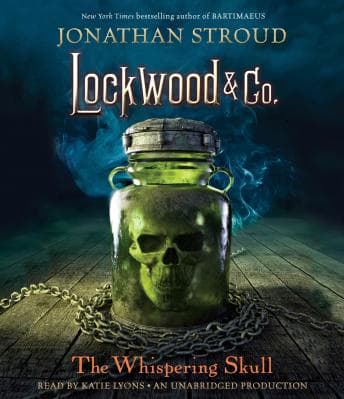

Everyone kept telling me this series is "just" middle-grade fiction. I want to talk about that word "just" for a second, because I was standing in my kitchen at 11 PM on a Tuesday, burning cumin because I was too absorbed in the Kensal Green Cemetery excavation scene to remember I was making dal. That's not a "just" anything experience.
Here's the thing though - I came into The Whispering Skull expecting the same gut-level dread that The Screaming Staircase delivered, and honestly? The creepiness doesn't quite hit the same way this time around. I noticed it, and I want to be honest about it. But what Stroud gives you instead is something I found myself caring about way more than I expected: a genuinely fascinating case study in group dynamics under pressure.
Three Teenagers, One Haunted Skull, Zero Healthy Communication
The protagonist exhibits classic avoidant attachment behavior - and I mean Lockwood specifically, not Lucy. Stroud does something clever here that most authors writing for younger audiences wouldn't dare: he lets his charismatic leader be wrong. Lockwood's cool, confident exterior is exactly that - exterior. When he accuses George of careless mistakes after the phantom incident at the coffin excavation, you can feel the displacement happening in real time. He's not actually mad about George's curiosity. He's terrified of losing control, and he's picking the safest target.
And George? George is the character my therapist would have thoughts about. His compulsive need to investigate Edmund Bickerstaff's attempts to communicate with the dead isn't just plot-convenient curiosity. It's the behavior of someone who processes fear through intellectualization. The research actually shows this is one of the most common defense mechanisms in high-stress environments, and Stroud nails it without ever making it feel clinical. The only other book I've reviewed recently where characters intellectualize their way through genuine trauma this convincingly is Tattooist of Auschwitz — obviously a completely different register, but the psychological honesty about how people cope under impossible pressure hits the same nerve.
Then there's Lucy, caught between these two boys and their unspoken anxieties, increasingly distracted by the whispers from the skull in the ghost jar. I found myself asking: why does Lucy really keep listening to the skull? It's not just because she's the one with the strongest psychic Talent. It's because the skull, grotesque as it is, is the only entity in her life that's being direct with her. Everyone else is performing.
The rivalry with Quill Kipps and his Fittes agents adds a whole layer of professional ego that - look, I work in academia, I know what it's like when someone with more institutional backing keeps swooping in on your work. The bet Lockwood makes, where the losing side has to admit defeat in the Times? Psychologically, this tracks perfectly. It's the exact kind of reckless gamble someone makes when their self-worth is entirely tied to professional identity.
Katie Lyons and the Problem of Three Boys in a Room
So here's where I have to be specific and fair. Katie Lyons does genuinely excellent work with Lucy's narration - the no-nonsense, slightly exasperated perspective of a teenage girl surrounded by male egos and literal ghosts. Her pacing during the action sequences is breakneck in the best way, and the whispering she does for the skull? Legitimately unsettling. I had my earbuds in during a morning jog through Cambridge and nearly tripped on a curb because one of those ghost whispers caught me off guard.
But - and this matters - when you've got Lockwood, George, Kipps, and Inspector Barnes all in a scene together at DEPRAC headquarters, the male character voices start blurring. I'd occasionally lose track of who was speaking for a beat or two before context clues caught me up. It's not a dealbreaker, but in a series where the interpersonal dynamics are half the fun, those moments of confusion pull you out. Some listeners apparently preferred Miranda Raison's narration from book one, and I can see why, though Lyons brings her own strengths - particularly that creepy modulation for supernatural elements.
Who Gets the Most Out of This
If you're the kind of listener who picks up on character psychology - the why behind what people do, not just the what - this book is surprisingly rich for its target demographic. Stroud understands human nature in a way that makes his YA/middle-grade classification feel almost arbitrary. The mystery around Bickerstaff's stolen glass relic is solid, the Victorian-ghost-hunting world remains inventive, and the group dynamics have real emotional stakes.
Skip it if you need constant horror-level scares. This one leans harder into mystery and relationship tension than pure supernatural dread. And if similar-sounding male character voices in audiobooks drive you up a wall, you might want to read the print version instead.
My Case Notes
I finished the dal eventually. It was fine. The book was better than fine. Stroud is writing what amounts to a psychological portrait of three deeply competent, deeply damaged kids who solve ghost problems more efficiently than their own emotional ones. That's pretty much my entire research interest in one sentence. Book three is already downloaded.