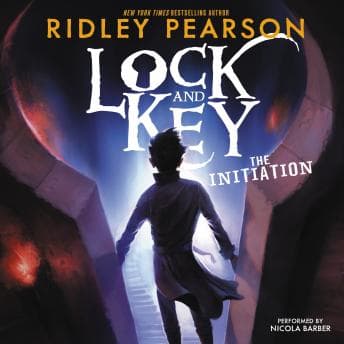

This is basically a Sherlock Holmes origin story told from the perspective of Moriarty's little sister, and honestly? That pitch alone got me through the Audible checkout faster than I solve a null pointer exception.
Here's the thing though - I went in expecting something closer to the dark, cerebral cat-and-mouse game between Holmes and Moriarty that I know from Doyle. What I got was a middle-grade boarding school mystery with some genuinely clever setup. And once I recalibrated my expectations (somewhere around the Millbrae stop on a Wednesday morning), I actually had a pretty good time with it.
Young Moriarty Has More Range Than Your Average MG Villain
Ridley Pearson does something smart here: he makes James Moriarty a kid from Boston who's angry about being shipped off to boarding school, not some mini-sociopath twirling a mustache. He's got an acid tongue and a chip on his shoulder, and his dynamic with young Sherlock - sorry, "Lock" - starts as genuine friction, not destined-rivals posturing. The fact that they're roommates forced into proximity over a missing heirloom Bible gives the whole thing a structure that reminded me of early Rick Riordan, which tracks since Riordan literally blurbed this book.
But the real narrative trick is Moria as the POV character. She's watching her brother and this weird British kid circle each other, noticing things neither of them catches, and Pearson uses her observational skills to seed clues that pay off later. It's a smart structural choice - you get the Holmes-Moriarty dynamic filtered through someone who loves one of them and is warily fascinated by the other.
The secret society angle and the school lockdown gave me strong "if Hogwarts were a New England prep school with less magic and more skulking" vibes. At 7.5 hours, it doesn't overstay its welcome, though the cliffhanger ending is... aggressive. Like, I literally said "wait, what" out loud on the train and got a look from the guy next to me who was clearly on his third attempted nap.
Nicola Barber's Patrician Problem
Nicola Barber is an Audie nominee and it shows - her narration is polished and her refined, slightly English-inflected delivery works perfectly for the patrician Boston setting. She nails the social class dynamics just through vocal register, which is doing a lot of heavy lifting in a story about boarding school hierarchies.
The catch: she sounds like a woman in her 30s or 40s narrating as a 12-year-old girl. Now, the book is framed as retrospective narration, so technically this works? Moria is telling us about her childhood from some future vantage point. But there were moments - especially in the more action-heavy sequences - where the composed, adult delivery didn't quite match the urgency a kid would feel. It's not a dealbreaker, but if you're coming from something like a full-cast YA production, the disconnect might bug you.
She does handle the adventure and intrigue elements well though. The pacing of her delivery keeps things moving, and at 1.25x she hits a sweet spot that feels natural without losing any of the mystery-building tension.
Who This Is Actually For (And Who Should Manage Expectations)
Perfect for: parents looking for something to share with kids on a road trip, or adults who enjoy middle-grade mysteries and don't need their Holmes gritty. If your kid burned through Percy Jackson and needs something with a similar adventure-plus-clever-kids formula, this is your next pickup. I'd also put Yearling in that same conversation - the kind of classic middle-grade that holds up precisely because it trusts kids to handle real emotional stakes without dumbing anything down.
Skip for: anyone expecting adult-level Sherlock Holmes complexity. This is a kids' book. A good kids' book, but if you're looking for Benedict Cumberbatch energy, you're in the wrong aisle.
I'll be honest - I listened to this because I was between series and it was short enough to fill three commutes without commitment. And for that purpose? It delivered. The concept is genuinely clever, the execution is solid if not spectacular, and I'm curious enough about where the rivalry goes that I might grab book two next time I need something light.
The ROI on this audiobook is decent if you know what you're getting into. It's comfort-food mystery with a literary pedigree twist. Just don't expect it to be the audiobook equivalent of a distributed systems deep-dive - it's more like a well-documented README. Gets you oriented, sets up the architecture, and leaves you wanting to dig into the actual codebase.
Commit to Main or Stash for Later?
Worth a listen if the premise intrigues you, but I wouldn't burn a full-price credit on it. Grab it on sale or through your library's Libby app. That cliffhanger ending means you're signing up for a trilogy, so factor that into your time budget.