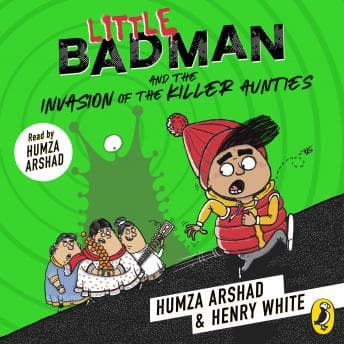

This is not a book I would have picked up for myself. Let me be honest about that upfront. I teach high school — my students are seventeen, eighteen, too cool to care about anything, and I spend my days wrestling with Fitzgerald and Morrison. But my niece was visiting last weekend, and Denise suggested I find something we could listen to together on our lakefront walk. So I downloaded Little Badman, and by the time we hit North Avenue Beach, this eleven-year-old rapper from Eggington had me grinning like an idiot while my niece kept elbowing me to stop laughing so loud.
Here's the thing: this book has no business being this fun.
The Kid Who Thinks He's Kendrick (And Why That Works)
Humza Khan — Little Badman — is convinced he's the greatest rapper his small town has ever produced. He's eleven. He's delusional. He's absolutely wonderful. And Humza Arshad, who co-wrote this thing and narrates it, delivers Humza Khan's self-aggrandizing inner monologue with this pitch-perfect mix of swagger and vulnerability that made me think of every fourteen-year-old who's ever sat in my classroom pretending they don't care about their grade while clearly dying inside.
Arshad's narration is the real engine here. His British accent carries these natural South Asian inflections that ground the whole story in a specific cultural world without ever making it feel like a geography lesson. When he voices the Aunties — the suspicious, sweet-dispensing substitutes who start replacing teachers one by one — he shifts into this exaggerated warmth that's just unsettling enough. You know something's wrong. The kids in the story know something's wrong. But the adults are too busy eating free gulab jamun to notice. (This reminds me of what Hemingway said about writing — the dignity of movement of an iceberg is due to only one-eighth of it being above water. The menace here is mostly below the surface, buried under comedy and sweets.)
And then there's Grandpa. Or Uncle. The book calls him Uncle but the dynamic is pure grandparent energy — this elderly man who seems checked out but turns out to have depths nobody expected. Arshad softens his voice for these scenes, slows down just a beat, and the tenderness that creeps in during their interactions caught me off guard. I found a similar focus on family bonds in Good Sister, though the tone is more serious. I was walking along Lake Michigan listening to a children's book about alien aunties and suddenly feeling things about intergenerational bonds. My niece looked at me funny.
Why a High School Teacher Has No Business Loving This (But Does)
Look, I know my lane. I do a podcast about classic literature for 47 listeners. I listen to Middlemarch during faculty meetings. My students already think I'm ancient. But good storytelling is good storytelling, and Arshad and Henry White understand something that a lot of "serious" authors forget: pacing is a form of respect for your audience.
At five hours and forty-six minutes, this thing moves. The premise — teachers vanishing, aunties multiplying, alien invasion hidden behind samosas and excessive cheek-pinching — escalates with the kind of comic momentum that keeps you from hitting pause. Arshad's timing is sharp. He knows when to let a joke breathe and when to snap into the next beat. There's a scene where Humza and his friends Umer and Wendy are trying to figure out what's happening to their school, and Arshad plays Umer's nervous energy against Wendy's dry pragmatism in a way that made each kid feel distinct without resorting to cartoon voices.
My students would hate this. I love it. (Actually, no — my students would secretly love this and just refuse to admit it. That's closer to the truth.)
The cultural specificity is what elevates it past generic kids' adventure. The dynamics of a South Asian family — the parade of aunties, the social pressure to be polite even when the aunties are clearly extraterrestrial threats, the way food functions as both love language and weapon — this isn't background detail. It IS the comedy. You can't swap in a different cultural context and get the same jokes. That's the mark of writing that actually knows what it's about. The same commitment to cultural authenticity drives Noughts & Crosses, where the world is built on a specific social reality that can't be separated from the story.
Who Should Press Play (And Who Should Keep Walking)
If you've got kids between eight and twelve, this is a no-brainer for road trips, bedtime, or — like me — lakefront walks where you want everyone laughing. Arshad narrating his own creation gives it an authenticity that a hired narrator couldn't replicate. He wrote this voice. He IS this voice.
If you're an adult with no kids in your life and you need your audiobooks to come with literary credentials? This probably isn't your next listen. But honestly, after twenty years of teaching teenagers and grading papers until my eyes blur, sometimes I need a book that just wants to make me laugh. And this one did.
Worth Pausing the Faculty Meeting For
Little Badman is a kids' book that trusts kids to be smart, funny, and capable of saving the world from alien aunties while also navigating the very real social landscape of being a brown kid in a small English town. The prose deserves to be savored — yes, even at this reading level. Arshad's narration is warm and kinetic, and at 1.0x speed (because I choose to hear words properly, thank you), every comedic beat lands exactly where it should. My niece wants to listen to the sequel next weekend. I didn't argue.