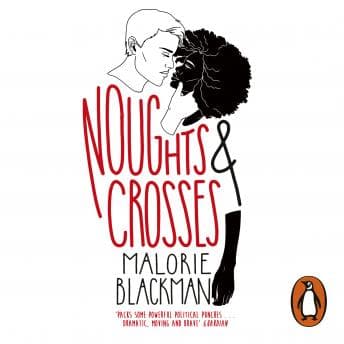

What happens when you flip the script on everything society tells us about race, power, and who gets to be human?
I've been thinking about this question since I finished Noughts & Crosses on a rainy Tuesday jog through Cambridge. Had to stop twice because I was crying. In public. Like a person who has completely lost control of her life. (My therapist would have thoughts about why I keep choosing emotionally devastating audiobooks for cardio.)
Malorie Blackman does something deceptively simple here—she inverts our racial hierarchy. Dark-skinned Crosses rule. Light-skinned Noughts are the underclass, the former slaves, the ones who sit at the back of the bus. And before you think "oh, it's just a thought experiment," let me tell you: the research actually shows that perspective-taking through fiction creates more lasting empathy than any lecture or documentary. Blackman isn't being clever for clever's sake. She's rewiring how we process prejudice.
The Psychology of Forbidden Love (And Why It Works)
Sephy and Callum. Classic attachment patterns that any developmental psychologist would recognize—Sephy's desperate need for connection despite her privileged position, Callum's internalized shame warring with his dignity. Neither of them is purely good or purely bad. They're products of their environment making choices that feel inevitable and heartbreaking simultaneously.
This is a fascinating case study in how systemic oppression doesn't just hurt the oppressed. Sephy's family dynamics are a mess. Her father is a politician playing both sides. Her mother is drowning in wine and denial. The Crosses aren't winning, not really. They're just differently broken.
Callum's trajectory—from hopeful student to something darker—psychologically, this tracks. I found myself asking: why does he really make the choices he makes in the second half? Is it love? Rage? The impossibility of existing in a world that refuses to see you as fully human? Blackman doesn't give easy answers. She just shows you the slow erosion of a person's soul.
Two Voices, Two Worlds
The dual narration here is... look, it's complicated. Syan Blake brings Sephy to life with this lilting quality that starts almost musical and grows tighter, more strained as the story darkens. You can hear Sephy's innocence cracking.
Paul Chequer's Callum is wistful, sometimes sneering—which some listeners apparently hated but I thought was the point? Callum is angry. He should sound a little bitter. The research actually shows that we respond more strongly to voices that match emotional content, even when that content is uncomfortable. Chequer's occasional sneer isn't a bug. It's a feature.
That said, I'll be honest: there were moments where Chequer was genuinely hard to understand. A few mumbled lines. Some sections where I had to rewind. And Blake does occasionally tip into melodrama—though honestly, given what happens in this book, maybe melodrama is warranted.
Where the Narrative Guts You
I'm not going to spoil anything, but. There's a section in the final third that I listened to while making dal. I burned the dal. I stood in my kitchen with smoke billowing around me, completely frozen, because Blackman had just done something I wasn't expecting and the narrators sold it so completely that I forgot I was a person with responsibilities.
The pacing is interesting—it's marketed as YA, and it has that accessibility, but it's not a quick read. Ten hours. The romance builds slowly, which I appreciated. Too many YA books rush the connection. This one earns it. Makes you believe these two people have known each other their whole lives before it all falls apart.
Who This Will Wreck (And Who Should Steer Clear)
Best for: Anyone who wants to feel something. Fans of dystopian fiction that's actually about something. People who can handle heavy themes—and I mean heavy. Racism, violence, terrorism, loss. This book doesn't flinch.
Skip if: You're looking for escapism. You need clear heroes and villains. You're sensitive to racial violence (the content warnings are there for a reason). Or if mumbled narration genuinely drives you up the wall—Chequer has his moments.
I keep comparing this to other "flip the script" narratives I've encountered in my research, and Blackman's version holds up. Paris Rose attempts something similar with its exploration of identity and belonging, though with less emotional devastation. Noughts & Crosses isn't subtle. It's not trying to be subtle. It's trying to make you feel what it's like to be on the wrong side of history, and then it's asking: what would you do? How far would you go?
My students would probably find this heavy-handed. But sometimes you need heavy-handed. Sometimes you need the point made so clearly that you can't look away.
Off to Emotionally Compromise Myself Further
I'm starting the sequel tomorrow. Pray for my emotional stability.