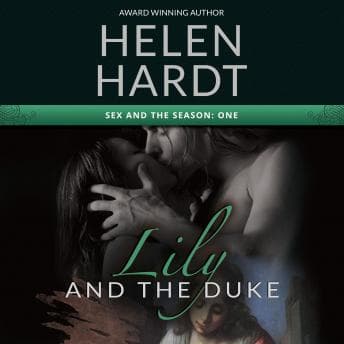

"What could be better worldly experience than a passionate affair with the notorious Duke of Lybrook?"
That line. That's the whole premise, and honestly? When I first heard it, I set down my stylus mid-logo revision and just... grinned. Because a heroine in 1845 who wants to skip marriage entirely so she can travel and paint and WRITE? Who sees a duke not as a husband prospect but as research material for her art? Abuela would have clutched her rosary AND leaned in closer. She loved a woman with nerve.
I was deep into a rebrand project - the kind where the client keeps changing the hex codes and you're on your fourth espresso - and I needed something to carry me through the tedium. A historical romance with steam and a heroine who paints felt like the universe winking at me. Ten hours and thirteen minutes later, I have... feelings. Mixed ones. But feelings.
Lily Jameson Deserved a Wilder Canvas
Here's what got me at first: Lily sneaking around a duke's estate to find a Vermeer. Not sneaking around to catch his attention. Not playing coy at a ball. She's literally trespassing for art history, and that distinction matters. It sets her apart from every "I'm not like other debutantes" heroine who then immediately acts exactly like other debutantes. Lily actually has a creative interior life - she talks about composition, about light, about why Vermeer's domesticity feels radical. As someone who dropped out of art school and still thinks about color theory at 2 AM, I felt that in my chest.
Daniel is your classic reluctant duke - title inherited through tragedy, would rather be dissolute than responsible. It's a well-worn setup, and Helen Hardt doesn't reinvent it so much as lean into the friction between his grief and his desire. The scenes where he's trying to be the rake and Lily basically says "cool, use me for experience" flip the power dynamic in a way that kept me interested through the middle stretch.
But here's where I got restless. The pacing drags in the second act. There are stretches - maybe hours five through seven - where the push-pull between them starts circling instead of escalating. The "danger lurks" element the description promises feels undercooked, more like a plot device than a genuine threat. I wanted stakes that matched the heat. The intimate scenes deliver (Hardt knows how to write steam, no question), but between them, I kept catching my attention drifting back to my design work when it should have been the other way around.
And that ending. I won't spoil it, but it left me feeling like I'd been watching a telenovela that cut to commercial right before the confrontation. Not a cliffhanger exactly - more like the resolution got summarized instead of lived in. I wanted to SIT in the aftermath with these characters, and instead the book just... wrapped up. Abuela would have yelled at the TV.
Honey Everest, Almost But Not Quite
Okay, so. Honey Everest has a warm quality to her voice - there's genuine emotion in her delivery during the romantic scenes, and she handles Lily's internal conflict with care. When Lily is torn between wanting Daniel and wanting her independence, you can hear that tension. That part works.
What doesn't work as well: distinguishing between characters. By hour three, I was sometimes losing track of who was speaking in dialogue-heavy scenes. The male characters especially blurred together - Daniel, Lily's father, secondary characters - they all lived in a similar vocal register without enough tonal separation. It's not BAD narration. It's just... it lacks that specificity that makes you forget there's only one person reading. Compare this to someone like Julia Whelan, who gives every character a whole interior life just through vocal texture. Everest is pleasant. She's occasionally moving. But she's not making me forget she's there, if that makes sense.
I listened at my usual 1.0x and honestly considered bumping to 1.15x during those slower middle sections. That's rare for me. I'm a savorer. If I'm reaching for the speed controls, something's off.
Who This Is For (And Who Should Keep Scrolling)
If you're already a Helen Hardt fan, you'll probably enjoy this - it's got her signature heat and a heroine with more personality than the genre sometimes allows. If you love historical romance with an art-world backdrop, Lily's passion for painting adds a layer that feels personal rather than decorative. It's a rainy Sunday book for sure - low stakes enough to be comforting, steamy enough to keep you warm. Bridgerton: The Duke and I scratches a similar itch and sticks the landing a bit more firmly, for what it's worth.
But if you need tight plotting, a narrator who gives you distinct character voices, or an ending that lands with a satisfying thud? This might frustrate you. I cried exactly zero times during this one, and for me, that's the most honest metric I have.
The Painting's Nice, But the Frame Needs Work
Lily and the Duke has a heroine I genuinely liked trapped in a story that doesn't quite rise to meet her. The concept - a woman choosing experience over safety, art over convention - is gorgeous. The execution gets about 70% of the way there. I finished it, I don't regret the ten hours, but I'm not adding it to my crying spreadsheet. And honestly? I wanted to. I really wanted to.