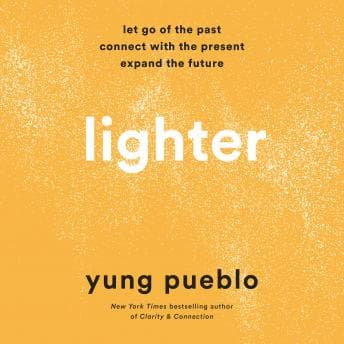
This is what my parents did instinctively. Now it has a TED talk.
I'm being unfair. Sort of. I listened to Lighter during a red-eye from SFO to JFK, somewhere over Nebraska at 2 AM, unable to sleep because the guy next to me was snoring like a broken air compressor. And you know what? Yung Pueblo's measured, deliberate voice actually worked in that context. Like having a very calm therapist whispering wisdom while chaos surrounded me.
But here's my problem with most self-help books in this space: they take concepts that immigrant parents, Buddhist monks, and your grandmother have known for centuries and repackage them with Instagram-friendly language. "Let go of the past." "Connect with the present." My mom's version was "Stop complaining, keep working, move forward." Less poetic, same result.
The 45 Minutes That Actually Matter
Look, there's genuine insight here. Pueblo's framework for understanding how unprocessed emotions create mental "heaviness" is useful. His breakdown of emotional maturity versus emotional reactivity—that's worth the listen. When he talks about how healing isn't linear and how we carry trauma in ways we don't recognize, I found myself nodding along. Emotional First Aid tackles this same territory with more practical tools and less poetry. I've seen executives making $500K decisions while operating from wounds they got at age twelve. That's real. Big Leap explores similar territory around self-sabotage and unconscious limits, though Gay Hendricks gets to the point faster.
The problem? It takes him about seven hours to deliver what could be a tight two-hour audiobook. Skip to the sections on emotional maturity and the parts about moving from self-awareness to action. The rest is... padding. Beautiful padding, eloquent padding, but padding nonetheless.
The Author-Narrator Paradox
Here's where it gets complicated. Pueblo narrating his own work makes complete sense—this is deeply personal material about his recovery from addiction and his journey to meditation. You can hear the authenticity. His voice is clear, his delivery sincere.
But—and Jenny would say I'm being harsh, Jenny is right—it's also monotonous. There's a meditative quality that works for maybe the first two hours, then becomes hypnotic in the "I'm falling asleep" way rather than the "I'm reaching enlightenment" way. At 2.0x speed, it becomes tolerable. At 1.0x? Even my usual 2.0x couldn't fully save this one.
The irony isn't lost on me: a book about being present and mindful is one I desperately wanted to speed through.
What McKinsey Taught Me About Self-Help
In consulting, we had a rule: if you can't explain the insight in one sentence, you don't understand it yet. Pueblo's core thesis is actually solid: heal yourself, then you can help heal systems. Individual transformation enables collective transformation. That's not just woo-woo—I've seen it play out in organizational change. Companies don't transform until the people in them do.
The final section on "structural compassion" is where Pueblo surprised me. He's not just talking about personal wellness; he's making a case that healed individuals have a responsibility to build better systems. That's more ambitious than most self-help books, which stop at "fix yourself and buy my next book." I respect the attempt, even if the execution gets a bit abstract.
Who Gets Value Here (And Who Doesn't)
If you're new to meditation, mindfulness, or the concept of emotional processing, this is actually a solid introduction. Pueblo explains things clearly without assuming you've already read twelve books on Buddhist philosophy. If you're dealing with unprocessed grief, anxiety, or that vague sense of heaviness he describes—there's real comfort here.
Skip it if you've already read Thich Nhat Hanh, done any serious meditation practice, or consumed more than three self-help books in this genre. You're going to find yourself checking how much time is left. Often. I did.
The Dry Cleaner's Son Verdict
Bottom line: There's a good audiobook buried inside this seven-hour meditation. The core insight on emotional maturity and healing-as-responsibility is worth the listen. The other five hours? Not so much.
My parents never had time for self-help books. They were too busy surviving, building, providing. And somehow they figured out most of what Pueblo is teaching—that you carry your pain until you choose not to, that healing is work, that you have responsibilities beyond yourself. They just didn't have the vocabulary or the Audible deal.
Lighter isn't bad. It's sincere, it's well-intentioned, and for the right listener at the right moment, it might genuinely help. But it's also the kind of book that made me appreciate my parents' efficiency even more. They didn't need seven hours. They just needed to keep showing up.