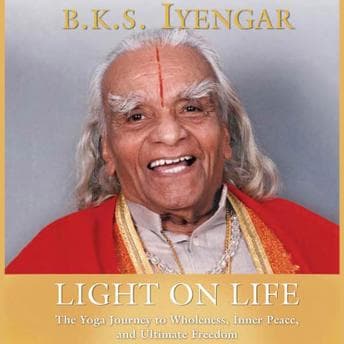

When's the last time a self-help audiobook made you feel like you were being gently lectured by your grandfather - in the best and worst ways simultaneously?
I picked up Light on Life during a week where I'd been doing desk yoga stretches between deploys (my L4-L5 is staging a rebellion against my Herman Miller), thinking maybe Iyengar could give me something deeper than "touch your toes and breathe." And he does. He really does. But the audio format fights him almost every step of the way.
The Diff Between Yoga Philosophy and Yoga Instagram
Here's what surprised me: this isn't a yoga instruction book. If you want poses, go read Light on Yoga. This is Iyengar at 87 years old, reflecting on what a lifetime of practice actually means - the integration of body, emotions, mind, and soul as distinct layers (he calls them sheaths, or koshas). He breaks yoga into these concentric rings of selfhood, starting from the outermost physical body and working inward toward what he considers the spiritual core.
The autobiographical bits are genuinely compelling. Iyengar grew up sickly in colonial India, nearly died of tuberculosis and malaria as a child, and basically reverse-engineered his own health through yoga. When he talks about his body as something he had to negotiate with rather than command, there's a specificity and earned authority that no wellness influencer can replicate. His distinction between "will" and "willfulness" in practice - that forcing a posture is the opposite of yoga - is the kind of insight that sticks with you on your 47th failed attempt at crow pose in your living room.
But here's the thing. This is a dense book disguised as a short one. At 5 hours and 13 minutes, you'd think it's a quick listen. Wrong. It's also abridged, which means someone already cut material and it's STILL packed with layered philosophical concepts that demand you actually process them. I caught myself rewinding sections on the Caltrain because my 6AM brain couldn't parse Iyengar's framework for how intellectual knowledge differs from experiential wisdom while simultaneously trying not to fall asleep on the person next to me.
Patricia Walden: The Sanskrit Is Flawless, Everything Else Is... Fine
Okay, let's talk narration. Patricia Walden is a senior Iyengar yoga teacher, not an audiobook narrator, and you can tell. Her Sanskrit pronunciation is impeccable - pranayama, asana, pratyahara - all delivered with the confidence of someone who's been using these words daily for decades. If you've ever winced at a narrator butchering foreign terms (looking at every sci-fi narrator attempting Mandarin), you'll appreciate this. One reviewer said the audiobook is worth the price just for the correct Sanskrit alone, and honestly? For practitioners, that's not wrong.
But the pacing. The pacing is rough. Walden reads with an earnestness that borders on monotone - she clearly believes in this material, and occasionally you get a spark of energy when she hits a passage she's passionate about. But long stretches feel like being read to at a meditation retreat where you're trying very hard not to check your phone. At my usual 1.5x, it was tolerable. At 1.0x, I would've abandoned it somewhere around the section on emotional intelligence.
Compare this to, say, Jon Kabat-Zinn narrating his own mindfulness books - there's a warmth and conversational quality there that makes philosophy feel like a fireside chat. I ran into a similar narration-vs-content mismatch with Mindfulness-Based Eating Solution, where the ideas were solid but the audio delivery kept pulling me out of the material. Walden's read feels more like a careful recitation. Respectful, yes. Engaging for two hours on a crowded commute? Not quite.
Who This Is Actually For (Be Honest With Yourself)
If you already have a yoga practice and want to understand the why behind what you're doing on the mat - the philosophy, the integration of physical practice with emotional and spiritual growth - this is pretty much the definitive text. Iyengar's framework for understanding the body as a vehicle for self-knowledge rather than just a fitness tool is genuinely unique. I haven't encountered another yoga book that draws the line from hamstring flexibility to existential freedom with this much intellectual rigor.
If you're a casual yoga-once-a-week person looking for motivation? Skip this audiobook version. Read the print book instead, where you can sit with paragraphs, underline things, and move at your own pace. The density-to-narration-quality ratio just doesn't favor audio here.
And if you have zero yoga background, this will feel like walking into a graduate seminar on day one. Iyengar assumes you know what he's talking about, and the abridgment probably cut some of the scaffolding that would've helped.
The ROI Calculation
The ROI on this audiobook is... complicated. The content is a solid 4 out of 5 - Iyengar's insights are hard-won and genuinely deep, not recycled platitudes. But the audio experience knocks it down. At 5 hours and change, it's not a huge time commitment, but it requires focused listening, which defeats the purpose of audiobooks for commuters like me. I finished it across maybe 4 commute sessions, but I retained maybe 60% of it. That's a bad hit rate for a book this short.
Perfect for: a quiet evening, a long bath, dedicated listening time. Skip for: commute, gym, anything where your attention splits.
I'll probably grab the print copy to actually absorb the sections on emotional and intellectual sheaths that flew past me on the train. Which is basically me admitting this book won the format war - it wants to be read, not heard.