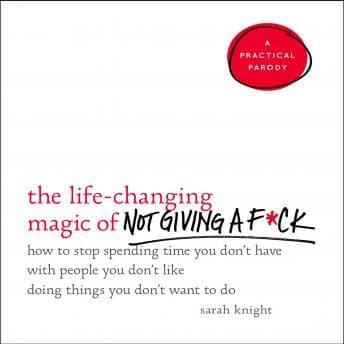

Look, I have complicated feelings about self-help books that tell you to care less. As someone who studies why people do what they do, the whole "just stop caring" advice usually makes me want to throw things. It's reductive. It ignores the psychological mechanisms that make us people-pleasers in the first place. So when I started Sarah Knight's audiobook during my morning jog through Cambridge, I was ready to be annoyed.
And I was annoyed. But also? I laughed so hard I nearly tripped over a jogger.
The Psychology Behind the Profanity
Here's the thing about Knight's approach—underneath all the f-bombs (and there are so many f-bombs, truly an impressive quantity), there's actually a legitimate cognitive behavioral framework happening. She's essentially describing what we'd call "values-based decision making" in the research literature, but she's wrapped it in a parody of Marie Kondo that somehow works.
The "NotSorry Method" she describes is basically this: identify what drains your mental energy, then systematically stop giving those things your attention. It's not groundbreaking if you've read any ACT-based therapy books. Journey of Souls takes a completely different approach to reframing guilt—less swearing, more past-life regression—but both end up in similar territory about releasing what doesn't serve you. Knight makes it accessible in a way that academic texts absolutely do not. My therapist would probably have thoughts about using shame reduction through aggressive swearing, but honestly? The research shows that profanity can actually reduce psychological stress. So maybe Knight's onto something.
What makes this a fascinating case study is how she's reframing guilt as a cognitive distortion rather than a moral failing. She's giving people permission to have boundaries without the usual self-help guilt trip about becoming your "best self." The bar is lower here—just stop doing stuff you hate. That's it. That's the whole thing.
Sarah Knight Narrating Sarah Knight
Okay, so the author-narrated situation. I have opinions.
Knight reading her own work is either going to be your favorite thing or make you want to yeet your headphones into the Charles River. There's no middle ground. Her delivery is enthusiastic—almost aggressively so—and she leans hard into the comedic timing. When she lists things you can stop giving a f*ck about (Iceland made me snort, I'll admit), her timing is genuinely good.
But four hours of that energy is... a lot. I found myself needing breaks, which is unusual for something this short. The repetition of the core concept—stop giving f*cks about things that don't matter—starts to feel a bit like being lectured by a very funny friend who's had three espressos. Entertaining in small doses. Exhausting as a continuous experience.
The production is clean though. No weird audio issues, which I appreciate when I'm trying to maintain my heart rate and not trip on uneven sidewalks.
Who Needs This Permission Slip (And Who Doesn't)
Here's where my researcher brain kicks in. This book exhibits classic characteristics of what I'd call "permission literature"—it's not teaching you anything new, it's giving you social permission to do what you already know you should do. And for a lot of people, that's exactly what they need.
The protagonist of this audiobook is really the listener themselves, and Knight is positioning herself as the irreverent friend who tells you it's okay to skip your cousin's destination wedding. Psychologically, this doesn't track as a comprehensive life philosophy. But as a four-hour pep talk for people with anxiety about disappointing others? It works.
I found myself asking: why does this land with so many people? And the answer is pretty obvious—we're socialized (especially women, and Knight is clearly writing for women primarily) to prioritize others' needs over our own. Knight is offering a counter-narrative, even if it's wrapped in a lot of profanity and jokes about not caring about coworkers' pets.
Listen if: you're a chronic people-pleaser who needs someone to yell permission at you, or you want a comedic palate cleanser between heavier reads. Skip if: you're looking for actual psychological depth on boundary-setting, or high-energy narration makes you twitchy.
The Researcher's Honest Take
This is not a deep book. If you're looking for nuanced exploration of boundary-setting or the psychology of people-pleasing, you'll be disappointed. Knight touches on these ideas but doesn't develop them. The content is repetitive—she essentially makes the same point in twelve different ways.
But that's also kind of the point? She's not writing a dissertation. She's writing a comedic permission slip.
I listened to this over three morning runs, and by the end I felt... lighter? Not because I learned anything I didn't already know, but because Knight's aggressive cheerfulness about not caring is weirdly infectious. It's the audiobook equivalent of a friend grabbing you by the shoulders and saying "STOP GOING TO THINGS YOU HATE."
Will I recommend this to my research colleagues? Absolutely not. Will I quietly recommend it to my friend who keeps complaining about her mother-in-law's weekly dinner demands? Already did.
Just maybe don't listen at 1x speed. 1.25x makes the energy more manageable and gets you through the repetitive bits faster. Trust me on this one.