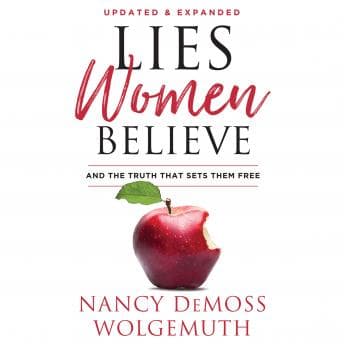

"Many women live under a cloud of personal guilt and condemnation."
That line hit me at approximately 6:47 AM, somewhere between Millbrae and San Mateo, and I remember thinking - okay, this book is going to swing hard. And it does. In every direction.
Let me be upfront: I am not the target audience for this book. I'm a software engineer who debugs distributed systems for a living. My approach to problems is: identify root cause, fix it, write a postmortem, move on. Nancy DeMoss Wolgemuth's approach is fundamentally different - the root cause is always Satan's lies, and the fix is always biblical truth. If you're already nodding along with that framework, this review will read differently than if you're not.
The Architecture Under the Hood
The book is organized around categories of "lies" - lies about God, about sin, about priorities, marriage, emotions, and so on. Structurally, it's basically a debugging guide but for your spiritual life. Each chapter identifies the lie, explains why women believe it, then provides the "truth" counter from Scripture. There's a certain satisfying completeness to the framework - she's clearly spent decades in ministry and has catalogued common patterns she's seen in women's lives.
At 9 hours, the pacing is reasonable. No massive filler. Each lie gets its own treatment without dragging, and the chapter structure actually makes it decent for commute listening - you can absorb a full "lie" in a single leg of the trip.
But here's where I have to be honest about the content itself: the book operates from a very specific theological framework - conservative complementarianism - and it doesn't hedge on that. Wolgemuth's positions on marriage, submission, and gender roles are not presented as one interpretation among many. They're presented as Truth with a capital T. If you're coming from a different theological tradition, or you're not coming from a theological tradition at all, large sections will feel like reading documentation for an API you don't use.
The Section That Made Me Pull Out My Phone to Text Kevin
I need to flag something specific. There's a section that addresses women in difficult or abusive marriages, and the framing is - genuinely concerning. The approach essentially tells women that wanting to leave abusive situations can be rooted in selfishness and deception. I sat on the train reading the research around this and multiple reviewers have flagged it as potentially dangerous advice. I'm not a theologian, but I am an engineer, and when I see a system that could cause harm in edge cases, I flag it. This is me flagging it. Hard.
If you or someone you know is in a domestic violence situation, please consult actual counseling professionals, not this chapter.
The Audio Experience - Functional, Not Flashy
Pamela Klein narrates alongside Wolgemuth herself. The production is clean - no audio artifacts, no weird level changes. Klein's delivery is steady and clear, a straightforward read without much dramatic range. It works fine for this type of content - you're not here for a performance, you're here for the teaching. Wolgemuth's own sections have a warmth that comes from genuine conviction; you can tell she believes every word deeply. That sincerity is actually the book's strongest audio quality.
But at 1.5x? Totally fine. At 1.75x? Also fine. This isn't dense enough to require slow processing. The concepts repeat and reinforce, which is a feature for the intended audience but means you can speed up without losing the thread.
Who Should Queue This Up (And Who Should Skip)
Perfect for: Christian women already aligned with a conservative evangelical framework who want structured devotional content for their commute or housework. If you listen to Revive Our Hearts radio and love Wolgemuth's teaching style, this is basically her greatest hits compiled.
Skip for: Anyone outside that specific tradition. Anyone looking for a nuanced discussion of women's issues from multiple perspectives. Anyone currently in a harmful relationship - please, please seek professional help instead.
The ROI on this audiobook is entirely dependent on whether you're already bought into the theological framework. For believers in that tradition, it's probably a 4-star devotional resource. For me - a sleep-deprived engineer who listens to optimization podcasts and hard sci-fi - the content gap was too wide to bridge, no matter how sincere the delivery.
Not Every System Runs the Same Stack
I respect Wolgemuth's conviction and the clarity of her framework, even when I disagree with significant chunks of it. But I can't in good conscience give a blanket recommendation when the book contains advice around abuse that could genuinely hurt people. That's not a theological quibble - that's a safety issue. The 9-hour runtime is well-structured, the audio is clean, and if this is your tradition, you already know if you want it. Emotional First Aid is one I'd actually point to - it tackles guilt and psychological injury from a clinical angle that holds up to scrutiny regardless of your worldview. If it's not, there are better self-help audiobooks for your commute hours.