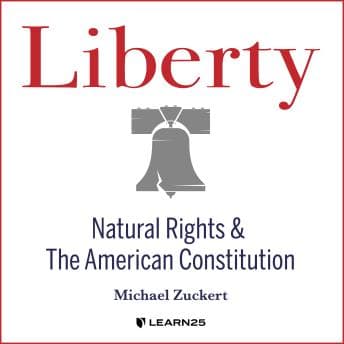

Most people hear "15 audio lectures on natural rights theory" and their eyes glaze over. I get it. I would've been one of those people ten years ago. But I picked this up during a stretch of late nights prepping threat assessments for a client, and something about Zuckert's approach to the philosophy underpinning the Constitution - the actual why behind the document I swore an oath to defend - kept me coming back to it like a briefing I couldn't put down.
Let me cut to the chase: this is an academic lecture series, not a narrative audiobook, and if you go in expecting anything else you'll bail by hour two. But if you want to understand what "rights" actually meant to the people who wrote them into our founding documents, Zuckert is the professor you wish you'd had in college.
The Professor Who Actually Gives a Damn
Here's what surprised me. I've listened to a fair number of Great Courses and Learn25 lecture series, and most of them feel like sitting in a university auditorium where the professor is reading from notes he wrote in 1997. Zuckert doesn't do that. The man wrote the book on this stuff - literally, he's spent his career at Notre Dame dissecting the philosophical DNA of the Declaration and the Bill of Rights - and you can hear it. There's a current of genuine intellectual excitement when he traces the line from Locke's natural rights theory through Jefferson's pen to the actual constitutional framework.
He's not a trained narrator, and it shows in places. The pacing is professorial - measured, sometimes circling back to restate a point from a different angle the way a good teacher does when he can tell the room hasn't quite gotten there yet. No vocal fireworks, no dramatic pauses for effect. Just a sharp mind working through complex ideas with clarity. At 1.25x speed, which is where I kept it, the cadence felt natural and kept things moving without losing the substance.
What I particularly appreciated: Zuckert doesn't just park on the 18th century. He threads the rights argument forward through same-sex marriage and other contemporary fights, showing how the same language gets weaponized by different sides across different eras. For someone who's spent 25 years operating under the authority granted by that Constitution, hearing the intellectual archaeology behind it was - I'll just say it - it hit me in ways I didn't expect.
Where It Lost Me (Briefly)
This is where it lost me - there are stretches, particularly around the middle lectures dealing with the more abstract philosophical distinctions between positive and negative rights, where Zuckert goes deep into the weeds. If you're not already comfortable with Enlightenment-era political philosophy, you might feel like you walked into the wrong classroom. I had to rewind a couple of sections, which I almost never do.
At 5 hours and 50 minutes, it's a manageable commitment, but this isn't windshield time material. I tried listening during a drive to a client site in San Antonio and realized I'd missed an entire lecture's worth of argument because I was navigating I-35 construction. This one demands your attention. Sit down with it. Maybe a bourbon. Ranger curled up at your feet. That kind of listening.
The production is clean but bare - no music, no sound effects, no dramatization. Just a man and a microphone. For this kind of content, that's exactly right. You don't need cinematic production when the ideas themselves are doing the heavy lifting.
Why This Matters More Than You Think
I've seen this scenario play out in real life - people on every side of the political spectrum throwing around "my rights" and "constitutional rights" like grenades, with roughly zero understanding of what those words meant to the people who chose them. Zuckert doesn't take sides. He's not pushing an agenda. He's doing something harder: he's making you understand the framework so you can evaluate the arguments yourself. I found that same kind of honest, unflinching examination of American history — the parts we'd rather not sit with — in Thirty Years A Slave, which puts the constitutional contradiction between natural rights language and the lived reality of slavery in front of you in a way no lecture ever quite could.
The lecture where he breaks down how the Declaration's rights language differs fundamentally from the Bill of Rights' rights language - that alone was worth the listen. I'd never thought about it that way, and I've read both documents more times than I can count. The Declaration asserts universal natural rights. The Bill of Rights constrains government power. Same word - "rights" - doing very different work.
Worth your time? Here's the debrief: if you care about understanding the American experiment at a level deeper than cable news commentary, this is solid intellectual ammunition. It's not entertainment. It's education, and good education at that. The author clearly did their homework - this is a man who's spent decades in these texts, and it shows.
Who Gets the Most Out of This
Anyone who's ever taken an oath to the Constitution and wants to understand what they actually swore to protect. History buffs who want the philosophy behind the dates and battles. Citizens who are tired of hearing rights arguments that go nowhere because nobody's operating from the same definitions. Skip it if you want narrative drive or if dense academic content makes you reach for the skip button.
Ranger slept through most of this one, but I think he was just processing.






![Steve Jobs [unabridged audiobook] audiobook cover](/_next/image?url=https%3A%2F%2Fcovers.audiobooks.com%2Fimages%2Fcovers%2Ffull%2F9788499923406.jpg&w=1920&q=75)