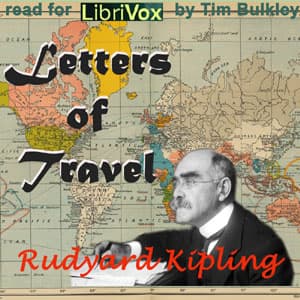

What happens when you hand one of the English language's sharpest pens a steamship ticket and tell him to write letters home?
I was up late waiting for a client's pitch deck revision — Jenny already asleep, the house quiet except for the dishwasher cycling — and I figured I'd knock out something from the backlog. Kipling's Letters of Travel had been sitting in my queue for months, one of those "I should be more well-read" picks that keeps getting bumped by the latest strategy book. Turns out, 11 PM with a bourbon was exactly the right setting for this.
A Management Consultant From 1892 (But With Better Prose)
Here's what surprised me: Kipling writes about foreign economies and infrastructure the way a good McKinsey engagement letter reads — sharp observation, structured thinking, recommendations implied rather than stated. His pieces on Canada read like an early-stage market analysis. He's sizing up timber resources, railroad expansion, the labor dynamics of frontier towns. He visits a salmon cannery and describes the operation with the precision of someone who could've written a decent process optimization memo. My parents would've recognized this energy — the instinct to look at any operation and immediately start calculating what's working and what's waste.
But then he pivots. Mid-paragraph, Kipling shifts from economic observation to describing a Japanese fishing family with such careful, layered attention that you have to slow down (even at 2.0x) to catch what he's actually doing. There's this bit where he calls a baby a "Japanese doll, price two shillings and threepence in Bayswater" — sounds awful, right? Classic colonial gaze. Except he immediately turns it: "something more valuable than money could buy." He's baiting you into the cheap reading so he can correct it. That's not lazy writing. That's a writer who knows exactly what he's doing.
The Elephant That Sits in Every Kipling Room
Let me be direct: there's racist language in here. The N-word shows up. "Oriental" is used freely. If you're listening in a shared space — AirPods, people. The audiobook description actually warns you, which I appreciate. But here's where I landed after nearly eight hours with this: dismissing Kipling as simply a bigot is the lazy take, and accepting him uncritically is the dangerous one. The interesting work happens when you hold both readings simultaneously.
His Egypt chapters are the most complicated. He writes about the Sudan and the British presence there with an imperialist confidence that would make any modern reader flinch. But then he describes the desert with a reverence that feels almost spiritual — you can hear this man looking at things harder than most of us look at anything. The section called "The Face of the Desert" has some genuinely uncomfortable characterizations of Jewish traders, and I'm not going to sugarcoat that. But Kipling's writing forces you to engage actively rather than passively, and that's — whether intentional or not — more valuable than comfort.
Tim Bulkeley: The Right Voice for a Difficult Author
Bulkeley narrates this like he's reading it aloud at a university common room, and I mean that as a compliment. He doesn't try to smooth over the wry humor or add dramatic weight where Kipling keeps things dry. There's a consistent, understated wit in the delivery — when Kipling is being sardonic about American political conventions or Canadian civic pride, Bulkeley's tone lets you hear the smirk without overselling it. Single narrator, no sound effects, no music. Just a steady, intelligent reading.
At 7 hours 47 minutes, I'll say this: it could be tighter. The Canada sections drag in places — there are only so many descriptions of railroad routes before even 2.0x can't save you. Skip to the Japan material if you're pressed for time (roughly the latter part of the first book). That's where Kipling's observation skills hit their peak.
Who Gets ROI Here (And Who Doesn't)
If you're looking for actionable business frameworks, this isn't it. But if you're someone who reads business biographies to understand how successful people see the world — how they observe, categorize, and synthesize what's in front of them — Kipling's travel writing is a masterclass in that specific skill. This is what my parents did instinctively. Now it has a TED talk. Except Kipling did it 130 years ago, across four countries, with a fountain pen.
Not for everyone. If period-appropriate racism is a dealbreaker regardless of context — completely valid, skip this. If you want beach-read travel writing — wrong Kipling. But if you want to watch one of history's most observant minds process unfamiliar environments in real time, and you can hold complexity without needing everything resolved into a clean takeaway? That same willingness to sit with unresolved tension — to let the hard stuff stay hard — is what I found myself wrestling with in Radical Awakening, which arrives at a similar place from a completely opposite direction.
Worth the Ticket, Not Every Stop
Bottom line: 70% insight, 30% Victorian padding. The Japan and Egypt sections earn the listen. The North American railroad chapters are the business book equivalent of a meeting that could've been an email. Bulkeley's steady narration holds it together. I finished it, which — checking my 70% unfinished Audible library — is saying something. Jenny would say I'm being harsh. Jenny is right. But I'm also not wrong.







![Steve Jobs [unabridged audiobook] audiobook cover](/_next/image?url=https%3A%2F%2Fcovers.audiobooks.com%2Fimages%2Fcovers%2Ffull%2F9788499923406.jpg&w=1920&q=75)