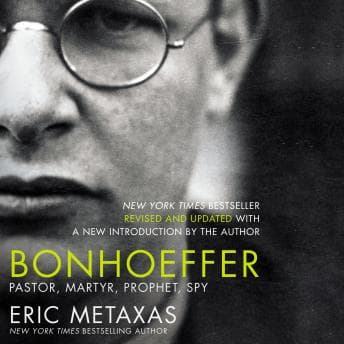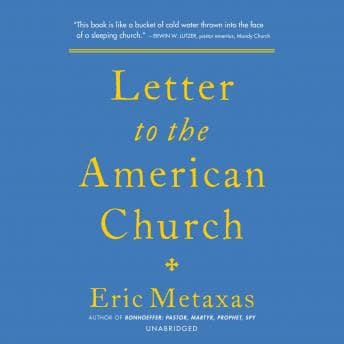

I was grading junior year essays on The Crucible - the irony isn't lost on me - when Metaxas started drawing his parallels between 1930s Germany and contemporary America. My red pen stopped mid-correction. Here was a book explicitly doing what I spend entire class periods trying to get seventeen-year-olds to understand: historical comparison as moral argument.
Whether it succeeds is another matter entirely.
When the Preacher Becomes the Lecturer
Metaxas narrates his own work, and there's an earnestness here that's impossible to fake. This is a man who believes every syllable he's speaking. His voice carries the weight of genuine conviction - that prophetic urgency you'd expect from someone who spent years studying Bonhoeffer's life and martyrdom. At 5 hours and 32 minutes, it's a focused sermon rather than an exhaustive treatise.
But here's the thing about conviction: it doesn't automatically translate to persuasion. Metaxas reads with authority, yes, but the pacing feels deliberately measured - almost too deliberate. I found myself wanting him to vary his rhythm more, to let some passages breathe while others cut. Instead, everything arrives at the same steady tempo of urgent importance. After two hours, urgent starts feeling like the new normal.
The Bonhoeffer Problem
I've assigned excerpts from Metaxas's Bonhoeffer biography to my AP students. It's genuinely excellent historical work - nuanced, researched, compelling in its portrait of moral courage against totalitarianism. This book feels like he's mining that earlier work for analogies.
Some listeners called it "a bucket of cold water thrown into the face of a sleeping church." Others found the parallels "a stretch." Having finished it during one of Principal Martinez's budget presentations (sorry, Martinez), I land somewhere uncomfortable in the middle. The historical analysis of the German church's failure - its silence, its accommodation, its cheap grace - remains powerful. Metaxas clearly knows this material cold.
But the contemporary applications? This is where my English teacher brain starts circling passages with questions in the margins. The leap from "here's what the German church did wrong" to "here's exactly what American Christians must do about cultural Marxism and globalist tyranny" requires more connective tissue than Metaxas provides. He's asking readers to accept his political framework as the obvious moral equivalent to opposing Nazism. That's a significant ask.
What Bonhoeffer Actually Means
This reminds me of what Hemingway said about the difference between motion and action. Metaxas is in motion throughout - passionate, urgent, prophetic in tone. But the action - the specific, grounded argument for why these particular political positions constitute the moral equivalent of resisting Hitler - often gets assumed rather than demonstrated.
My students would hate this comparison, but it's like when they write essays claiming two texts are "basically the same" without doing the close reading to prove it. The surface similarities are there. The depth work is sometimes missing.
The book's strongest moments come when Metaxas sticks to his Bonhoeffer expertise - the theology of cheap versus costly grace, the church's temptation toward comfortable silence, the moral weight of inaction. When he's teaching rather than exhorting, he's genuinely illuminating. I found myself pausing the audiobook to jot down quotes about the church's prophetic responsibility. That's the Metaxas who wrote the biography I admire.
Who This Is For (And Who Should Skip It)
If you already share Metaxas's political convictions, this will feel like necessary prophecy. You'll nod along, feel convicted, maybe share quotes with your small group. The author-narration adds authenticity - you're hearing the argument exactly as intended.
If you're skeptical of his political framework, you'll likely find the historical parallels overdrawn. Some listeners noted discomfort with what they called "deifying Reagan," and there's a tendency here to treat certain contemporary positions as self-evidently equivalent to opposing Nazism.
If you're somewhere in the middle - genuinely wrestling with what faithful Christian engagement looks like in a polarized age - this might frustrate you. It's not really an argument so much as a call. Metaxas assumes you already agree with his diagnosis; he's here to shake you into action.
The Annotation I'd Leave in the Margins
Denise asked me what I was listening to during our lakefront walk last Saturday. I tried to explain it and found myself saying: "It's a sermon disguised as history, or maybe history weaponized into a sermon." That's not entirely fair, but it's not entirely wrong either.
The prose deserves to be savored when Metaxas is doing historical theology. When he shifts into contemporary application, the urgency sometimes overwhelms the nuance. Worth pausing the faculty meeting for? Honestly, yes - but more for what it reveals about a certain strand of American Christian thought than for its historical arguments.
I'd recommend his Bonhoeffer biography first. For a different take on leadership principles grounded in questions rather than declarations, Good Leaders Ask Great Questions offers a more collaborative approach. Then, if you want to understand how Metaxas applies those lessons to today, come here. Just bring your red pen. Some of these arguments need more revision before they're ready for the final draft.